

A Bwindi Impenetrable National Park safari is a gorilla trekking trip first and a forest trip second, since roughly half the world’s mountain gorillas live in this single forest across four trekking sectors. Permits are sold by the wildlife authority through licensed Ugandan operators, and the busy months fill early. Bwindi covers 321 square kilometres of Albertine Rift forest in southwest Uganda, protected as a World Heritage site for its tree and butterfly diversity.
Mountain Gorilla Trekking Safari in Bwindi Impenetrable Forest
Gorilla trekking in Bwindi starts with a briefing at whichever sector visitor centre your permit names, and it starts early. Rangers and trackers go out ahead of you; the trackers have often been in the forest since first light, working from where a family built its nests the previous evening. Tracking itself begins at eight. By then you have been sorted into a party, matched to a family, and told the rules.
The rules are short and the wildlife authority means them. A maximum of eight visitors go to any one family in a day. You get one hour, timed from the moment you reach the gorillas rather than from when you left the gate. Stay ten metres back. No flash, no eating, no drinking, no smoking. Cover your face and turn away if you cough. Nobody under fifteen goes at all.
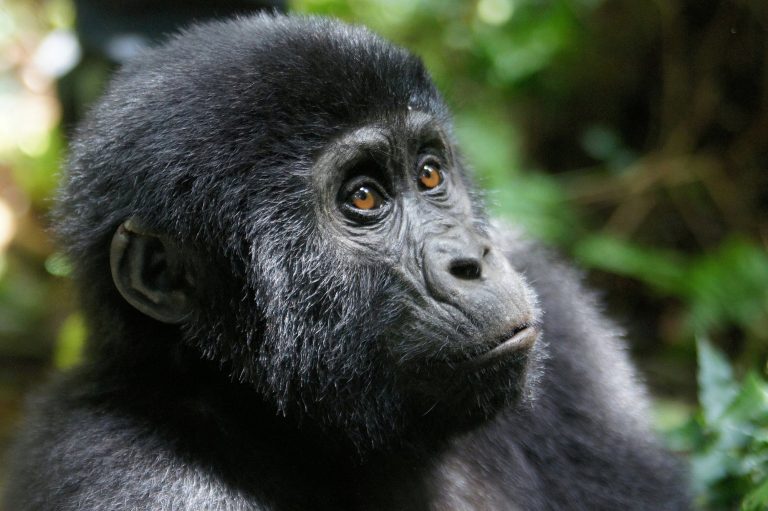
The ten metre distance is the rule people arrive least prepared for, because gorillas do not read it. A juvenile will walk straight past your boots if it feels like it, and the instruction then is to hold still and let it go rather than reach out or back away sharply. The distance exists because mountain gorillas catch human respiratory infections and die of them, which is also why a cold on the morning of your trek disqualifies you.
How long the walking takes is the great unknown and no honest page will pin it down. The wildlife authority’s own guidance for a Uganda gorilla trek is two to seven hours. Trip reports run the full spread, from a family found forty minutes from the trailhead to a party still climbing at three in the afternoon. Trackers radio the rangers as the morning goes on, so your guide often knows roughly where you are heading by mid morning, which is the point at which the day either gets easier or does not.
Sightings are close to reliable but they are not promised, and any page claiming a fixed sighting percentage is inventing precision. What exists instead is a written position on failure, and it is worth knowing before you pay.
Porters wait at every trailhead and hiring one is the closest thing to universal advice in this whole subject. The bag matters less than the arm. On a wet descent through clay a porter takes your weight on the awkward steps and pushes from behind on the climbs, and people who thought they were too fit to need one routinely change their minds around hour three. Pay cash at the gate. That money lands in a household beside the park, often one that used to hunt in it.
Choosing Between the Buhoma, Ruhija, Rushaga and Nkuringo Trekking Sectors
Four sectors run treks, and the wildlife authority lists each as a separate designated entry point: Buhoma in the north, Ruhija in the east, and Rushaga and Nkuringo in the south. This is the single decision that shapes a Bwindi trip most, because the sector fixes your drive, your lodge, your altitude and the character of your walk. Get it wrong and you spend two extra hours a day in a vehicle. A three day gorilla trekking trip out of Kampala appears on the safari list here.
One thing to be clear about: your permit buys a sector, not a gorilla family. Family allocation happens at the briefing on the morning, and rangers assign it. They do take a look at who is standing in front of them, and if you tell them at the briefing that your knee is unreliable or that your mother is seventy four, they will usually put you with a family that is closer in. Say it out loud. Nobody guesses.
The southern sectors sit closer to Kisoro and to the Rwandan border, so a trip arriving through Kigali usually lands in Rushaga or Nkuringo. Buhoma and Ruhija make more sense on a route coming down through Queen Elizabeth National Park. That geography, rather than the gorillas themselves, is what decides sector for most itineraries.
Altitude follows the same split loosely. Buhoma sits lowest and warmest, Ruhija and Nkuringo highest and coldest, and the difference is enough that a fleece which felt silly in Buhoma is welcome at a Ruhija dinner table.
Gorilla Habituation Experience Treks in the Rushaga and Nkuringo Sectors
The gorilla habituation experience is the other product Bwindi sells, and it is a genuinely different day rather than a longer version of the same one. Instead of an hour with a fully habituated family, you go out with the researchers and trackers who are still doing the habituating, on a family that is not yet used to people. The wildlife authority caps the time with the gorillas at four hours and starts these treks at half past six in the morning, an hour and a half before standard tracking begins.
Parties are small, typically four visitors rather than eight, and it runs in the southern sectors. Rushaga is where it operates most consistently.
Four hours changes what you see. In one hour you watch a family being calm at you. In four you watch them stop noticing you: feeding, moving on, an infant testing a branch, a silverback deciding whether the researchers are worth standing up for. The gorillas are also less settled than a tourism family, so there is more movement and more distance covered.
Who should buy it: photographers, repeat visitors, and anyone for whom the cost gap between the two permits is less painful than the thought of the hour ending. Who should not: first timers on a tight budget, and anyone with doubts about walking hard for the best part of a day, since the habituation trek is longer on its feet than a standard one and the group is too small to slow down for.
Birding Safaris in Bwindi and on the Mubwindi Swamp Trail
Birding safaris here are the reason Bwindi appears on lists that have nothing to do with primates. The wildlife authority records more than 350 species in the park with 23 Albertine Rift endemics, a concentration that no other Ugandan forest gets near. Some sources publish lower totals, mostly because they are counting a subset or an older survey, but the endemic figure is the one that matters and it is consistent.
The Mubwindi Swamp trail out of Ruhija is the walk birders come for. It drops through the forest to a high swamp, takes most of a day there and back, and holds the African green broadbill, which is the bird that pulls people across continents. Grauer’s rush warbler works the swamp itself. The trail also produces Rwenzori turaco, handsome francolin, dusky crimsonwing, Rwenzori batis and the regional apalises.
Buhoma has its own birding along the main trail and the river, easier walking, more species per hour and less altitude. A separate bamboo walk runs from Ruhija into the high bamboo, which is where the altitude specialists sit.
Two practical points that guides make and brochures do not. Bwindi birding is largely by ear in dense cover, so a guide who knows calls is not a luxury but the whole difference between a list of twelve and a list of sixty. And the light in this forest is poor most of the day, which is punishing for photography and the reason experienced birders here carry binoculars they can use at dusk rather than a longer lens.
Forest Walks, Waterfall Trails and Nature Hiking Tours in Bwindi
You do not need a gorilla permit to walk in Bwindi, and the trail network is better than most visitors realise because almost nobody books it. The nature hiking tours run from Buhoma mostly, on a set of marked trails through the same forest the gorillas live in.
The Muyanga waterfall walk is the popular short one, following the river out of Buhoma to a fall of about 33 metres. Half a day, no altitude problem, and the ferns and epiphytes along the river are the best illustration you will get of why this forest is listed as a World Heritage site. The Ivi River trail is the long one, around 14 kilometres and most of a day.
The trail worth knowing about is the crossing from Buhoma to Nkuringo, which the wildlife authority sells as a guided long walk and which cuts through the forest between the northern and southern sectors. Walking it beats driving between the two, which takes hours on rough road around the outside of the park. Guides carry your bag ahead by vehicle if you arrange it. A second long walk runs from Rushaga to Nyabaremura on the same principle.
Guided night walks are also available and are undersold. A torch and a ranger after dark in a forest with pottos, bushbabies and tree hyraxes produces a completely different animal list from the daytime one, and the noise alone is worth the couple of hours.
Batwa Cultural Tours and Community Walks Around Bwindi
The Batwa cultural tours around Bwindi are led by Batwa guides and cover what the forest meant when they lived in it. The Batwa were hunter gatherers in this forest for a very long time, and when Bwindi became a national park they were moved off it without land in exchange. That fact underlies every version of this tour and the good ones say so plainly rather than presenting the whole thing as folklore.
Practically, a Batwa forest experience runs as a guided walk with demonstrations of hunting technique, honey gathering, plant medicine and fire making, followed by songs and dancing. Expect a couple of hours. The wildlife authority sells it as a park activity, and separately there are community walks in the villages around Buhoma and Nkuringo that visit craft groups, a traditional healer and often a school.
Two of the community organisations around Buhoma have become small institutions in their own right. One runs a women’s craft and sewing enterprise that also rents bicycles, another trains former poachers into guiding work. Buying a basket there is worth more to the household than the same money spent at a lodge shop, and the difference is not marginal.
A share of the park’s revenue goes back to the parishes on its boundary under the wildlife authority’s revenue sharing arrangement, which pays for schools, water and crop protection. That is the argument for the permit price in one line, and it is a better argument than most operators bother to make.
Buniga Forest Cycling and Mountain Biking Adventures
Cycling is the activity almost nothing written about Bwindi mentions, and it is genuinely good. A marked route of about 13 kilometres runs from the park headquarters at Buhoma through forest edge and farmland toward the southern side of the park, and it is ridden with a guide. Bikes are rented from the women’s cooperative in Buhoma, which trains local women as mechanics and guides, so the money stays where you are riding.
The Buniga Forest walk sits near Nkuringo and is a community managed patch of forest outside the park boundary, guided by Batwa from the settlement beside it. It is shorter and gentler than anything inside Bwindi, works well on an arrival afternoon or a rest day, and is one of the few places where the guiding fee goes to a Batwa community rather than through the park.
Both suit the day after a trek, when your legs are done but you are not ready to sit in a lodge.
Wildlife Beyond the Gorillas on a Bwindi Forest Safari
A Bwindi forest safari is not a game viewing trip and the park is honest about that. Sightings of anything larger than a monkey are a matter of luck, because the vegetation is thick enough to hide an elephant at twenty metres, which it regularly does.
The wildlife authority records around 120 mammal species. Forest elephants live in the park and are heard far more than seen. There are chimpanzees, though they are not habituated for tourism here, plus L’Hoest’s monkey, blue monkey, red tailed monkey, black and white colobus, olive baboon and several duiker species. Golden cat and African civet are on the list and all but invisible.
What Bwindi actually holds in world beating quantity is smaller. Over 200 tree species, ten of them found nowhere else. Around 104 fern species. More than 200 butterfly species, which is the great majority of everything Uganda has, with eight of those endemic to the Albertine Rift. That combination is what the World Heritage listing rests on, alongside the gorillas.
The forest itself is the oldest thing here. It has stood for more than 25,000 years, surviving as a refuge through the last ice age while forest cover across much of Africa retreated, which is why so much that lives in it lives nowhere else.
On the gorillas, the numbers worth carrying are these. The most recent full survey of the Bwindi and Sarambwe population counted 459 animals in 36 social groups plus 16 lone males. Across the whole species, the last combined count put the world total at 1,063, with 604 in the Virunga massif. A new Bwindi survey has been under way, so the figure will move. Anything you read claiming 700 gorillas in the world is a decade out of date.
How many families you can actually track is the figure the ranking pages get into a tangle over, and the reason is simple: it changes. Eight permits per family per day is fixed and does not vary. The park total is that figure multiplied by the number of families open to tourism at the time, which sits somewhere in the low twenties and moves as groups are habituated, split or rested. That is why published daily totals for Bwindi range from about 160 to about 190 depending on when the page was written. A figure of 36 for the whole park is simply wrong.
Best Time for a Bwindi Gorilla Trekking Safari, Month by Month
Bwindi runs two wet seasons and two drier ones, and neither dry season is dry in the way a savanna park is dry. This is rainforest at altitude taking something like 1,400 to 1,900 millimetres of rain a year, and it can rain in any month. What changes is how much and how often, and with it how much clay you are climbing through.
Trekking never stops. Rain does not close the park.
Read that as a plan rather than a table. Travelling in the wet half of the year means gaiters, a spare pair of trousers and an extra hour allowed for the walk, with whatever the permit discount saved you going into a warmer lodge. If your dates fall in June through September, book everything early and pick a sector on interest rather than on availability, because you will have the choice. Uganda Safaris also lists a gorilla trekking safari running from Entebbe.
Preparing for a Bwindi Gorilla Trek: Fitness, Footwear and Health
Fitness for a Bwindi gorilla trek is less about speed than about being able to keep going uphill on unstable ground for several hours without your legs failing. There is no path in the sense you are used to. Trackers cut through vegetation with a machete, the slope is steep in most sectors, and after rain the clay behaves like grease. Somebody who walks a hilly ten kilometres at home on weekends will be fine. Somebody who does no walking at all will have a long day.
Say who this is not right for, since nobody else will. Anyone with a knee or hip that gives out on descents should think hard, because coming down is worse than going up. Anyone with a heart condition should take medical advice, given altitude plus sustained exertion. Anyone under fifteen cannot go. And anyone who cannot accept that a bad day means four hours of walking for an hour that ends on time should probably choose a different holiday.
Footwear settles most of the outcome. Boots with ankle support and aggressive tread, worn in before you fly. Trail runners are not enough in mud. Gaiters, knee height, are the single most recommended item among people who have actually done it in the wet.
Cover your skin. Long trousers tucked into boots, long sleeves, and gloves. Plain gardening gloves are the standing recommendation, because you will grab at vegetation constantly for balance and a good deal of what you grab stings. Stinging nettles are the complaint that comes up more than any other in trip reports from this forest, and bare forearms suffer.
On health, the point that matters is the one that runs the other way. You are the risk, not the gorillas. Human respiratory viruses have killed mountain gorillas, and the whole architecture of distance rules, illness screening and masks exists for that reason. Declare a cold. The refund position exists precisely so that declaring it costs you less than hiding it.
Photography in this forest is harder than people expect. It is dark under the canopy, the gorillas are often in deep shade, and flash is banned. A fast lens and a willingness to push the sensitivity higher than feels comfortable will do more than reach. Plenty of people come back happiest with the phone pictures.
Getting to Bwindi for Your Gorilla Safari
Bwindi is 512 kilometres from Kampala by the wildlife authority’s own measure, and by any route that is a long day. The northern route through Mbarara and Rukungiri runs about 472 kilometres to Buhoma and takes roughly eleven hours. The southern route through Kabale is similar in time. From Kabale it is about 95 kilometres and four hours to Ruhija, or 105 kilometres and four hours over the mountain road to Nkuringo. The last stretch in every case is dirt and steep, and four wheel drive is not optional after rain.
Almost nobody drives it in one go, and there is no reason to. Lake Mburo, Mbarara or Lake Bunyonyi break the trip sensibly. Coming south from Queen Elizabeth National Park, Buhoma is only a few hours away on the Ishasha road, which is why the two parks pair so often on an itinerary.
Flying changes the arithmetic completely. Scheduled flights run from Entebbe to Kihihi for the northern sectors and to Kisoro for the southern ones, taking about an hour and ten minutes, with a road transfer of one to two hours at the far end. A trip that takes six days by road takes three by air, and for anyone with limited leave that is the whole decision.
Arriving through Rwanda is common and legitimate as an access route. Kigali to the southern sectors is three to four hours, crossing at Cyanika or Katuna, which is a fraction of the drive from Entebbe and the reason some trips are sold as two day Bwindi gorilla tours starting in Kigali. Check the visa position for your nationality before you rely on it.
Getting between sectors once you are there is slow and worth planning around. Buhoma to Rushaga is several hours around the outside of the forest on rough road, so treat a two sector trip as two separate bases rather than a day trip. Locally, boda bodas cover short distances and hired four wheel drives with a driver cover everything else.
Take cash. This is the practical warning almost no guide gives. There is no reliable bank machine at Buhoma or Nkuringo, some lodges take only cash, porters and tips are cash, and craft cooperatives certainly are. Draw what you need in Kampala, Mbarara or Kabale before you head into the hills, and bring newer dollar notes if you are paying in dollars, since older ones are widely refused in Uganda.
On safety, the region has been settled for many years and armed rangers accompany every trek as standard practice rather than as a response to anything current. Check your own government’s travel advice before you travel and then get on with it.
Where to Stay Near Bwindi and How to Plan the Trip
A little history helps make sense of the map. Two blocks of this forest were gazetted as Crown forest reserves in 1932, the northern one at Kayonza and the southern one at Kasatora, and they were run for timber and hunting rather than for gorillas. National park status came in 1991, and with it the eviction of the Batwa. Tourism opened in April 1993 when the Mubare family at Buhoma became the first habituated group in Uganda, which is why Buhoma has the oldest lodges and the widest trail network. In 1994 a further ten square kilometres was added and the park was inscribed on the World Heritage list. The southern sectors came later, which is why Rushaga and Nkuringo feel newer on the ground than the north does.
Lodging follows the sectors, and the first rule is to sleep in the sector your permit names. A lodge an hour away means a five thirty start and a miserable morning.
Buhoma has the widest choice, running from a community rest camp at the bottom of the market through a solid band of mid range lodges to two or three properties at the luxury end with forest views and heating. Ruhija is thin, quiet and cheap, with a handful of simple lodges and a stronger birding crowd. Rushaga has grown quickly and now covers budget to mid range well, with a couple of upmarket options. Nkuringo sits high on its ridge with a small cluster of lodges that trade lodge polish for the best view in the park. Camping is possible at designated sites with prior booking, and the wildlife authority prices it modestly.
Now the sequence, which six pages will tell you to get right and none will actually spell out.
How long to stay: two nights is the minimum that works, arriving one afternoon, trekking the next morning, leaving the day after. Three nights lets you add a second activity without rushing. Four or more only earns its place if you are birding Ruhija, doing the habituation experience or trekking twice, and a second trek is a better use of a day than most people expect, since the two are never alike.
The comparison everyone runs is Bwindi against Volcanoes National Park in Rwanda. Rwanda is quicker to reach from an international airport and the walking is usually shorter on more open volcanic slopes. Bwindi has far more habituated families, far more permits, the habituation product, a genuine rainforest rather than bamboo and heath, and a permit at a little over half the Rwandan price. Both show you mountain gorillas. Uganda gives you more forest, more birds and more change from the same budget.
Bwindi also combines better. Queen Elizabeth National Park is a few hours north, Lake Bunyonyi an easy afternoon east, and Mgahinga Gorilla National Park, with the only golden monkeys in Uganda and three climbable volcanoes, sits ninety minutes from the southern sectors.
Bwindi Safari Questions, Permits and Costs
What does a Bwindi gorilla permit cost, and what does it include? The wildlife authority’s tariff puts a standard tracking permit at 800 US dollars for a foreign non resident. Foreign residents pay 700, citizens of African countries outside East Africa pay 500, and East African citizens pay a far smaller sum in shillings. Habituation sits at 1,500 dollars, dropping to 1,000 for foreign residents and other Africans. There is also a reduced low season rate of 600 dollars in April, May and November, sold on the condition that it cannot be moved to another date. Standard gorilla tracking is not affected by the tariff announced for 1 January 2027, so 800 dollars is the figure to budget on either side of that date. Habituation is the one that moves, rising from 1,500 to 1,800 dollars on 1 January 2027. The permit covers your park entrance for the day, ranger guides and trackers, and a community contribution. It does not cover a porter, tips, transport or your lodge.
What do the other Bwindi activities cost? Park entrance on its own is 40 dollars a day for foreign non residents and 30 for foreign residents. Birding and day nature walks are 40 and 30. A guided night walk is 50 and 30. The long walks from Buhoma to Nkuringo and from Rushaga to Nyabaremura are 60 and 50, rising on 1 January 2027 to 100 and 80 respectively. The Rushura Hill walk and the Ruhija bamboo walk are 40 and 20. The Batwa forest experience is 40 for both categories and excludes park entrance. Camping runs from 30 to 40 dollars per person per night depending on the site. Lodges cover the full spread, from roughly 40 dollars a night at a community rest camp to several hundred at the top properties, with solid mid range lodges commonly between 150 and 350.
What do I get back if I have to cancel? Four brackets govern it. Give more than two months of notice and three quarters comes back. Between forty six and sixty days out, you keep half. From fifteen to forty five days, a quarter. Under a fortnight, nothing survives. Bank charges and taxes the wildlife authority has already paid come off whatever is returned, and a permit you have previously moved loses its refund entitlement altogether. Money paid ahead for entrance and other activities is gone regardless, so buy those at the gate.
Which sector should I choose? Buhoma for easier walking, the best lodge choice and a route down from Queen Elizabeth. A wildlife and gorilla safari taking in Queen Elizabeth and Bwindi is listed on the site. Ruhija for birds, quiet and cold. Rushaga for permit availability and the habituation experience. Nkuringo for the hardest trek and the best views. If you are coming through Kigali, the southern sectors save you hours in the car.
How hard is the trek, honestly? Harder than most brochures imply and easier than the horror stories. Two to seven hours of walking on steep, often slippery ground with no formed path. Fit people find it a good day out. Unfit people find it the hardest thing they have done on holiday. A porter closes most of that gap, and rangers will put visitors who ask onto the nearest family. A one day gorilla trek is among the shortest listings on the site.
What if I cannot finish the walk? Local teams carry visitors on a sedan chair or stretcher, arranged at the trailhead with a group of porters, and it is used more often than you would think, particularly by older travellers determined to get there. It is not cheap, running to several hundred dollars, and it is paid locally in cash. Turning back partway does not attract a refund, since the permit was available to you.
What should I pack for the trek? Worn in boots with ankle support, knee high gaiters, long trousers you can tuck in, a long sleeved top, gardening gloves, a rain jacket, two litres of water, and a small daypack a porter can carry. Add a fleece for Ruhija and Nkuringo evenings and a dry bag for the camera. Gaiters and gumboots can often be hired at the trailhead if you would rather not carry them.
Is a gorilla sighting guaranteed? No, and be wary of anyone who says otherwise. Trackers find the families almost every day, which is why the reputation is what it is, but wild animals move and weather intervenes. The written protection is the wildlife authority’s position on a failed full day of tracking, which offers you the next day or a partial refund.
Can children come? Not on a gorilla trek. Fifteen is the minimum age and identification is checked at the briefing. Younger children can do nature walks, the community and Batwa tours, cycling and birding, so a family can still have a good few days here while the over fifteens trek.
Uganda Safaris carries Bwindi trips from Ugandan operators who run this forest every week of the year, from short three day gorilla treks through to two week circuits. All of them hold the Ugandan licence that a foreign non resident permit legally has to be bought through.
If it is the habituation experience rather than the standard hour that you want, say so at the enquiry stage and start from the trips built around a single tracking or habituation day in Bwindi, because the permit has to be requested differently.
Compare the full range of Uganda safaris, or give one operator your dates and have them check permit availability before anything else in the trip gets paid for.
1 Place to Visit in This Area
Individual sites within reach of here, each with its own guide. Some are written up because the name circulates and the place does not, which is worth knowing before you plan a drive around one.
Safaris That Visit Bwindi Impenetrable National Park
3 of the 31 safaris listed here that visit Bwindi Impenetrable National Park, from different operators where the listings allow it. Each is sold and run by an independent Ugandan tour company. This site lists them and passes on enquiries; it takes no booking and charges you nothing.


3 Day Uganda Gorilla Habituation Safari
by Insight Safari Holidays Verified operator

3 Days Gorilla Habituation Experience Safari in Bwindi
by Kori Safaris Verified operator


4 Days Uganda Gorillas and Habituation
by Tranquil Safaris Verified operator