
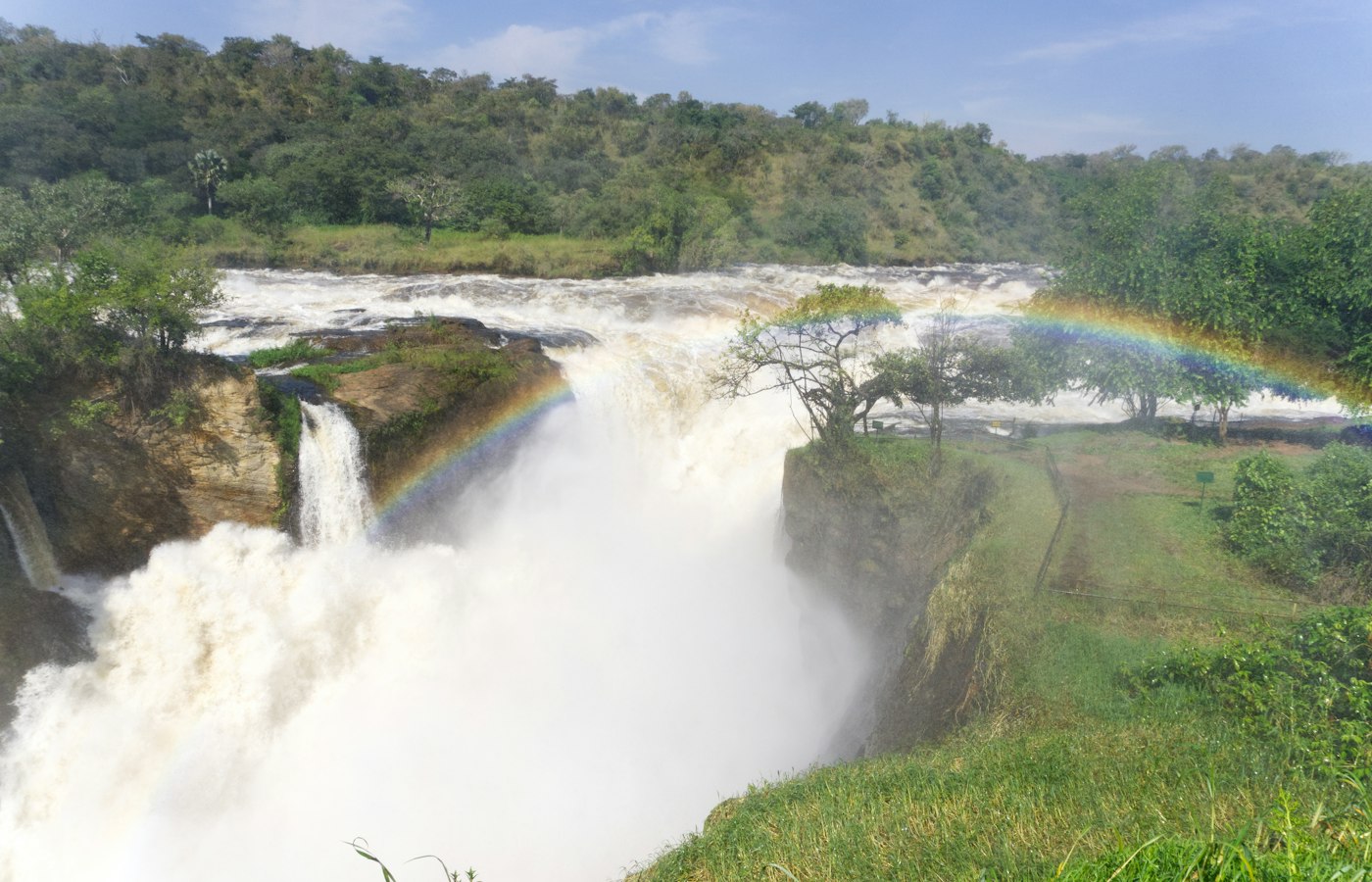
A Murchison Falls National Park safari is built around two things: the launch trip up the Victoria Nile to the foot of the falls, and the game drives on the Buligi tracks north of the river. Most travellers book it as a two or three night stop at the start of a Uganda circuit. A wildlife and gorilla circuit out of Entebbe is one of the listings that includes it. The park covers 3,840 square kilometres of north western Uganda, which makes it the country’s largest protected area.
Why Murchison Falls National Park Is Uganda’s Largest Safari Park
The park sits at the northern end of the Albertine Rift, cut in half by the Victoria Nile as the river runs west from Lake Kyoga towards Lake Albert. That river is the whole logic of the place. Game concentrates on its banks, the launches run on it, the falls interrupt it, and the ferry across it decides most of your itinerary. Uganda Safaris lists a Murchison Falls and Nile trip out of Entebbe.
It became a game reserve in 1926 and a national park in 1952, which makes it Uganda’s oldest park and also its biggest. For a stretch after independence it carried the name Kabalega, after the Bunyoro king who fought the British, and older maps and a few lodges still use it.
Most guides you will read online quote 76 mammal species and 451 birds for this park. Those numbers are old. The Uganda Wildlife Authority now publishes 144 mammals, 556 birds, 51 reptiles and 51 amphibians for the park. The gap between those two sets of figures is a fair measure of how stale a lot of Murchison content has become.
The recovery story behind those numbers is worth knowing before you go, because it changes what you are looking at. Poaching through the seventies and eighties emptied this park. Elephant fell to a few hundred. Giraffe dropped below two hundred animals. What you drive through now is the result of forty years of rebuilding: roughly 900 elephant, around 10,000 buffalo, something like 35,000 Uganda kob, and a giraffe population of about 2,250, which is the largest wild Nubian giraffe population on earth. Not everything is going up. Lion numbers across Uganda are drifting down and snaring is still the main cause. But the herbivore trend here has been the right way for a long time.
One more thing that separates Murchison from the rest of Uganda’s savanna. It is genuinely big. You can drive for an hour on the north bank and see grassland running to the horizon with borassus palms standing in it and nothing else, which is not an experience the smaller parks can give you.
Nile Launch Safaris to the Base of Murchison Falls
The Nile launch safari to the base of the falls is the activity everyone comes for and the one that justifies the drive north on its own. Boats leave the jetty at Paraa and run about seventeen kilometres upstream over two to three hours, ending in the churn below the falls where the water arriving from the gorge is still white.
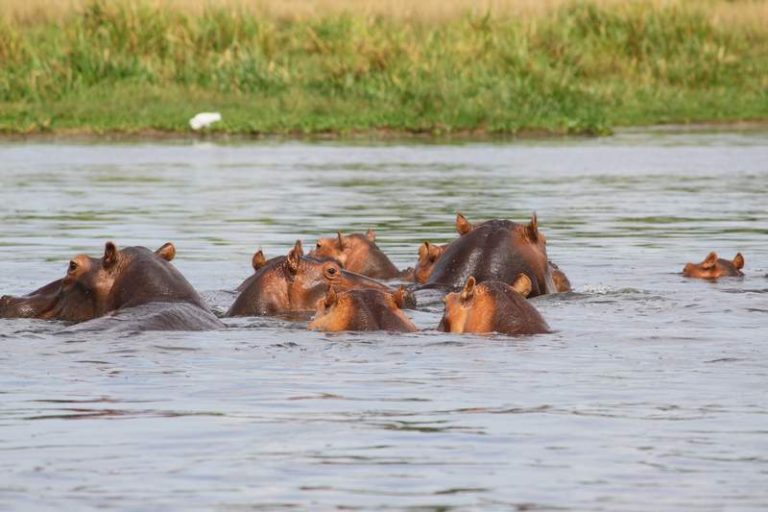
The banks do the work. Hippo sit in pods of thirty and forty in the shallows. Nile crocodile, some of them very large, lie out on the mud with their mouths open. Elephant come down to drink and stand in the river to cross. Buffalo, waterbuck and bushbuck work the fringes. The birding is constant: African fish eagle on almost every dead tree, goliath heron, saddle billed stork, malachite and pied kingfisher, red throated bee eater colonies nesting in the sand banks, and rock pratincole on the exposed rocks when the water is low.
The last twenty minutes is the part people remember. The boat noses into the spray and the noise, holds position against the current, and everyone gets soaked. Bring a dry bag or a plastic bag for a camera. This is also where the boat drops hikers who are walking up to the top, which is covered in the next section.
Two departures run through the day, mid morning and mid afternoon. The afternoon boat gives better light on the way back and slightly more animal movement on the banks as the heat drops. There is one thing nobody warns you about: tsetse are active on the river and they bite through thin fabric. Wear something with a bit of weight to it and nothing dark blue or black, since both colours draw them.
The Top of the Falls Hiking Trail and the Seven Metre Gap
Murchison Falls is not the tallest waterfall in Africa and it does not pretend to be. What it has is compression. The Victoria Nile, carrying something in the order of 300 cubic metres a second, is forced through a gap in the rock roughly seven metres wide, then drops about 43 metres into a pool called the Devil’s Cauldron. Divide that volume by that width and you get more water per metre of channel than any other waterfall on the planet. You feel it in the ground before you see it.
A second cascade, Uhuru Falls, sits just to the north. It appeared after a flood tore a new channel through the rock in the early sixties, and it is taller and more vertical than the main falls, though less dramatic because the water is not squeezed. Samuel Baker reached the falls in 1864 and named them after the president of the Royal Geographical Society, which is why a Ugandan waterfall carries a Scottish geologist’s surname.
The top of the falls hiking trail is done in one of two ways, and knowing the difference matters more than any other planning detail on this page.
The good version is walked. Ask the launch to drop you at the landing below the falls at the end of the cruise, and climb from there with a ranger. It takes forty five minutes to an hour on a steep rocky path, well defined and with handrails on the worst sections, opening onto a series of viewpoints as you gain height. Each one shows you a bit more of the gorge. You arrive at the top wet through, because the spray reaches you regardless of whether the sun is out, and the noise at the lip is loud enough that conversation stops. Your vehicle meets you at the car park and drives you back.
The other version is driven. There is a road from Paraa to the viewpoint at the top, about thirty four kilometres, and a short walk from the car park to the railings. It gets you the same view of the gap and the cauldron without the climb, and it is the right choice for anyone whose knees are not up to a steep hour on wet rock or who is travelling with young children.
Neither version needs particular fitness beyond the ability to walk uphill steadily. Take water, wear shoes with grip rather than trainers, and put anything that must stay dry inside something waterproof. There is a shorter walk to Baker’s Point on the south side, about twenty minutes, which gives a side on view and is worth the stop if your schedule is tight.
Game Drive Safaris on the Buligi Tracks North of the Nile
The Buligi game drive safari is the north bank circuit, running across the triangle of grassland between the Victoria Nile and the Albert Nile, and it is where Murchison stops being a waterfall park and starts being a serious savanna one.
Here is a fact that no ranking guide to this park will tell you. The most recent nationwide carnivore survey put Murchison’s lion population at roughly 240 animals across the sampled area, five to ten times the density recorded at Queen Elizabeth or Kidepo. Whatever you have read about Uganda’s lions being scarce, that scarcity is not this park’s problem. Prides here are numerous, several are used to vehicles, and the odds on a morning drive are better than most Uganda itineraries lead people to expect. Leopard are present in reasonable numbers along the wooded drainage lines. Spotted hyena are common and often the first thing you see at first light.
Giraffe are the signature animal on Buligi. The Nubian giraffe here, still widely called Rothschild’s, number somewhere around 2,250, and you will see them in loose groups of ten and twenty standing among the borassus palms. It is the largest concentration of them anywhere. Elephant work the same country, kob are everywhere, and Jackson’s hartebeest, oribi, bohor reedbuck and warthog fill in the rest.
Drives leave around half past six and again in the late afternoon. Some lodges run night drives with a spotlight where the park permits it, which is the only realistic way to see white tailed mongoose, genet, civet and occasionally a hunting leopard.
One thing you should know before you arrive, because it will be in front of you and nobody writes about it. There is an oil development inside this park. Two drilling rigs are operating within the boundary, roughly 38 kilometres of new road and nine well pads have been built in the north of the park, and a buried feeder pipeline runs under the Nile and the delta. The operator says the surface footprint during production will be a fraction of one percent of the park’s area. Conservation groups dispute the wider effects, and giraffe have been moved away from the noisiest sites. You are not going to drive through an industrial zone, and the game viewing on Buligi is unaffected in any obvious way. But you will pass graded roads and see infrastructure in a place you might not expect it, and it is better to know that now than to be surprised by it from the back of a vehicle.
Delta Launch Trips and Shoebill Watching on Lake Albert
The delta launch trip is the second boat and it is not the same trip as the first one. This is the single most common planning mistake people make here, so it is worth being blunt about it. The falls launch runs upstream for two to three hours. The delta launch runs downstream about twenty kilometres to where the Victoria Nile spreads into Lake Albert, and it takes four to five hours there and back. They leave at different times, the delta boat typically at seven in the morning. On a two night stay you will realistically do one, not both.
What the delta gives you that the falls launch cannot is the shoebill. The papyrus and sandbanks where the river meets the lake are one of the two most dependable places in Africa to find one, the other being Mabamba swamp near Entebbe. A shoebill standing motionless in the reeds at thirty metres, that ludicrous clog of a bill pointed at the water, is a sight that converts people who did not think they cared about birds.
The honest position on odds: nobody can promise you a shoebill, and an operator who does is selling rather than guiding. Water level drives everything. The dry months from around January into March are the strongest window, when the birds are pushed onto exposed sandbars and are much easier to pick out. In high water they scatter into papyrus you cannot see into. Some boats come back having seen five. Some come back having seen none.
The rest of the delta trip stands up regardless. Buffalo herds come down to drink, elephant cross the shallows, crocodile line the sandbanks, and the bird list runs long: African skimmer, osprey, saddle billed stork, papyrus gonolek in the reed beds, and pelican and cormorant working the lake edge. Twenty three Albertine Rift endemic species have been recorded across the conservation area, which is why serious birders build extra days in. The park also sits on a fifteen day wildlife and primate circuit.
Birding here is good year round but it is best in the wetter months from March to May and again October into November, when Palearctic and intra African migrants arrive. That is the opposite of the best game viewing season, which is a real trade off rather than a detail.
Budongo Forest Chimpanzee Trekking Safaris at Kaniyo Pabidi
South of the park, on the road in from Masindi, sits Budongo Forest, 435 square kilometres of mahogany and ironwood and the largest natural forest in Uganda. Chimpanzee trekking safaris here run from the Kaniyo Pabidi site, about eight kilometres inside the Kichumbanyobo gate, which puts them inside the national park boundary and easy to slot into a Murchison itinerary without a separate day of driving.
Budongo holds somewhere between 600 and 800 chimpanzees, which is one of the densest populations in East Africa, and the community at Kaniyo Pabidi is habituated. Treks leave in the morning and again in the afternoon, take two to three hours of walking on relatively flat forest floor, and allow an hour with the group once they are found. The walking is far easier than the gorge treks further south, which makes this a sensible option for anyone who wants to see chimps without a hard climb. There is a minimum age of fifteen, which catches families out.
Budongo is also one of the finest birding sites in Africa, and the Royal Mile is the reason. It is a straight avenue of mature forest, once used for processions by the kings of Bunyoro, now a flat mile of trail with over 350 recorded species along it. Chocolate backed kingfisher, blue breasted kingfisher, Ituri batis, white thighed hornbill, forest robin and Puvel’s illadopsis are the names that draw people. Go at first light with a guide who knows the calls.
Rabongo Forest, a small block of riverine forest in the south east of the park proper, is the third forest option. It has chimpanzees that are not habituated, a nature trail, a campsite, and almost no visitors. It is a quiet half day rather than a headline activity.
Sport Fishing Trips on the Nile Below Murchison Falls
The water below the falls is one of the best places in Africa to fish for Nile perch, and sport fishing trips run from the Karuma and Fajao stretches with a ranger and a permit. Perch over a hundred kilogrammes have come out of this water. Vundu catfish and tigerfish are the other targets. Fishing is catch and release except under specific arrangements, you supply your own tackle or hire locally, and the productive months line up with the dry seasons when the water drops and the fish concentrate below the rapids.
Karuma Falls, at the eastern edge of the conservation area where the Kampala road crosses the Nile, is a set of rapids running for about eighty kilometres above the main falls. The Karuma Wildlife Reserve around it is part of the same conservation area and carries game that moves in and out of the park.
The Bugungu reserve on the Lake Albert side does the same. Guided nature walks run from Paraa and from the forest sites for anyone who would rather be on foot than in a vehicle.
Rhino Tracking at Ziwa and Cultural Tours Around Murchison Falls
You cannot see rhino inside Murchison Falls National Park. Both species were shot out of Uganda by the early eighties. What exists instead is the Ziwa Rhino and Wildlife Ranch, a fenced reserve of roughly seventy square kilometres at Nakitoma, sitting directly on the Kampala road about three hours short of the park gate, which is why almost every itinerary stops there on the way in.
Rhino tracking at Ziwa is done on foot with a ranger, and it works. The population has been rebuilt from six founder animals to somewhere in the forties, and the rangers know where each group is because they are monitored around the clock. You walk twenty minutes or an hour, depending on where the animals have moved, and you stand at a sensible distance from southern white rhino in long grass. There is also a shoebill on the swamp there and a canoe trip that finds it more often than people expect.
Around Murchison itself, community tourism is small but real. The Boomu Women’s Group near Kichumbanyobo runs craft work, cooking and village walks and puts the money back into the households that host them. The Mubako community perform storytelling and dance at several of the lodges in the evenings. The park sits where three cultural regions meet, Banyoro to the south, Alur to the west and Acholi to the north, and the guides drawn from those communities are the best source you will have on how people here live alongside the animals.
Park rules are enforced and worth stating. Stay in your vehicle unless a ranger says otherwise, keep to the tracks, do not feed anything, and keep to the speed limit, which exists because kob cross without looking. The park closes its gates in the evening and the ferry stops running, so a late finish means a night on the wrong bank.
Planning Your Murchison Falls Safari: Days, Seasons and the Paraa Ferry
Two nights is the working minimum here and it buys you one launch, one game drive and the top of the falls. Three nights lets you add the second boat or a chimpanzee trek without a rushed morning. A ten day gorilla and wildlife safari is among the longer listings that include the park. Four is right if birding matters to you, because the delta trip and the Royal Mile both want a whole morning each.
The ferry is the constraint nobody plans around and everybody should. Paraa is the hub, the lodges are split between the south bank and the north, and the Buligi game tracks are all on the north side. The ferry crosses on a fixed timetable through the day, first crossing early morning and last in the evening, with a gap in the middle of the day. Miss a sailing and you wait. If your lodge is on the south bank and your morning drive is on the north, the first ferry decides what time your day starts, and a driver who knows the timetable is worth a great deal more than one who does not.
| Boat trip | Direction | Hours | Main draw |
|---|---|---|---|
| Falls launch | Upstream | 2 to 3 | Hippo, falls |
| Delta launch | Downstream | 4 to 5 | Shoebill |
| Fishing trip | Below falls | Half day | Nile perch |
| Ziwa canoe | Swamp | 1 to 2 | Shoebill |
Seasons split cleanly. Two dry periods, December through February and June through September, and two wetter ones, March to May and October to November. Rainfall averages a little over a thousand millimetres a year, and the north bank runs hot, regularly into the low thirties Celsius by early afternoon.
Packing follows the heat and the water. Light long sleeves and long trousers in neutral colours, nothing dark blue or black because of the tsetse on the river and on the forest tracks. A hat and real sun protection, since the north bank has no shade. Waterproofs in any month, and a dry bag for the launch. Shoes with grip if you are walking up to the falls. Binoculars, because a lot of what is worth seeing here is on the far bank or in the top of a mahogany. Insect repellent, and something warm is unnecessary except in the very early morning.
Self drive is workable on the main routes and harder on the north bank, where tracks are unsigned and the grass in the wet months hides them. Four wheel drive is required. Weigh it against a driver guide who knows the ferry timetable, the Buligi loops and which pride was seen where yesterday, which is most of the difference between a good day and a slow one.
Getting to Murchison Falls National Park and Where to Stay
By road from Kampala the run is roughly 300 to 305 kilometres, three hours to Masindi on good tarmac and another two on murram to the falls, so five hours in total with a stop at Ziwa built in. From Entebbe add about an hour. The southern gates are Kichumbanyobo, which is the Masindi route and the one that puts you past Kaniyo Pabidi, and Bugungu, which comes up from the Lake Albert escarpment and is the more scenic drive. Tangi and Wankwar gates serve the north from the Gulu road.
Flying is the alternative. Scheduled light aircraft leave Entebbe in the morning for Pakuba airfield on the north bank, near the old Pakuba Lodge site, in about an hour and a quarter. Bugungu airstrip serves the south. Flying makes sense if you are short of days or connecting to Kidepo, and it costs you the Ziwa stop.
A word on the park’s odd history, because it comes up. Winston Churchill came through in 1907 and wrote about it. Theodore Roosevelt shot his way along the Nile here two years later. Ernest Hemingway survived two aircraft crashes near the falls in the same week, which is the kind of detail guides enjoy and which is, for once, true.
Accommodation splits by bank. On the south side around Paraa sit Paraa Safari Lodge, which is the old established property above the ferry, plus Nile Safari Lodge and Baker’s Lodge on the river west of it, Murchison River Lodge and Sambiya River Lodge inland, and Red Chilli Rest Camp, which is the long standing budget option and where most independent travellers end up. On the north bank, Chobe Safari Lodge sits upriver at the Karuma end, and Pakuba Safari Lodge sits out on the plains close to the game tracks, which is the practical argument for staying north. Fort Murchison and Kabalega Wilderness Lodge cover the mid range outside the gates, and Budongo Eco Lodge sits in the forest at Kaniyo Pabidi for anyone whose priority is chimps and birds.
Book early for the dry months. The riverside lodges around Paraa fill six months out for July through September and for the Christmas fortnight, and the north bank places go first because everyone works out the ferry problem eventually.
Murchison Falls Safari Questions Answered
How many days do you need at Murchison Falls?
Two nights covers the falls launch, one north bank game drive and the walk to the top, which is the standard trip and works well. Three nights lets you add either the delta launch or a Budongo chimpanzee trek without cutting anything short. Four is right for birders, since the delta and the Royal Mile each want a full morning. A single night is not worth the drive from Kampala.
What do park entry and activities cost?
Park entry for a foreign non resident has been running at 45 US dollars per adult per day, with foreign residents at 35, other African nationals at 30 and East African citizens at 25,000 Uganda shillings, and the ticket covers 24 hours from issue. Murchison carries a slightly higher rate than most Uganda parks. The Nile launch to the bottom of the falls is 30 dollars per person for foreign non residents and 25 for residents, and the hike to the top of the falls is 15 and 10. A ranger guide for a day game drive adds 25 dollars, a night drive is 40 per person, and driving yourself without a guide is 10. Foreign registered vehicles pay their usual entry charge plus an extra 10 dollars at this park. The conservation tariff carries no line at all for Budongo chimpanzee trekking at Kaniyo Pabidi, which runs under a separate arrangement, so ask your operator for that figure in writing rather than working from a published one. Rhino tracking at Ziwa is billed separately, since it is not a national park, at 20 dollars to get in plus 30 for the tracking itself. The ferry is a few thousand shillings per person and rather more per vehicle. Everything above is the rate in force now under the Uganda Wildlife Authority’s current conservation tariff; the revised schedule the authority has announced does not take effect until 1 January 2027. Treat these as the shape of the bill and have your operator confirm the current figures before you pay.
Which boat trip should you take if you can only do one?
The falls launch, unless you are a birder. It is shorter, it delivers the hippo and crocodile concentrations, and it ends underneath the falls with the option of walking to the top, which combines two activities into one afternoon. Take the delta launch instead if the shoebill is the reason you came to Uganda, and if you can, come in the drier months when the sandbars are exposed and the birds are findable.
Is the walk to the top of the falls hard?
It is steep and rocky rather than technical, taking forty five minutes to an hour uphill, with handrails on the worst sections and a well marked path throughout. Anyone who walks regularly will manage it. The spray soaks you whatever the weather, so protect cameras and phones, and wear shoes with grip because wet rock is the actual hazard. If the climb is not for you, the road from Paraa reaches the same viewpoint at the top and takes about an hour to drive.
Will you see lions at Murchison Falls?
Your chances are better here than anywhere else in Uganda. Recent survey work puts the population at roughly 240 animals, which is several times the density in the country’s other savanna parks, and a number of the Buligi prides are used to vehicles. Nothing is guaranteed, but a morning drive on the north bank with an experienced guide gives you good odds. Giraffe are close to certain, elephant and buffalo nearly so, and leopard remain the difficult one unless you can get on a night drive.
What should you pack?
Neutral coloured long sleeves and long trousers, with nothing dark blue or black, because tsetse are active on the river and along the forest tracks and both colours attract them. A hat and strong sun protection for the north bank, which has no shade. Waterproofs in any month and a dry bag for the launch, since the boat goes into the spray. Shoes with grip for the falls walk. Binoculars earn their space. Insect repellent, and a torch for the smaller camps.
Can you see rhino in the park?
No. Uganda lost both rhino species by the early eighties and none live in Murchison Falls National Park. The rhino are at the Ziwa ranch at Nakitoma, on the main road from Kampala roughly three hours before the park gate, where a herd rebuilt from six founder animals now numbers in the forties. Tracking there is done on foot with a ranger and is one of the more reliable wildlife stops in the country, which is why almost every northern circuit includes it.
When is the best time for a Murchison Falls safari?
December through February is the strongest window overall: dry ground, short grass, game held to the river and the best shoebill conditions on the delta. June through September is the other dry season and is nearly as good, though busier and hotter late in the day. March to May and October to November bring the rain, and with it the year’s best birding, the lowest rates and the emptiest tracks, at the cost of tall grass and harder driving.
Uganda Safaris lists trips from licensed Ugandan operators who run Murchison week in and week out, know the ferry timetable, and can tell you whether a two night or three night shape suits what you want to see.
At the short end, a two day Murchison Falls safari on a budget covers the launch and a game drive out of Kampala.
A three day Murchison wildlife route adds the rhino stop at Ziwa and the Budongo forest. Look at what each one includes on the river, and send an enquiry to the operators whose plan fits yours. Asking a question costs nothing and commits you to nothing.
1 Place to Visit in This Area
Individual sites within reach of here, each with its own guide. Some are written up because the name circulates and the place does not, which is worth knowing before you plan a drive around one.
Safaris That Visit Murchison Falls National Park
3 of the 11 safaris listed here that visit Murchison Falls National Park, from different operators where the listings allow it. Each is sold and run by an independent Ugandan tour company. This site lists them and passes on enquiries; it takes no booking and charges you nothing.

11 Days Uganda Primates Safari
by Tranquil Safaris Verified operator
15 Days Uganda Safari
by Wild Whispers Africa Verified operator

15 Days Uganda Wildlife & Primate Safari
by Oree Safaris Verified operator