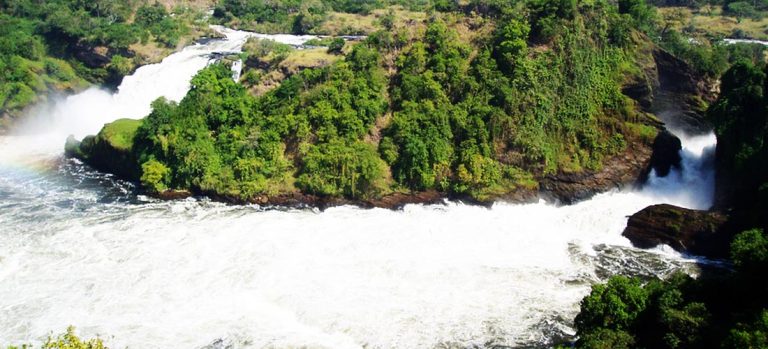
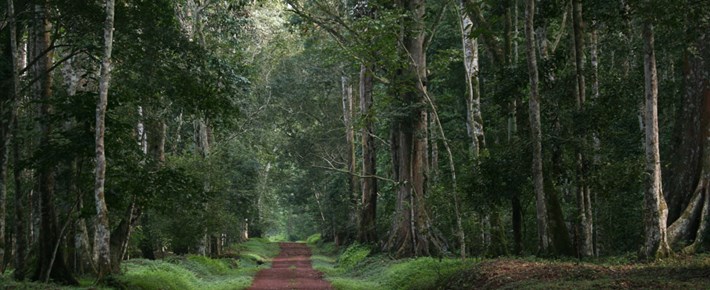
Budongo Forest is Uganda’s largest natural forest and its cheapest place to track wild chimpanzees, with the Royal Mile rated among the best forest birding tracks in Africa. Most travellers book it as a stop on a Murchison Falls safari, tracking at Kaniyo Pabidi at first light and driving into the park by lunch. The 825 square kilometre reserve sits in Masindi District under the National Forestry Authority, not the wildlife authority that runs the park next door.
Why Budongo Forest Belongs on a Murchison Falls Safari
The road from Masindi to Murchison Falls runs straight through it. That single geographic fact is why Budongo Forest works so well on a safari itinerary: you are already driving past the trailhead, and the detour costs you a morning rather than a day.
Gazetted in 1932 and still carrying the scars of a long sawmilling history, the reserve covers 825 square kilometres. Roughly half of that is moist forest at medium altitude, the kind that drops part of its canopy in the drier months. The rest is a mosaic of savannah and woodland that thins out towards Lake Albert. The forest is best known for two things, and both of them are worth planning around: chimpanzee tracking at a fraction of what Kibale charges, and the Royal Mile, a birding track that specialist guides rank at the top of the continent.
What Budongo will not give you is a polished product. Trails are less developed than Kibale’s, sighting odds are lower, and the two tourism sites sit an hour apart on opposite sides of the forest under different management. Plenty of people prefer it for exactly those reasons. You are rarely sharing the forest with anyone.
Chimpanzee Tracking Safaris at Kaniyo Pabidi
A chimpanzee tracking safari at Kaniyo Pabidi starts with a briefing at the visitor centre beside Budongo Eco Lodge, twice a day, once around eight in the morning and again in the early afternoon. Groups are small. On a quiet week you may be walking with your guide and nobody else.
The Kaniyo Pabidi community numbers around a hundred animals, and the habituated core of it is what visitors track. Budget three hours from briefing to return, of which the last hour is spent with the chimpanzees once they are found. Guides cap that hour strictly.
The tracking itself is more literal here than at the busier sites. Guides read fresh dung, check night nests overhead, look at what has been dropped half eaten under a fig, then stop and listen for pant hooting. Trip reports consistently describe it as feeling earned rather than delivered. That cuts both ways. Sighting rates are usually quoted around eighty to eighty five percent, below what Kibale manages, and a morning that ends with calls in the distance and no visual does happen. Nothing about wild chimpanzees is guaranteed.
Walking is easy underfoot, mostly flat, but you will be pushed off the cut trail into undergrowth once the group is located. Long sleeves earn their place. The minimum age applied for chimpanzee tracking is fifteen.
The Chimpanzee Habituation Experience Trek in Budongo Forest
The chimpanzee habituation experience is a full day trek rather than a three hour one, and it is a different proposition entirely. You join trackers before dawn at the point where the chimpanzees were left in their nests the previous evening, then stay with the group through the day until they build new nests at dusk.
Numbers are tiny and it needs booking well ahead. It suits photographers, repeat visitors and anyone who found a one hour slot frustrating. Be realistic about the day though: much of it is spent waiting while the group forages high in the canopy, and long stretches pass with nothing visible but movement in the leaves. The pricing on this one varies more widely between sources than any other figure attached to Budongo, which is covered further down.
Royal Mile Birding Safaris in Budongo Forest
A Royal Mile birding safari is the reason serious birders come to Budongo at all. The track runs from Nyabyeya Forestry College towards the old research station, a broad straight avenue lined by enormous trees, and it takes its name from the Bunyoro royal association with the forest.
Why it works is simple geometry. The track is wide enough to let light reach the floor, so mid storey and canopy birds show themselves at eye level along the edges instead of forcing you to crane upwards through closed forest. It is also flat and drivable, which means scopes, tripods and tired legs are all manageable.
Around 360 bird species have been recorded across the reserve, among them roughly sixty West and Central African species known from fewer than five sites in the whole of East Africa. That is the draw. Regulars on a good morning include Puvel’s Illadopsis, Nahan’s Partridge, Chocolate backed Kingfisher, African Dwarf Kingfisher, Blue breasted Kingfisher, Ituri Batis, Yellow footed Flycatcher, Chestnut capped Flycatcher, White thighed Hornbill, Fire crested Alethe, Lemon bellied Crombec and Cassin’s Hawk Eagle. Black eared Ground Thrush turns up for the patient.
Arrive at dawn. A guide is compulsory and is arranged on site: there is a sign at the entrance telling you to call, and a local guide will usually be with you within minutes. Fees are collected there rather than booked centrally, so carry cash. Three hours covers the track comfortably. February to April and September are the strongest months.
Busingiro Sector Tours and What Is Actually Open
Busingiro is the western tourism site, and the Royal Mile sits inside it. The Budongo Conservation Field Station still lists Busingiro and the Royal Mile as designated for tourism, alongside Kaniyo Pabidi, so the short answer is that the sector is open.
The longer answer is the useful one. What Busingiro is today is a birding access point, not a base. Older guidebooks and a good many competitor pages describe a visitor centre with bandas, a campsite and a full activity menu on this side of the forest, and travellers arriving on that basis have been caught out. Chimpanzee tracking does not run from Busingiro either: the chimpanzee community there has never been habituated. Plan to bird the Royal Mile from Busingiro and sleep elsewhere, and confirm before you commit to anything more.
Nyabyeya Forestry College sits right beside the track and takes paying guests in simple rooms, which is the practical fix for a dawn start. On the Kaniyo Pabidi side, the Boomu Women’s Group runs a small community enterprise near Kichumbanyobo gate offering craft, food and village walks.
Mahogany Trail Nature Walks and Forest Adventures
Guided forest walks at Kaniyo Pabidi run on their own, without a tracking permit attached, and they are the cheapest way into the forest. The trail network is short and the walking is gentle.
The headline tree is an East African mahogany of genuinely awkward proportions, tall enough at around eighty metres to be hard to photograph and thick enough that a party holding hands struggles to ring the trunk. Budongo holds roughly 465 tree species in total, with Uganda ironwood dominating much of the canopy rather than the mahogany the forest is famous for. Guides will point out the stumps too, which tell the sawmill story better than any sign.
Around 290 butterfly species and 130 moths have been recorded, and a slow walk in the right month puts a good many of the butterflies on the puddles along the track. There is a small waterfall on the northeastern edge where the forest meets the park boundary. Set expectations correctly: Budongo has no viewpoints and no long horizons. Everything here is seen at close range, under a roof of leaves.
Primates and Wildlife on a Budongo Forest Tour
Nine primate species live in the reserve, and a Budongo Forest tour of any length usually turns up three or four of them. Olive baboons work the road edges, blue monkeys and red tailed monkeys move through the mid storey, black and white colobus sit high and still, and grey cheeked mangabeys announce themselves before you see them. Potto and galagos are nocturnal and rarely seen by day visitors.
Elephants and buffalo move between the forest and the open country of the park, and both leave obvious sign on the trails without often showing themselves. Bushbuck and duiker slip away at the first sound. Bush pigs are heard more than seen.
Treat all of this as a bonus rather than a plan. Forest game viewing is a matter of glimpses, and the guides are honest about it.
Who Manages Budongo Forest and What That Means for Your Safari
This is where most published guides get it wrong, and it costs travellers money at the gate. Budongo is a Central Forest Reserve. It belongs to the National Forestry Authority, which is a separate body from the Uganda Wildlife Authority that runs national parks. Budongo is not a national park and never has been.
Kaniyo Pabidi complicates that, because it lies inside the Murchison Falls Conservation Area boundary. Chimpanzee tracking there is sold as a wildlife authority activity and booked through that channel or through an operator, and arriving from Masindi you pass a park gate. Park entry is charged separately from the tracking permit. Two payments, not one.
Busingiro and the Royal Mile fall outside the conservation area and are run on the forest side. Fees there are collected locally, in cash, and are not part of any nationally published schedule. That is precisely why quoted prices for the Royal Mile bounce around so much online.
One further wrinkle worth knowing before you budget. The published conservation tariff lists chimpanzee tracking rates for Kibale and for Kyambura Gorge, and carries no Budongo line at all. Operators quote figures for Kaniyo Pabidi anyway, and those figures differ from each other by a wide margin. Get yours confirmed in writing before you pay.
Chimpanzee Research at the Budongo Conservation Field Station
Vernon Reynolds began studying Budongo’s chimpanzees in 1962, and the field station that grew out of that work has been running ever since, on and off through the war years. It is a working research base rather than a visitor site, and it does not take tourists. Its output is the reason tracking here exists.
More than six hundred chimpanzees live in the reserve across several communities. Three are studied closely, and only one of those is open to visitors.
| Community | Size | Visitors |
|---|---|---|
| Kaniyo Pabidi | About 100 | Yes |
| Sonso | 85 plus | Research only |
| Waibira | 100 to 120 | Research only |
| Busingiro | Not counted | No |
| Waisoke | Not counted | No |
Snares are the thing that will strike you in the field. Wire traps set for bushmeat catch chimpanzees that were never the target, and the injuries are permanent. Roughly three in ten adults in the Sonso community carry old snare damage, and juveniles, who make up around a tenth of the population, account for about half the victims. The Budongo Snare Removal Project has been pulling wire out of the forest with the Jane Goodall Institute since January 2000. You will very likely see a missing hand or a shortened foot on the group you track. Guides will tell you the individual’s name and what happened.
The other pressure is quieter. Senna spectabilis, planted decades ago along forest boundaries, has spread into the understorey and crowds out native regeneration, and clearing and replanting work is ongoing.
Best Time for a Budongo Forest Safari
Budongo takes between 1,200 and 2,200 millimetres of rain a year depending where in the reserve you stand, and it never really dries out. The heaviest rains fall from September to November, with a softer wet spell from March to May. Drier stretches run from mid December to mid February and again through June and July.
For chimpanzees, October to January is usually the strongest window: fruit is ripening, groups move less to feed, undergrowth has been knocked back and the trails hold together. For birds, February to April and September do best, which sits awkwardly against the chimpanzee peak. If you want both at their best, you are choosing between them.
Getting to Budongo Forest for Your Safari
From Kampala the drive runs north on the Gulu highway through Luweero and Nakasongola, turning west at Kafu for Masindi. Reckon on roughly 230 to 250 kilometres and about four hours if the traffic out of the city behaves. Ziwa Rhino and Wildlife Ranch sits close to the route and slots in neatly as a morning stop.
From Masindi it splits. Kaniyo Pabidi is around 29 kilometres north on the Kichumbanyobo road towards the park gate, signposted, and easy in any vehicle when dry. Busingiro and the Royal Mile lie west, twenty to thirty minutes out of town on the Butiaba road. Coming the other way, out of Murchison Falls through Kichumbanyobo gate, Masindi is about forty five minutes.
Tarmac takes you to Masindi. Beyond that it is murram, which is fine in the dry months and slippery in the wet ones. A vehicle with clearance is the sensible choice from September to November.
Where to Stay Around Budongo Forest
Budongo Eco Lodge at Kaniyo Pabidi is the only accommodation actually inside the forest, with self contained cabins and dormitory beds, and it puts you a short walk from the tracking briefing point. That proximity matters if you want the early departure.
For the Royal Mile, Nyabyeya Forestry College offers plain self contained rooms and local food within minutes of the track, which is the only realistic way to be birding at first light. Masindi town has a spread of hotels and guesthouses and works as a base for both sides of the forest, at the cost of an early alarm. Anyone continuing north can also sleep at the Murchison lodges and drive back down for a morning at Kaniyo Pabidi, though that eats into the day. Camping is possible at Kaniyo Pabidi with prior arrangement.
Budongo Forest Safari Questions Answered
How much does chimpanzee tracking in Budongo Forest cost? This is the figure to pin down before you travel, because it is genuinely unsettled. Operators quote between USD 85 and USD 130 per person for foreign non residents at Kaniyo Pabidi, and the published national conservation tariff carries no Budongo line to settle the argument. For comparison, the same tariff prices chimpanzee tracking at Kibale at USD 250 for foreign non residents, with a revised schedule that lifts it to USD 300 on 1 January 2027, and Kyambura Gorge at USD 100 now, rising to USD 200 on the same date. The full day habituation experience at Budongo is quoted anywhere from around USD 160 up to USD 300. Ask your operator for a written confirmation naming the issuing body, and treat any single number you read online as a starting point.
Do I pay park entrance fees on top at Kaniyo Pabidi? Yes. Kaniyo Pabidi sits inside the Murchison Falls Conservation Area, so park entry applies separately from the tracking permit. Entry runs at USD 45 per adult for foreign non residents, USD 35 for foreign residents, USD 30 for other African nationals and a shilling rate for East African citizens worth roughly USD 7, charged per twenty four hours. Vehicles are charged separately, from USD 40 for a foreign registered saloon car, with a lower shilling rate near USD 5 for a Ugandan registered one, plus a further supplement of about USD 10 specific to this park. A guided birding or nature walk inside the conservation area is USD 25 for foreign non residents, USD 20 for foreign residents and about USD 5 for East African citizens, on top of entry.
What does it cost to bird the Royal Mile? Entry to the Royal Mile is collected on site rather than through a national booking system, and travellers report paying in the region of USD 25 to USD 40 per person, with a guide fee of around USD 50 for a party for a three hour walk. Rates are not published centrally and change without notice. Bring cash in small denominations, confirm the figure at the gate before you start, and budget a little above what you were quoted.
How likely am I to see chimpanzees in Budongo? Guides and operators usually quote eighty to eighty five percent, which is honest and lower than Kibale. The trade is that when you do find them you are often the only group there. Morning walks tend to do better than afternoon ones. If seeing chimpanzees is the single reason for your trip, Kibale is the safer bet and Budongo is the better experience.
Is there a minimum age for chimpanzee tracking in Budongo? Fifteen, applied at the briefing. Younger children can join guided forest walks instead, which suit them better anyway since there is no pressure to keep up with a moving group.
How fit do I need to be, and what should I wear? Moderate fitness covers it. The forest floor is largely flat and the walking is slow, but you will be pushing through undergrowth once the chimpanzees are located. Long trousers, long sleeves, boots with grip and gaiters if you have them. Insect repellent matters more here than most people expect, and safari ants find any gap between boot and trouser. Carry more water than feels necessary and something to protect optics from sudden rain.
Is Budongo worth it if I am already going to Kibale? For chimpanzees alone, no. For birds, absolutely, because the Royal Mile holds species that Kibale does not and is one of the few places in East Africa where a run of Guinea Congo forest specials is realistic in a single morning. Many birders build the trip around Budongo and treat the chimpanzees as the second reason to be there.
Can I visit the Royal Mile and Kaniyo Pabidi in one day? It is possible but tight, and the two sites sit about an hour apart on opposite sides of the forest under different management. Birding the Royal Mile at dawn and tracking on the afternoon departure at Kaniyo Pabidi works if the driving goes well. Most people who try it wish they had given the Royal Mile a full unhurried morning instead.
Is Busingiro still open, and can I stay there? The site remains designated for tourism and the Royal Mile is birded regularly, so access is not the problem. Accommodation is. Do not plan on sleeping at Busingiro itself on the strength of older listings. Nyabyeya Forestry College nearby, or Masindi town, are the dependable options.
Budongo rewards people who arrive with the right expectations: a working forest reserve with real research behind it, modest facilities, and two experiences that are hard to better anywhere in Uganda. The forest already appears by name on itineraries such as this three day Murchison Falls wildlife safari taking in Budongo and Ziwa.
If you would like help fitting Kaniyo Pabidi and the Royal Mile around a Murchison Falls itinerary, the Ugandan operators listed here can build it, book the permits through the correct authority and confirm every fee in writing before you pay. Compare what is on offer across the full safari list.
1 Place to Visit in This Area
Individual sites within reach of here, each with its own guide. Some are written up because the name circulates and the place does not, which is worth knowing before you plan a drive around one.
Safaris That Visit Budongo Forest
Every safari listed here that visits Budongo Forest. Each is sold and run by an independent Ugandan tour company. This site lists them and passes on enquiries; it takes no booking and charges you nothing.
Open the full Budongo Forest listing