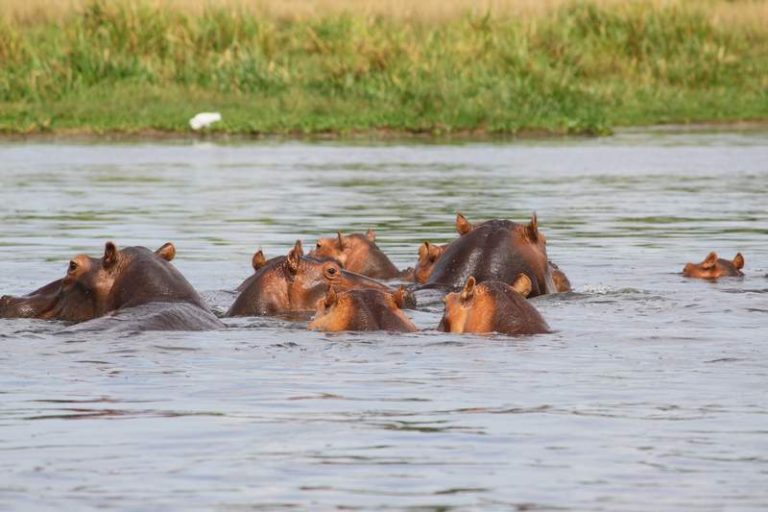
The Mabamba Wetland is Uganda’s most dependable place to find a shoebill, a papyrus swamp on Lake Victoria searched by canoe with local guides. Most visitors go as a half day trip from Entebbe, leaving before dawn and back by late morning. Mabamba Bay covers 2,424 hectares in Wakiso District, carries Ramsar listing, and holds over three hundred bird species.
What a Mabamba Wetland Shoebill Safari Actually Involves
A Mabamba shoebill safari is a search, not a sighting. That distinction shapes everything about how the morning runs and how you should think about the odds.
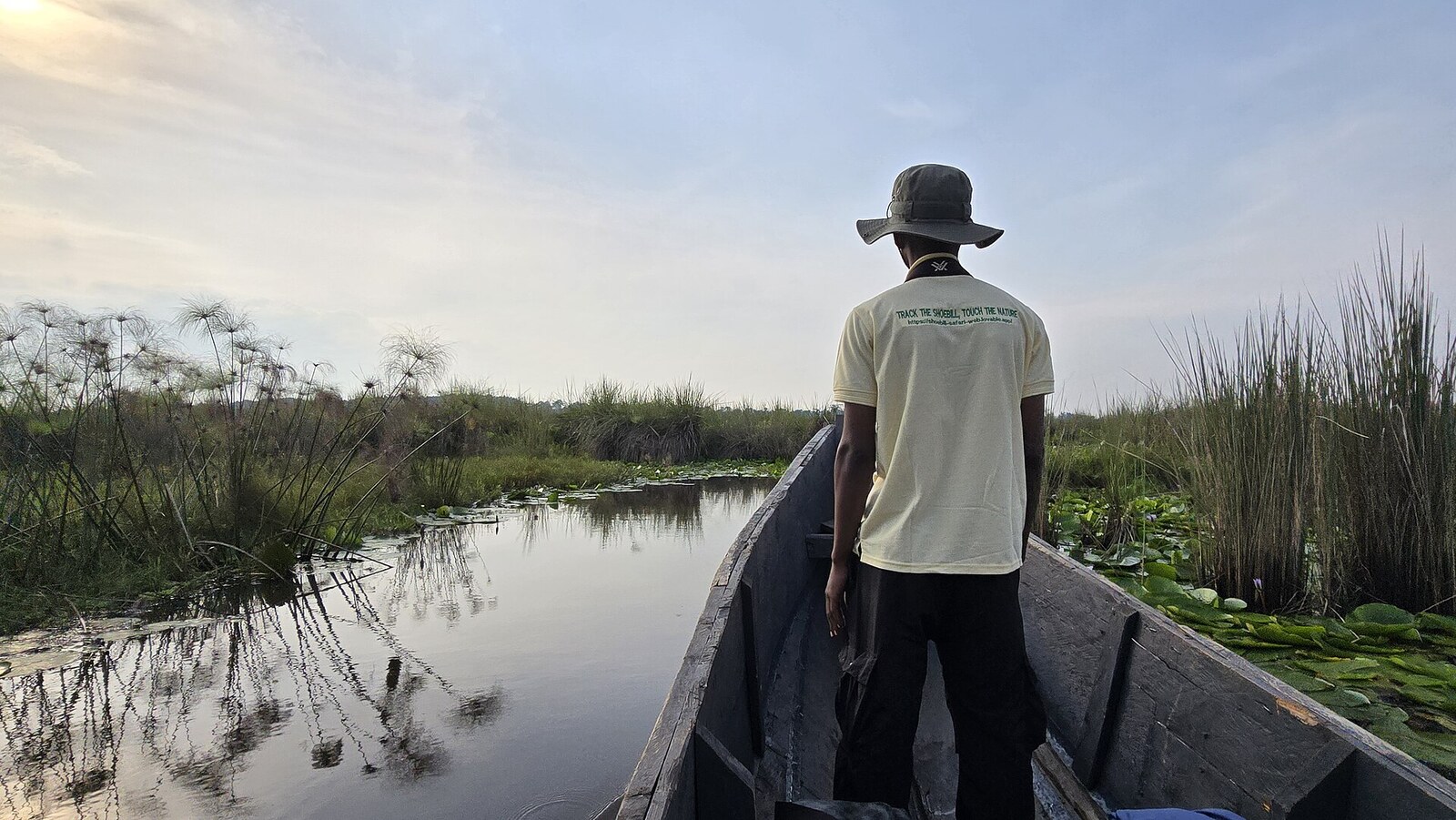
You leave Entebbe in the dark, reach the landing at Kasanje as it gets light, and step into a narrow wooden canoe with a guide and a boatman. An outboard pushes you out through the main channel for the first stretch. Then the engine goes off, and the boatman poles and paddles while the guide stands and reads the papyrus.
What follows is quiet, slow and slightly monotonous, punctuated by long stops. The guide is looking for one thing across a wall of green: a grey shape about a metre and a bit tall, standing motionless at the edge of open water where the lungfish come up to breathe. Shoebills hunt by sight and by stillness. They can stand without moving for a very long time, which is precisely why a bird can be forty metres away and invisible until someone who does this every day points at it.
Guides work the channels together and phone each other. If one boat finds a bird, the others converge, so a search that has produced nothing for an hour can end abruptly with three canoes drifting toward the same patch of reed.
Then the sighting itself, which is usually longer and closer than people expect. A settled shoebill will tolerate a canoe at reasonable distance for twenty minutes or more. The bird does almost nothing. That turns out to be the point.
Realistic Odds of Seeing a Shoebill on a Mabamba Tour
Almost every page about this place quotes a number: above 90 percent, or in one case 99 percent. Neither figure comes from a count of anything. They are marketing estimates that have been copied between sites until they look official.
Here is the honest version, built from what is actually known about the site.
Roughly a dozen shoebills live across 2,424 hectares. They are territorial, they use the same productive shallows repeatedly, and the guides who search those shallows six mornings a week know where each one tends to be. That combination is why the odds are genuinely good. It is not because the swamp is full of shoebills. It is because a small number of birds are being watched by people who have learned their habits.
So: on a morning trip, in the right season, with a MWETA guide who has been out that week, most visitors see at least one bird and a fair number see two. Some see one at distance and feel short changed. A minority see none at all, and that outcome is real rather than theoretical.
The three things that push you toward the wrong side of that split are all avoidable. Going in the afternoon. Going when the water is high. Booking the shortest possible slot and having to turn back at the ninety minute mark just as the guides start covering the far channels.
Build in the extra hour if the budget allows. It costs comparatively little and it is the single most useful thing you can do to improve your chances.
How Water Levels Change a Mabamba Shoebill Trip
This is the variable that decides your morning, and it is barely discussed anywhere.
Lake Victoria’s level moves, sometimes a great deal, and Mabamba is directly connected to it. When the lake is low, the swamp behaves the way the guidebooks describe: defined channels through solid papyrus, shallow muddy margins where lungfish surface for air, and shoebills standing in a predictable set of hunting spots. Under those conditions the search is efficient.
When the lake is high, several things go wrong at once. Papyrus that was rooted lifts and floats, so channels shift and some close entirely. The shallows that concentrate fish disappear under deeper water. Birds spread out across a much larger area of flooded margin, and the ones that stay are harder to reach because the routes have changed. Guides still find shoebills in high water, but it takes longer and the boats work harder.
A high lake also means floating papyrus mats can block a channel between one week and the next, which is why a guide who was out yesterday is worth more than a guide who was out last month.
You cannot check the lake level from home in any useful way. What you can do is ask the operator, the day before, how the water is and whether the boats have been getting through. A straight answer to that question tells you a lot about who you have hired.
The Canoes and Channels on a Mabamba Wetland Tour
The boat is a long narrow wooden canoe, locally a mtumbwi, and it takes four or five people with a boatman and a guide. It sits low, it has no shade and no rail, and getting in and out at a muddy landing is the least dignified part of the day.
Two modes of travel happen in one trip. The outboard runs while you cross the open lagoon and the main channel, which is fast, noisy and wet in a breeze. Once you are among the papyrus the engine goes off and the boatman poles. That switch is when the morning changes character, because a paddled canoe makes almost no sound and birds that would flush from an outboard stay put.
Birders often ask to be dropped into different parts of the site rather than doing one loop, and that is worth requesting. The site works as four rough zones. The landing itself, with weavers, kingfishers and whatever is sitting on the moored boats. The open lagoon, with jacanas, pygmy geese and terns. The papyrus channels, where the shoebill and the skulking specials live. And the cultivated edge and the forest patch behind it, which is a different bird list again and is reached on foot.
Nkima Forest sits about two kilometres from the landing, a twenty minute walk, and adds forest species to a morning that would otherwise be entirely wetland. Very few visitors do it, and birders who do come back pleased.
Two practical notes about the canoe. Bring a dry bag or at least a plastic bag for a camera, because there is always water in the bottom. And take a cushion or fold a fleece under you, since the seats are planks and two hours is a long time on a plank.
Booking a Mabamba Shoebill Tour: Site Guides or a Packaged Trip
The prices quoted for this trip vary by a factor of five or more across different websites, and readers reasonably conclude that someone is lying. Mostly nobody is. Two entirely different things are being sold under the same name.
The first is the site itself. MWETA runs a published rate card at the landing: a per person visitor fee, a per boat hire covering four or five people for ninety minutes to two hours, and an hourly rate to stay out longer. That is what you pay if you turn up at Kasanje under your own steam. It is modest, it goes to the community association, and it is the figure the lodge at the site publishes.
The second is a packaged half day trip. That includes a vehicle and driver from Entebbe or Kampala, a bird guide who works for the operator rather than the association, the site fees paid on your behalf, water, and someone to blame if it goes wrong. It is quoted per person and it is several times the site rate. It is also, for most visitors, the sensible purchase, because the road to Kasanje is not obvious, the departure is before dawn, and a good bird guide changes what you see.
What to actually do depends on how you are travelling. If you have a vehicle and a driver already, go direct and pay the site rate. If you are flying in and out of Entebbe with no transport, buy the package and stop comparing it against the rate card, because they are not the same product.
Either way, book the day before rather than turning up. Guides are finite, the good ones go first, and an unannounced arrival at six in the morning sometimes means waiting for a boat.
Timing Your Mabamba Shoebill Tour and the Morning Window
Go early. That is the whole rule, and it is not a preference.
Shoebills hunt hardest in the first hours of light, when lungfish come to the surface and the air is still. By the middle of the morning the wind gets up, the papyrus moves, the birds go into cover and the heat becomes unpleasant in an open canoe. The productive window is roughly half past six to ten, which is why every operator schedules a departure from Entebbe between five and six.
Afternoon trips exist and they are sold. They are a worse product and the odds are lower. If your schedule only allows an afternoon, go anyway, but adjust your expectations rather than your outrage.
The trip fits an airport layover, which is the reason a lot of people do it at all. From landing to landing you need about eight hours to make it comfortable: an hour and a half each way, two hours on the water, and enough slack for traffic and check in. Anything under six hours is a gamble not worth taking with a flight at the end of it.
One more scheduling point. Most people pair the swamp with the Entebbe Botanical Gardens, a short drive from the airport on the lake shore, where a couple of hundred species have been recorded across ground you can walk in an hour. A Mabamba morning and a botanical gardens hour make a full and satisfying birding day without leaving the peninsula for long.
Papyrus Specials and Other Birds Worth Watching at Mabamba Bay
Over three hundred species have been recorded here, and the shoebill is far from the only reason a birder comes. Seven of the twelve Lake Victoria biome restricted species that occur in Uganda are present at Mabamba, which is the sort of statistic that means nothing to a general visitor and a great deal to someone working a list.
The name is worth pausing on. Mabamba comes from the lungfish, not from anything to do with birds. A swamp named after the fish that feeds the bird that everyone travels to see is a tidier piece of ecology than most place names manage.
Photographing the Shoebill on a Mabamba Wetland Safari
The photography here is harder than the pictures suggest, and being told why in advance saves a lot of frustration.
Distance is the first problem. Birds are typically across a channel or set back in reed, so 200mm is the floor and 400mm or more is what you actually want. A phone will produce a grey smudge in a green field and nothing else.
The canoe is the second problem. It is unstable, it is low, and it moves whenever anyone leans. Brace your elbows on your knees rather than on the gunwale, keep the shutter speed high, and accept that a monopod is useless in a boat that narrow. If there are four of you in the canoe, agree before you set off that nobody stands up.
Light is the third. The best hunting hours are also the best light, low and warm from the side, but the papyrus behind the bird is a bright green wall that will fool an averaging meter. Expose for the bird.
The behaviour worth waiting for is the strike. A shoebill hunting will stand still for an age and then collapse forward onto the fish in one violent movement, bill, head and body together, and about six strikes in ten succeed. It is over in well under a second. If your finger is off the shutter when it starts, you have missed it.
Keep your distance and let the guide manage the boat. A bird that walks away or flushes is a bird nobody else sees that morning, and the guides police this among themselves.
MWETA, the Fishermen and Why the Swamp Is Still There
Papyrus swamp is not protected by being pretty. It survives when it is worth more standing than cut, and at Mabamba that arithmetic was changed deliberately.
The community here organised itself into the Mabamba Wetland Ecotourism Association, MWETA, in the late nineteen nineties, before the Ramsar listing existed. Its members are fishermen, farmers, craftspeople and bird guides, all of whom depend on the same water. NatureUganda and others put training and capacity into it, and the guides you go out with are, in most cases, men who used to fish these channels and now take visitors down them instead.
The effect is straightforward. Birding income belongs to the people best placed to cut the papyrus, drain the margins or set illegal nets, and it only continues while the swamp holds shoebills. That has produced real reductions in illegal fishing and papyrus cutting in the core birding zones, which is a better conservation result than fencing would have achieved.
It also explains the fee structure. The visitor charge is a community fee rather than a park entry, and it is distributed among guides, boat owners and the association’s own conservation work. When you pay at the landing, you are paying the reason the birds are still there.
Conduct in the channels follows from the same logic. Keep noise down, do not ask the boatman to push closer than he wants to, do not play calls, and take the guide’s word on when to back off. Nobody enforces this from outside. It holds because the people whose income depends on it are the ones in the boat.
What to Wear and Bring for a Mabamba Wetland Trip
The canoe has no shade and the swamp has no shelter, so the two things that ruin a morning here are sun and rain, sometimes both.
Wear light long sleeves and long trousers rather than shorts. A wide brimmed hat that will stay on in a breeze beats a cap. Sunglasses help enormously against glare off the water, and polarised ones help you see into it. Take sun cream and put it on before you get in the boat, not after you notice.
Bring a light waterproof even in the dry months. Lake Victoria weather turns fast and a squall in an open canoe is memorable for the wrong reasons.
Footwear should be something you do not mind getting muddy and wet. Sandals are fine at the landing and unpleasant if there are ants where you stand for the forest walk. Closed shoes are the safer call.
Binoculars matter more than a camera for most people, and eight by forty two is the sensible choice. Take water, take insect repellent for the edges of the day, and take small denomination cash, because the site fees are paid in person and change at the landing is not guaranteed.
Leave anything you cannot afford to drop at the lodge. There is water in the bottom of every canoe and a low freeboard between you and the rest of the swamp.
Best Months for a Mabamba Shoebill Safari
The swamp works all year, which is one of its advantages over the parks. Some months are still better than others, and the reasons are about water and wind rather than temperature.
What to take from that: if you can choose, choose June to August or December to February. If you cannot, go anyway and go at first light, because the hour of the day matters more at Mabamba than the month of the year.
Getting to Mabamba from Entebbe and Kampala for Your Tour
Two routes, and they suit different travellers.
By road you loop around the top of the bay through Kasanje, roughly an hour and a half from Entebbe and closer to two from Kampala depending on traffic and how much of the murram section is wet. The last stretch is unsurfaced and slow. This is what packaged trips use, because a vehicle at the landing means you can move on afterwards.
By water you take the ferry from Nakiwogo in Entebbe across to the far shore, a crossing of about ten minutes, then a vehicle for twenty minutes to the landing. On paper this is much shorter. In practice it depends on the ferry timetable lining up with a dawn start, and you need transport waiting on the other side.
A third option is a speedboat direct from Entebbe, forty to fifty minutes across the lake to the mouth of the swamp. It costs more, it is exposed if the water is choppy, and it is the choice of people staying at the smarter Entebbe hotels who want to skip the road entirely.
Staying nearby is the other way to solve the dawn problem. There are simple lodges on the far shore near the site and one small forest lodge within walking distance of the landing, and a night there turns a pre dawn drive into a ten minute walk.
Other Shoebill Sites in Uganda Compared With Mabamba Tours
Mabamba is the most reliable, not the only option, and a longer Ugandan itinerary may put you nearer one of the others anyway.
| Site | Where | Odds |
|---|---|---|
| Mabamba Bay | Wakiso | Very high |
| Makanaga Bay | Wakiso | High |
| Nile delta | Murchison Falls | Good |
| Lugogo swamp | Nakasongola | Variable |
| Lake Opeta | Eastern Uganda | Good |
| Lake Mburo | Kiruhura | Low |
Makanaga Bay sits on the same wetland system as Mabamba and is the fallback the guides use when Mabamba is crowded or the water is wrong. Almost nothing is written about it, which is its own recommendation.
The Nile delta in Murchison Falls, where the Victoria Nile spreads into Lake Albert, is the other genuinely good site, searched from a launch rather than a canoe. It suits anyone whose itinerary already includes the park, and the boat is far more comfortable than a mtumbwi.
The rest are opportunistic. Lugogo swamp near the rhino property, the eastern lakes, and the occasional bird in Lake Mburo are all real records rather than plans. If seeing a shoebill is the point of your trip, come to Mabamba and treat everything else as a bonus.
Mabamba Wetland Questions Answered
How much does a Mabamba shoebill tour cost?
Two different prices exist and both are honest. Paying at the landing yourself, the community rate is roughly $7 per person for the visitor fee plus about $40 for the canoe, which carries four or five people, with roughly $13 for each extra hour. Two people pay somewhere near $55 between them and a group of four nearer $70 in total. A packaged half day trip from Entebbe including transport, a bird guide, water and the site fees runs from about $45 per person in a decent sized group to well over $150 for a solo traveller with a private vehicle. The gap is transport and guiding, not a markup on the swamp.
What are the chances of seeing a shoebill at Mabamba?
Good, and lower than the numbers you will see quoted. The 90 and 99 percent figures on tour pages are estimates rather than counts. Roughly a dozen resident birds use 2,424 hectares, guides know their usual hunting shallows and coordinate by phone when one is found, and on a morning trip in a drier month most visitors see at least one. Some see two. A minority see none, and that is a genuine outcome rather than bad luck at the margins. Going early, going in a drier month and paying for an extra hour on the water all move you the right way.
How long does a Mabamba wetland trip take?
The standard boat hire covers ninety minutes to two hours on the water, and extra time is charged by the hour. Add an hour and a half each way by road from Entebbe and the trip occupies a morning, typically leaving between five and six and back around eleven. Birders who want the papyrus specials and the forest patch behind the cultivation should plan on three to four hours afloat plus a walk, which turns it into most of a day.
Can I visit Mabamba on an airport layover?
Yes, and it is one of the best uses of a long connection anywhere in Africa. Allow eight hours between landing and your next check in to do it comfortably: ninety minutes each way, two hours on the water and slack for traffic. Six hours is possible and tight enough that any delay costs you the trip. Arrange the vehicle in advance rather than negotiating at arrivals, and tell the operator your flight number so somebody is tracking it.
What do the community fees at Mabamba pay for?
They go to MWETA, the local wetland ecotourism association, and are shared among guides and boat owners and the association’s conservation work. This is a community charge rather than a national park entry, and there is no wildlife authority gate here. The arrangement is the reason the swamp is intact: the people who could most easily cut the papyrus or set illegal nets earn more by keeping shoebills findable, and illegal activity in the core birding zones has fallen as a result.
Is Mabamba suitable for children or people with limited mobility?
Partly. There is no walking involved beyond getting in and out of the boat, which helps, but the canoe is narrow and low, the landing is muddy, and there is no shade or seat back for two hours. Anyone with balance difficulties will find boarding hard, and a wheelchair cannot be accommodated. For children, the limiting factor is patience rather than physical difficulty, since the activity is long periods of quiet scanning. Older children who like birds do well. Restless toddlers do not, and they also flush the bird for everyone else in the canoe.
What camera and binoculars do I need at Mabamba?
Binoculars are the priority and eight by forty two suits the conditions. For photographs, treat 200mm as the absolute floor and 400mm or longer as what you actually want, because birds are usually across a channel or set back in reed. Keep the shutter speed high, since the canoe never stops moving, and brace on your knees rather than the side of the boat. Bring a dry bag: there is water in the bottom of every canoe. A phone will not produce a usable shoebill photograph at realistic distances.
Do I need to book a Mabamba tour in advance?
Book the day before at minimum. Guides and boats are limited, the best guides go first, and arriving unannounced at dawn can mean waiting. Booking ahead also lets you ask the question that matters most: how the water has been this week and whether the boats are getting through the channels. An operator who answers that clearly is worth choosing over one who quotes you a sighting percentage.
What else can I see near Mabamba on the same morning?
The Entebbe Botanical Gardens, down on the lake shore, hold a few hundred recorded species across a small walkable area, and they pair naturally with a Mabamba morning. Nkima Forest, two kilometres from the landing, adds forest birds to an otherwise wetland list and takes a twenty minute walk. The Uganda Wildlife Education Centre in Entebbe is the honest fallback if the swamp does not produce, since it holds shoebills in care and is a straightforward way to see the bird up close, though nobody should mistake that for the wild thing.
Uganda Safaris lists Ugandan operators who run Mabamba the way it should be run: out of Entebbe before dawn, with a real bird guide, and with MWETA boatmen who know which channel has been holding a bird this week.
A five day birding trip opens with the shoebill search here before giving a full day to Kibale.
A fifteen day wildlife and primate circuit also starts at Mabamba and then runs the length of the country.
Look through the other birding trips on the site, check the start time and what is included, then message an operator directly if you need a shoebill morning fitted around a flight or the rest of a safari.
Safaris That Visit Mabamba Bay Wetland
1 of the 2 safaris listed here that visit Mabamba Bay Wetland, from different operators where the listings allow it. Each is sold and run by an independent Ugandan tour company. This site lists them and passes on enquiries; it takes no booking and charges you nothing.
See all 2 safaris to Mabamba Bay Wetland