
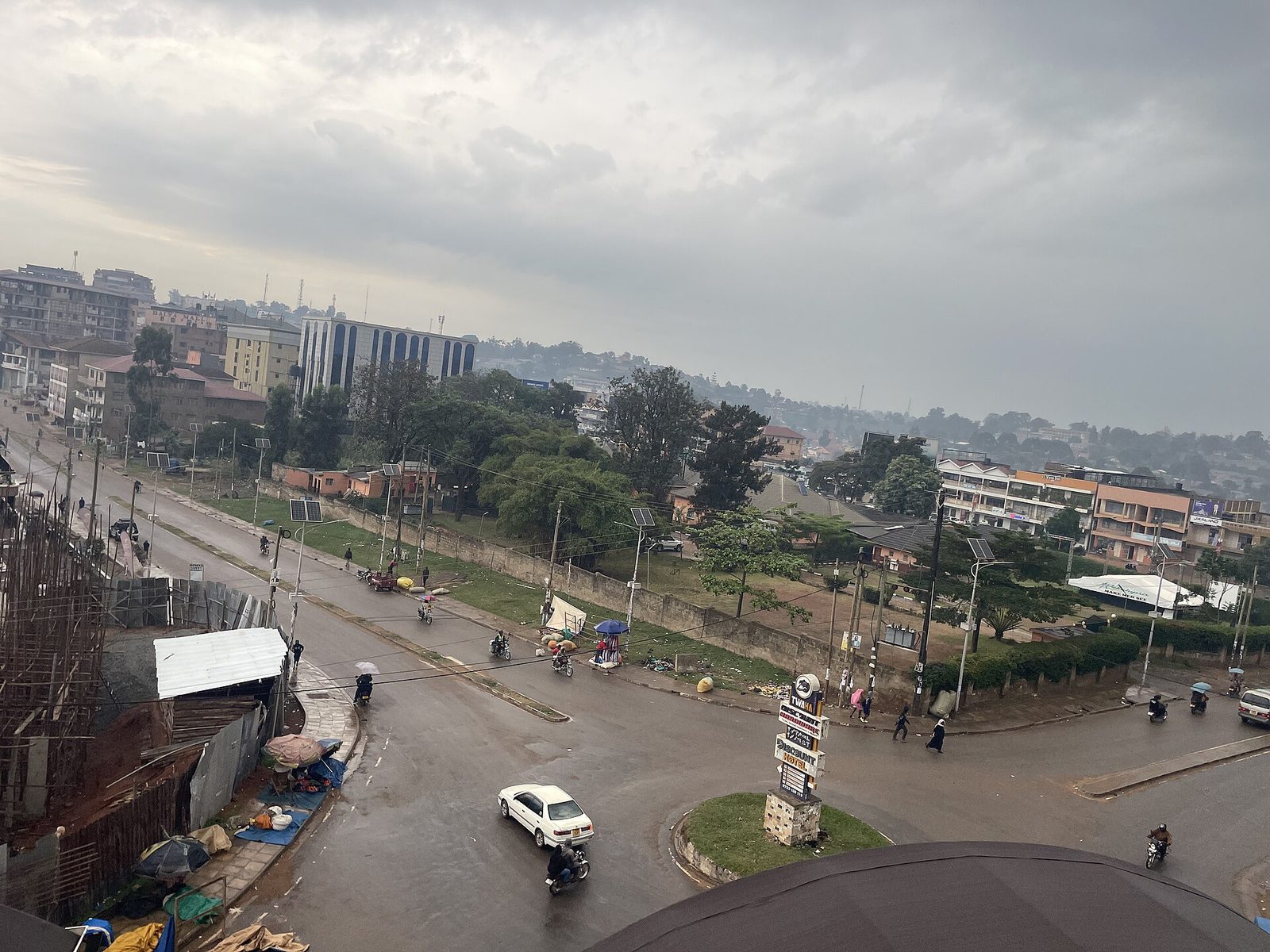
Mbarara is western Uganda’s largest city and the standard lunch or overnight break on the drive from Kampala to the gorilla parks. Most travellers give it a few hours, some give it a night, and the choice between those two is the only real decision here. The city sits about 270 kilometres southwest of Kampala at roughly 1,147 metres, in Ankole long horned cattle country, with the Igongo Cultural Centre 12 kilometres back along the Masaka road.
Mbarara City Tours and the Western Route at a Glance
Let us be straight about this, because it saves a wasted afternoon. Mbarara has no set piece sight. There is no old quarter, no cathedral anyone crosses a country for, no museum inside the city limits. What it has is position. Every vehicle heading from Kampala to Bwindi, Mgahinga, Queen Elizabeth or the Rwenzori passes through, and almost every one of them stops.
That is the honest frame for a Mbarara city tour. It is a working town of roughly 264,000 people by the most recent national census, the commercial hub for the whole Ankole sub region, and the place where a long drive gets broken. It became a city in its own right on the first of July 2020, after cabinet approved the upgrade the previous year. The name came from a colonial mangling of emburara, a tall grass that grew across these hills before the cattle and the maize took them.
The city spreads over six divisions and sits in a shallow bowl of grassland and low ridges. Four things anchor the local economy and all four are visible from the road: dairy, a brewery, a bottling plant and a steel works. Add four universities and a teaching hospital and you have a town full of students and nurses rather than tourists, which is a large part of why the evenings are livelier than the days.
Igongo Cultural Centre Tours and the Eriijukiro Museum
The Igongo Cultural Centre tour is the single best reason to slow down anywhere near Mbarara, and the reason is not the building. It is that the museum inside it, the Eriijukiro, is the only place on the western route that explains what you have been driving past for four hours. The word means a place of remembering.
Igongo sits at Biharwe, about 12 kilometres northeast of the city on the Masaka side, so travellers coming from Kampala reach it before they reach Mbarara. That geography matters more than it sounds. Stop on the way out and you get lunch at the right hour. Stop on the way back and you are doubling back for it.
The museum runs through Ankole and Kigezi life in a sequence that makes sense: milk pots and gourds, the tools of a cattle household, hides, stools, the regalia of the Omugabe, the smithing and basketry that supported all of it. Half an hour covers the galleries at a walking pace. An hour does it properly. Beyond the museum there is a reconstructed village called Eitaramiro, a crafts shop with local history books that are hard to find elsewhere, and the Mpororo Court display of eighteenth century kingdom material.
The restaurant is the part most people remember. It runs a buffet built on Ankole cooking rather than hotel food, and it is timed for the traffic, which means it is busiest from noon to two. Millet bread, matooke, beef and ghee sauce are the core of it. If you arrive with a driver, he will already know. Drivers on the western route treat Igongo as the default and they are not wrong.
A word on the museum fee. It is charged separately from the grounds, which are free to enter, and the published figure moves around between sources. Confirm it at the desk rather than planning around a number you read online.
Biharwe Eclipse Monument Hiking Trail Above the Highway
Behind Igongo, a short hiking trail climbs the hill to the Biharwe Eclipse Monument, and this is the piece almost every guide to Mbarara leaves out. It takes twenty minutes up at an easy pace, less coming down, and the view opens across the Ankole grassland in both directions.
The story it marks is genuinely old. A Bunyoro raiding party under Olimi I came through here driving stolen cattle north, and at Biharwe a solar eclipse fell over them. The raiders panicked, abandoned the herd and scattered. Astronomers later dated that eclipse to 1520, which makes it one of the very few precisely fixed dates in the pre colonial history of the region. The monument has three pillars, one for each of the kingdoms tangled in the episode, and it was inaugurated in 2014.
Take water and go early or late. There is no shade on the hill and the grass is thin. Anyone stiff from four hours in a vehicle will find this the best twenty minutes of the day.
Ankole Long Horned Cattle Tours and the Dairy Country Around Mbarara
You do not book an Ankole cattle tour so much as look out of the window. From roughly Lyantonde onwards the herds start appearing beside the road, and the animals are hard to mistake: deep red coats, and horns that sweep out and up in a lyre shape, sometimes past two metres tip to tip on a good bull.
They were the currency of this region long before shillings were. Bahima herding families measured wealth, standing and marriage in cattle, and the breed carries a deep local name, the cattle of kings. The horns are partly defensive and partly a cooling system, since blood circulating through them sheds heat in a country with little shade.
Mbarara is the centre of Uganda’s dairy belt, and milk is the reason the town has money. Tankers work the roads from dawn. Several farms and cooperatives around Kiruhura and Sanga now take visitors for a morning: milking, churning ghee, drinking fresh milk from a gourd if your stomach is up to it. These are arranged through lodges or operators rather than walked into, and quality varies a great deal, so ask what the visit actually involves before agreeing to it.
One thing worth knowing. The pure Ankole breed is under pressure, because crossing with Friesians raises milk yields and many herders have done exactly that. The long horned animals you see from the road are increasingly kept by people who value them culturally rather than commercially.
Nkokonjeru Royal Tombs Tour and the Kingdom That Was Never Restored
Three kilometres out of the centre at Kakiika, a colonial era house holds two concrete slabs. This is the Nkokonjeru tombs tour, and it is the burial ground of the Ankole royal line: Omugabe Kahaya II, laid there in 1944, and Omugabe Gasyonga II, in 1982. Other royal graves sit in the grounds outside.
The site is quiet to the point of desolate. There is a caretaker, usually, and a visitors book. There is no interpretation to speak of, so the visit works only if you know the story before you arrive, which is the argument for doing Igongo first and Nkokonjeru second.
The story is this. Obote’s government abolished all of Uganda’s kingdoms in 1967. When Museveni restored the others in 1993, Ankole was left out and remains so, because the Banyankole themselves were split and still are. One camp argues the abolition was never lawful. The other argues the kingdom’s rigid caste structure has no place in modern Ankole. The result is a royal tomb with no successor to visit it, which explains both the neglect and the periodic campaigns to tidy the site up. Parts of the surrounding land have been sold to developers, and that fight is live.
Fifteen minutes is enough for the tombs. Go with a Runyankole speaker if you can, because the caretaker’s account is worth more than the slabs.
Mbarara City Walking Tours, the High Street and the Central Market
A Mbarara walking tour takes about an hour and a half and works best between four and six in the afternoon, when the heat drops and the town comes back outside. The core is small. High Street runs the length of it with the banks, the phone shops and the eating houses, and you can cross the commercial centre on foot in fifteen minutes.
The central market is the part with real texture: matooke in stacks, dried fish, beans by the sack, second hand clothing, and a dairy section that tells you immediately where you are. Nobody hustles tourists here because tourists are not the trade. Ask before photographing people and the answer is usually yes.
Two other stops make sense on the same loop. The Ankole Kingdom palace site at Kamukuzi sits on a rise above town, more an administrative compound now than a palace, and the golf course on the edge of the centre is open to visitors who want nine holes and a cold drink under old trees.
Boda boda motorcycles handle short hops and cost very little. Agree the fare first. Traffic through the middle of town backs up badly at market hours and around school closing, which is worth planning around if you are trying to leave the city in a hurry.
Eshabwe, Akaro and Mbarara Food Tours
If you do one thing in Mbarara that you cannot do elsewhere, eat. An informal Mbarara food tour means three dishes and they are all local to Ankole.
Eshabwe comes first. It is a white sauce made by whipping pure cow ghee with warm water and rock salt until it thickens, and it is served over millet bread or matooke. It is ceremonial food, poured at marriage negotiations where the groom, his father and two of the bride’s relatives taste it in turn. Older women traditionally made it in silence, on the belief that talking would ruin the texture. It is rich, it is faintly smoky, and people either love it immediately or never come back to it.
Akaro is the millet and sorghum bread that goes under it, dense and dark. Obushera is the fermented millet drink, sold everywhere from roadside flasks, mildly sour and better cold than warm. Add roast goat from any of the mbuzi choma places on the main road and you have eaten properly.
For a visitor, the easiest route to all of it is the Igongo buffet, where the kitchen cooks it as a matter of policy. In the city itself, the local eating houses do it better and cheaper, but you need to ask, because the menu board will offer you chicken and chips first.
Lake Mburo National Park Safari Trips From Mbarara
Lake Mburo safari trips are the only wildlife on offer within reach of a Mbarara bed, and the park is closer than most itineraries admit. Park headquarters at Rwonyo lies 47 kilometres from the city. The Sanga gate turning is about 37 kilometres out on the Masaka road, the Nshara gate roughly 50, and both sit around two kilometres from headquarters once you are inside.
Mburo is small and it is the only Ugandan park with impala and the only one where zebra are common. Eland, topi, buffalo, warthog and hippo are all regular. There are no elephants and lion sightings are rare, so treat this as a park for open grassland game rather than a place to tick predators. Sightings are never guaranteed anywhere.
The thing Mburo does that other parks cannot is let you walk and ride. Guided walking safaris with an armed ranger get you among zebra and eland on foot, horseback safaris run from a lodge inside the park, and the boat trip on the lake is the reliable way to see hippo and, with luck, a shoebill in the papyrus fringe. Night drives run too, which is when the leopard and the bush baby odds improve.
Basing in Mbarara and driving out works, but be honest about the arithmetic: an hour each way eats the golden hours at both ends of the day. It saves money and costs game. Our full Lake Mburo National Park guide covers the gates, activities and lodges in detail.
River Rwizi, Lake Nakivale and the Mbarara Attractions Worth Skipping
Two places appear on almost every online list of things to do in Mbarara, and both listings are misleading. Saying so plainly is more useful than repeating them.
River Rwizi is described on several travel pages as a spot for boating and wildlife. In practice it is a river in serious trouble. It supplies the city’s water, and the national environment authority has reported roughly sixty percent of its catchment degraded by farming, brick making, sand mining and construction in the wetlands that used to feed it. Industry and the town discharge into it. Water levels have fallen far enough that factories draw only a fraction of what they need. There are community restoration projects along it and they deserve attention, but nobody should drive to Mbarara expecting a river cruise.
Lake Nakivale, roughly 40 kilometres southeast, appears on two travel sites as a beach and leisure destination. It is not. Nakivale is one of Africa’s oldest refugee settlements, opened in 1958, home to well over a hundred thousand people from Congo, Burundi, Somalia and elsewhere, administered jointly by the Office of the Prime Minister and UNHCR. It is a place where people live under difficult circumstances, not a day trip. Access is controlled and requires clearance. If your interest is genuine and professional, apply through the proper office. If it is sightseeing, go somewhere else.
Mbarara Nightlife, Live Music and Evening Tours
Evenings are when the town earns its keep. Four universities and a regional hospital mean a young population with somewhere to be on a Friday, and the live music scene is the best in western Uganda by a distance, with more bands playing in a single weekend here than Kabale sees in a month.
The pattern is straightforward. Bars around the centre and along the Kakoba side fill from about eight. A few venues double as something else by day, a car wash or a restaurant, and turn into clubs from Friday. Kwaito, Ugandan pop and nineties throwbacks dominate the playlists. Most places wind down by one.
Two practical notes. Take a boda or a taxi back to your hotel rather than walking after dark, the same rule any Ugandan in town would follow. And if you are driving to Bwindi at six the next morning, one drink is the sensible ceiling, because the road west does not forgive a tired driver.
Mbarara Safari Stopover Drive Times West, South and North
This is the section most readers actually came for. Mbarara is a junction, and the value of a stop here depends entirely on what comes next. The figures below are road distances with realistic driving times, allowing for speed bumps through trading centres and for the fact that nobody averages the legal limit on these roads.
| Destination | Road distance | Drive time |
|---|---|---|
| Kampala | 270 km | 4 to 5 hours |
| Entebbe airport | about 300 km | 5 to 6 hours |
| Lake Mburo HQ | 47 km | 1 hour |
| Kabale | 150 km | 2 hours |
| Bwindi Rushaga | about 220 km | 4 to 5 hours |
| Bwindi Buhoma | about 250 km | 5 to 6 hours |
| Queen Elizabeth | about 190 km | 3 to 4 hours |
| Kasese | 156 km | 3 hours |
| Fort Portal | about 230 km | 4 hours |
The Masaka to Mbarara stretch is the good half. Recent resurfacing left it smooth and the traffic thins after Masaka, so the drive rolls through ranch country at a decent pace. The Kampala to Masaka half is the problem: it is one of the most accident prone roads in the country, with heavy truck traffic, unmarked speed bumps outside every trading centre and a fatality record that runs into the hundreds each year. Police speed traps have been stepped up along the whole corridor and fines are steep.
Practical rules from people who drive it constantly. Sit at seventy to eighty rather than the ninety the limit allows. Slow to walking pace at every trading centre, because the bumps are frequently unpainted. Keep well back from trucks and buses. And do not drive this road after dark if you can avoid it, since unlit vehicles and pedestrians on the verge are the real hazard, not the tarmac.
Two notes on the onward legs. Bwindi times swing widely by sector, and the last stretch into Buhoma or Nkuringo is murram that wants a four wheel drive in the wet, so the distance column understates the difficulty. For Queen Elizabeth, the route through Bushenyi and Ishaka is the one to take.
Best Time for Mbarara Tours and Trips Into Ankole
Mbarara sits high enough that the heat never gets punishing. Daytime highs hold between twenty six and twenty eight all year and nights drop to around sixteen, so a light fleece covers the evenings and nothing heavier is needed. Rain, not temperature, is what changes.
The practical reading is simple. June through early September and again from late December into February give the easiest driving and the firmest tracks. March to May and October to November are wetter but not closed, and the western route stays tarmac the whole way to Kabale, so rain affects the last murram stretches rather than the main drive.
Where to Stay in Mbarara and How to Reach the City for Your Safari
Accommodation splits into three bands. Guesthouses and small hotels around the centre are basic, clean and cheap, and they suit a single night of sleep before an early start. Mid range business hotels such as Acacia and the Agip Motel add air conditioning, reliable wifi and a proper restaurant. At the top, Lake View Resort is the four star option in the city with a pool and around seventy rooms, while Igongo Country Hotel sits out at Biharwe with about fifty rooms and the advantage of being on the highway rather than in the traffic.
That last point decides it for many travellers. If you are leaving westward at dawn, sleeping at Igongo saves you the crawl through town. If you want the evening out, sleep in the city.
Getting here is nearly always by road. Coaches and minibuses run all day from Kampala’s bus parks and take five hours or so, with services continuing to Kabale, Kasese and Bushenyi. Private transfer with a driver is what most safari itineraries use, and it is the only option that lets you stop at the equator monument at Kayabwe and at Igongo without negotiating.
By air, Mbarara Airport, the old Nyakisharara strip, lies about ten kilometres northwest of town. It handles light aircraft on charter and has no customs, immigration or fuel, and it does not appear on the scheduled tourist network the way Kihihi and Kasese do. Flying into Mbarara means chartering, which is why almost nobody does.
Frequently Asked Questions About Mbarara Tours and Stopovers
How much should I budget for a night in Mbarara and a stop at Igongo?
Budget guesthouses in the city start around USD 18 to USD 25 for a double room. Mid range business hotels such as Acacia run roughly USD 50 to USD 70. Lake View Resort and Igongo Country Hotel sit higher, in the USD 80 to USD 120 band depending on room type and season. A buffet lunch at Igongo is modest by safari standards, usually under USD 15 a head, and the Eriijukiro museum charges a separate entry fee of roughly USD 6 to USD 8 for a foreign visitor, though this figure moves and should be confirmed at the desk. Boda boda hops around town cost well under a dollar. Rates change, so confirm at booking.
Is Mbarara worth an overnight stop, or should I push on to Lake Mburo?
It depends on what you want from the evening. Lake Mburo lodges put you inside the park for a dawn game drive and give you the sounds of the bush at night, which Mbarara cannot match. Mbarara gives you a proper restaurant, reliable electricity and wifi, a much lower bill and live music if you want it. Families breaking a long drive with children usually do better in the city. Anyone whose itinerary already includes Mburo should sleep in the park and treat Mbarara as a lunch stop only.
How long is the drive from Kampala to Mbarara, and is the road good?
Around 270 kilometres and four to five hours in daylight. The second half from Masaka is smooth tarmac through ranch country and pleasant to drive. The first half from Kampala is the difficult part: heavy truck traffic, unmarked speed bumps, frequent overtaking on blind bends and a bad accident record. Leave Kampala before seven if you can, and do not attempt the return leg after dark.
Can I see Ankole long horned cattle without arranging a farm visit?
Yes. The herds graze right beside the highway from Lyantonde onwards and you will pass hundreds of animals before you reach the city. Pull into a lay by rather than stopping on the road itself, and ask before walking towards a herd, since every animal you see belongs to somebody. A farm visit adds the milking, the ghee churning and the conversation, which is what makes it worth booking if you have a spare morning.
Do I need a four wheel drive for Mbarara and the sites around it?
Not for the city, not for Igongo, and not for the tombs at Kakiika, all of which are reachable in a saloon car on tarmac or short graded murram. You need the four wheel drive for what comes after: Lake Mburo’s internal tracks in the wet, and above all the final stretches into Bwindi, where the murram climbs get greasy fast. Most travellers hire the vehicle for the whole trip rather than for one leg.
Can I visit Nakivale refugee settlement as a tourist?
No, and it should not be on a holiday itinerary. Nakivale is home to well over a hundred thousand people who fled conflict, administered by the Office of the Prime Minister together with UNHCR, and access is controlled for good reason. Researchers, journalists and organisations with a working purpose apply for clearance through the proper channels. Travel pages that list it as a lakeside leisure spot have simply copied each other without checking.
Is Mbarara safe to walk around, and what about after dark?
The centre is comfortable to walk in daylight and the town is used to outsiders without treating them as targets. Ordinary city rules apply: phone out of sight in the market crowd, bag across the body, agree boda fares before you sit on the bike. After dark, take a boda or a taxi rather than walking back from a bar, which is what local residents do themselves. Solo women travellers report the town as easy going by day and worth being careful in at night, the same as anywhere.
What should I pack for a stop in Mbarara?
A light fleece for the evenings, since the altitude takes the edge off after sunset. A rain shell in every month, because even July throws a shower. Small denomination cash, as card payment thins out quickly outside the main hotels. Shoes with some grip if you plan the walk up to the eclipse monument, where the grass is slippery when damp. Sun protection for that same hill, which has no shade at all. And an extra bottle of water in the vehicle for the road west.
What are the entry fees like at Lake Mburo if I base myself in Mbarara?
Park entry under the current conservation tariff is USD 40 for foreign non residents and USD 30 for foreign residents, valid for 24 hours from the moment you pass the gate. A guided nature walk with an armed ranger runs roughly USD 15 to USD 30 depending on length, the boat trip about USD 30 per person with a minimum party size, and a ranger guide riding along in your own vehicle is around USD 25 for a half day and the best value on the list. Vehicle entry is charged separately. Rates are revised periodically, so check before you travel.
Mbarara rewards travellers who see it for what it is: a junction town with good food, honest prices and the one museum that makes sense of the country you have been driving through.
A three day gorilla safari breaks the western route here on the way to Bwindi.
A four day gorilla safari uses the same stop and adds Queen Elizabeth on the way back. Ask whether your package includes the Igongo stop or simply drives past it.
13 Places to Visit in This Area
Individual sites within reach of here, each with its own guide. Some are written up because the name circulates and the place does not, which is worth knowing before you plan a drive around one.
Safaris That Visit Mbarara
Every safari listed here that visits Mbarara. Each is sold and run by an independent Ugandan tour company. This site lists them and passes on enquiries; it takes no booking and charges you nothing.

10 Days Uganda Cultural Tour
by Insight Safari Holidays Verified operator


4 Days Gorilla Safari Uganda
by Oree Safaris Verified operator

3 Days Gorilla Safari Uganda
by Oree Safaris Verified operator