
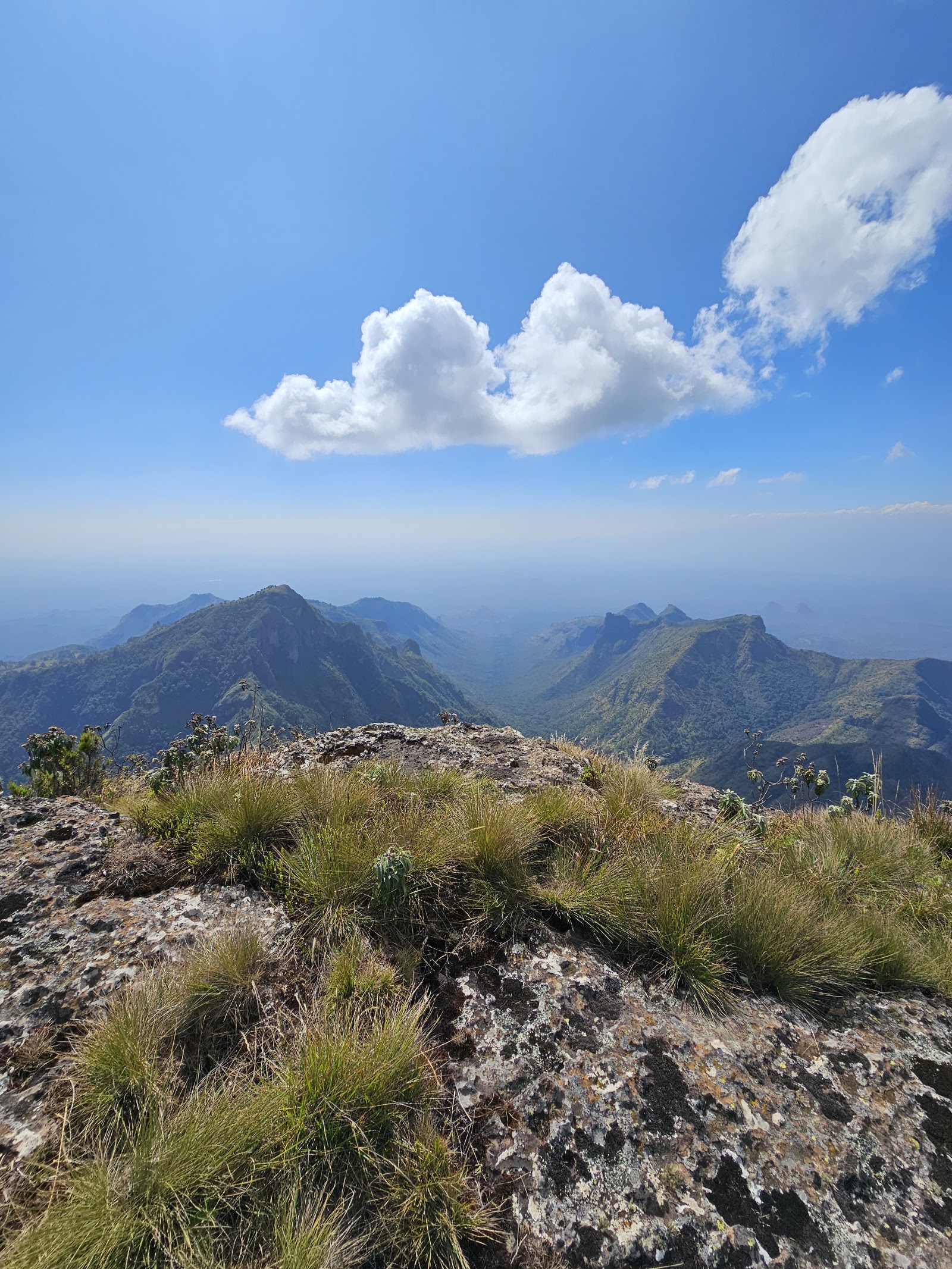
A Matheniko Wildlife Reserve safari is a half day or full day out of Moroto for ostrich, Bright’s gazelle, dry country birds and Karamojong rock art, in the driest and least visited protected area in Uganda. Drives are registered at the wildlife authority office in Moroto and run with a ranger. Matheniko covers about 160,000 hectares along the Kenyan border in Moroto district.
What a Matheniko Wildlife Reserve Safari Is Really Like
The pages ranking for this reserve promise elephants, lions, giraffe and sport hunting. Set all of that aside before you plan anything.
Matheniko is thorny deciduous thicket on a dry plateau, running up against the Rift escarpment that forms the Kenyan border. It has no lodge, no gate, no game drive circuit and no visitor facilities of any kind. It gets very little rain. Wildlife is present in genuinely small numbers, and cattle are present in large ones, because this reserve has served as seasonal grazing for Karamojong herds for as long as anyone has kept records.
So the trip is a short one. You register in Moroto, pick up a ranger, drive out for a morning across thornbush and open ground, look for ostrich and gazelle, walk to a rock art site or scramble a granite outcrop, then come back. Add a Karamojong homestead visit in the afternoon and that is a satisfying day. Nobody stays out here for three nights, and anybody suggesting you should is not describing a place they have been.
One administrative point that saves confusion. Matheniko and the Bokora Corridor to the west are run together by the wildlife authority as a single unit, sitting inside a wider conservation area with Pian Upe. Ask for Matheniko Bokora, not for Matheniko, and one office handles both.
Uganda’s Driest Reserve, from the Thornbush to the Kenyan Escarpment
Rainfall is the fact that explains everything else here. Around 670 millimetres a year, arriving in one season rather than the two that most of Uganda gets, on a plateau with almost no permanent surface water. That is a different country from the one visitors picture when they think of Uganda.
The vegetation follows. Thorny deciduous thicket dominates, with red acacia, desert date, woolly caper bush and combretum through it, and stretches of open ground between. Nothing here is green for long. In the dry months the thicket is grey and leafless and you can see through it, which is one reason the dry season works better for wildlife viewing than the wet.
The eastern edge is the drama. The Great Rift escarpment rises along the boundary and it is the Kenyan border as well, so you are looking at Turkana country from the reserve. Granite outcrops and small hills break up the plateau elsewhere, and they matter out of proportion to their size: they hold the rock art, they give the only shade worth the name, and they are where klipspringer and rock hyrax live.
Do not confuse the reserve with the mountain. Mount Moroto stands south of it as a separate forest reserve of its own, and the hiking, the Tepeth villages and the montane birds all belong to the mountain rather than to Matheniko. Several pages fold the two together and it leads people to book the wrong thing.
Game Drive Safaris from Moroto into Matheniko
A Matheniko game drive safari starts in Moroto town rather than at a park gate. You register at the wildlife authority office, a ranger is assigned to you, and the ranger rides with you into the reserve. There is no ticket booth in the bush and no self guided option, so this step is not skippable.
Tracks are rough and limited. A 4×4 with real clearance is the minimum, and in the wet months parts of the reserve simply are not driveable. Most drives work the western and southern parts within reach of the Moroto and Kotido road, because that is where tracks exist.
Go at first light. The reserve is hot, exposed and almost shadeless, animals are into cover by mid morning and stay there, and the middle of the day is genuinely unpleasant. Late afternoon works as a second option. Drives of two to four hours are the norm and there is no purpose in longer ones.
What a drive here actually produces is a handful of good sightings rather than a stream of them. The reserve has less rain and fewer animals than Kidepo and honest guides in Moroto will tell you so before you set out. Bring binoculars, accept the pace, and treat the thornbush and the escarpment as half the reason you came.
Ostrich, Bright’s Gazelle and the Matheniko Wildlife Safari List
Ostrich are what Matheniko does well. The Karamoja reserves are the only reliable place in Uganda to see wild common ostrich, and Matheniko is among the better spots within them, birds walking across open ground in the early morning with nothing else in sight.
Bright’s gazelle is the other one worth chasing. This is a northern Grant’s gazelle at the very western edge of its range, and the Karamoja reserves hold almost the whole of its Ugandan distribution. Alongside it come oribi, dik dik, bohor and mountain reedbuck, bush duiker, waterbuck and Uganda kob, with olive baboon, vervet and patas monkey in the thicket and along the watercourses.
The reserve’s official species record does include lion, leopard, cheetah, giraffe, roan antelope and eland, and the entry is an old one. Read it as what the reserve once carried rather than what it carries now. Cheetah and leopard remain in the wider conservation area and are almost never seen. Roan antelope and giraffe are Pian Upe animals. Lion have no resident population here that any recent work supports, and elephant, listed on at least one ranking page, are not in this reserve at all.
Lesser kudu is the one where an honest hedge is required. It is listed for the Karamoja reserves, this is the extreme western limit of its global range, and records are sparse. Seeing one would be genuinely notable. Planning around it would be foolish.
Birding Safaris in the Matheniko Thornbush
Birding is the strongest argument for the reserve and the one a Uganda list actually benefits from. Dry acacia thornbush is habitat the rest of the country does not have, so a Matheniko birding safari adds species that no amount of time in Bwindi, Kibale or Murchison will produce.
Raptors do well here because the escarpment gives them lift and the open ground gives them hunting. Verreaux’s eagle along the rock faces, Egyptian vulture, pygmy falcon and fox kestrel are the ones birders come for. On the ground, common ostrich, kori bustard, secretary bird, Abyssinian ground hornbill and black headed plover work the open country.
The thornbush itself holds the small dry country species: Karamoja apalis in the whistling thorn stands, red and yellow barbet, white headed buffalo weaver, Jackson’s hornbill, Abyssinian roller and a spread of larks, pipits and shrikes. The apalis is the prize. Survey work across Matheniko, Bokora and Pian Upe has confirmed it in all three and named overgrazing and the clearing of whistling thorn as the main threat to it, so the birding and the cattle question are the same question.
Work the rock faces and the thicket edges on foot with your ranger rather than from the vehicle, and go early. The escarpment at dawn is where the raptor watching happens.
Rock Art, Rock Climbing and Hiking Tours in the Matheniko Hills
Rock painting sites in and around the reserve are the cultural draw, red and white figures of animals and people on sheltered granite faces. Ages quoted for them run from about three thousand five hundred years to a figure of thirty five thousand that appears on one page and can be safely ignored. No controlled dating has been published for these sites, so treat the age as unknown and the art as old.
The sites are reached on short walks from a vehicle with a ranger, and some sit on ground the Karamojong hold as significant, which means access is granted by local custodians rather than bought at a desk. Going with someone who has that relationship is the difference between seeing the paintings and being turned back.
The outcrops themselves are worth the scramble whether or not there is art on them. They are the only high ground in the reserve and the view from the top gives you the shape of the country: thornbush running flat to the escarpment, the Kenyan hills beyond, the odd herd threading through. Bring proper footwear, because the granite is coarse and the ground around it is thorn.
Rock climbing in the technical sense is offered in Karamoja and it belongs mostly to the bigger faces around Mount Moroto rather than to the reserve. If climbing is your reason for coming, plan around the mountain and treat Matheniko as the wildlife half of the trip.
Mount Moroto Trekking and the Tepeth Beside the Reserve
Mount Moroto sits immediately south of the reserve and it is the anchor of most Karamoja trips, so it belongs in any honest Matheniko guide even though it is a separate protected area.
The mountain is an extinct volcano with twin peaks, Sogolomon and Sokdek, at about 3,082 metres, and the forest reserve enclosing it covers roughly 483 square kilometres with over 220 bird species recorded. Mount Moroto trekking ranges from half day walks on the lower slopes to two and three day climbs to the peaks, and the vegetation change on the way up, from dry thorn through montane forest to open ground, is more dramatic than anything on the plain.
The mountain is also the ancestral home of the So, usually called the Tepeth, one of the smallest ethnic groups in Uganda and a people whose way of life is built around the mountain rather than around cattle in the way their Karamojong neighbours are. Guided walks visit Tepeth villages on the slopes, arranged through Moroto operators.
Pairing the two is what most visitors end up doing and it is the right call. A morning in Matheniko for the ostrich and the birds, a day or two on the mountain for the walking and the Tepeth, and Moroto in the middle as the base.
Karamojong Cultural Tours Around Matheniko
The Matheniko are one of the Karamojong groups and they give the reserve its name, with the Bokora west of them, the Pian to the south and the Pokot towards Amudat. Turkana communities sit across the Kenyan border and Tepeth up on the mountain, which makes this a busier cultural crossroads than the emptiness suggests.
A Karamojong cultural tour takes in a manyatta, the thorn fenced homestead, and covers the cattle economy that everything here revolves around, the age set system, beadwork and stool carving, and the singing and jumping dances. Community based operators in Moroto run these and some offer homestays, which is the version worth doing if you have the time.
There is also a community conservation and beekeeping project near the reserve that takes visitors, and it is a more interesting stop than it sounds, because it is one of the few working examples in the region of the reserve generating something for the people living beside it.
Sort out photography before any camera comes out. Karamoja has a long and unhappy history of being photographed by visitors on its own doorstep, and permission here is a courtesy with real weight behind it.
Grazing, Hunting and the Honest State of the Matheniko Reserve
Two things get repeated about this reserve that a visitor deserves to have corrected.
The first is the cattle. Matheniko is not a reserve that livestock has recently invaded. The wildlife authority’s own record describes it as the traditional wet season pasture for herds moving up from southern Karamoja, particularly off the Pian Upe plains, which is a pattern older than the reserve itself. Grazing pressure has grown well beyond what the old pattern involved, and the acting warden for Matheniko Bokora has said publicly that tourists complain about arriving to find the reserve full of cows instead of animals. He has also given the enforcement picture: around forty three staff across all the districts covering Matheniko Bokora, with some outposts down to four rangers. A presidential statement allowing herders to graze in conservation areas while a coexistence policy was worked out has made the position harder to enforce still.
None of that is an argument against the Karamojong, who are pastoralists on marginal land in the poorest region of the country. It is an argument for going in with accurate expectations, and for building your visit around the birds, the rock art and the culture, none of which the grazing affects.
The second is sport hunting, which three ranking pages list as an activity here. Uganda does permit regulated sport hunting under a wildlife use rights system, and in Karamoja the concessions sit in community wildlife areas such as Iriri, Karenga and Amudat rather than inside the wildlife reserves. Matheniko was carved out of a controlled hunting area decades ago, which is where the confusion comes from. Nobody is selling you a hunt inside the reserve, and if somebody does, ask hard questions.
Security in Karamoja and What It Means for a Matheniko Safari
Matheniko sits closer to the Kenyan border than any other Ugandan reserve in this region, so the question deserves a proper answer rather than the silence every ranking page gives it.
Karamoja has a long history of armed cattle raiding, ended in large part by a national disarmament campaign in the late two thousands and revived from 2019 as weapons came back across the borders with Kenya and South Sudan. Moroto, Kotido and Nakapiripirit were among the districts worst affected. Military and police operations from 2021, followed by a voluntary disarmament and amnesty programme, have brought raiding and gun violence down substantially, and military assessments now describe the region as calm with isolated cattle theft rather than organised raiding.
The British foreign office does not advise against travel to Karamoja. It notes an increased security presence across the Karamoja districts because of cattle theft, records that armed raids and robberies tied to cattle trading have caused deaths, and tells visitors to stay alert, be cautious and avoid travelling at night.
What that means on the ground is straightforward. Drive by day and be back in Moroto before dark. Take the wildlife authority ranger, which you have to do anyway. Use a Moroto based operator who works the reserve regularly rather than a Kampala company selling a region it has never driven. Check the position in the week before you travel rather than relying on advice written months earlier. The raiding has always been about cattle and between communities, not aimed at visitors, and it is at a low ebb by the standards of the last decade.
Best Time to Visit Matheniko Wildlife Reserve for a Safari
Karamoja has one wet season, not the two the rest of Uganda gets, and Matheniko sits at the dry end of it. Rain builds around April, peaks in April and May, often breaks in June, returns in the second half of the year and fades through November. December to March is properly dry, with December driest of all.
| Months | Rain | Tracks | Verdict |
|---|---|---|---|
| Dec to Feb | Very low | Firm | Best |
| Mar | Building | Firm | Good |
| Apr to May | Peak | Soft | Avoid |
| Jun to Jul | Broken | Mixed | Fair |
| Aug to Sep | Steady | Soft | Birding |
| Oct to Nov | Easing | Drying | Good |
December to February is the window. The thicket is leafless so you can see into it, animals hold near what water there is, and the tracks stay firm. The cost is heat that gets seriously uncomfortable by mid morning and dust that gets into everything, so early starts stop being optional.
Birders should weigh it differently. The wetter months bring migrants and put the thornbush into leaf, and an August or October birding visit will out list a January one even though the driving is worse. Raptors along the escarpment are there year round.
April and May are the two months to keep clear of. Tracks in this part of Karamoja go from firm to impassable quickly, there is no surfaced road inside the reserve and no recovery vehicle waiting, and being stuck out here is a longer problem than being stuck almost anywhere else in Uganda.
Whatever month you pick, pack a warm layer. The plateau runs above twelve hundred metres and the nights drop away sharply once the sun goes.
Where to Stay and Getting to Matheniko for Your Safari Trip
There is nothing to stay in inside the reserve. No lodge, no bandas, no permanent camp. Camping is possible in designated spots with prior permission from the wildlife authority, with rangers providing security and simple ablutions, and you bring everything including water and food. A guest house at the reserve has been proposed for well over a decade and has never been built, so do not plan around it.
Moroto is where everyone bases and it is under an hour from the reserve. The town has a reasonable spread of beds, from plain hotels to a guest house run by the regional tour operator, and it is also where the wildlife authority office, the fuel and the food are. Kotido has basic options further north. Mbale, five hours or more to the south, has the best hotels in the wider region and is far too far to visit from.
Driving from Kampala, the practical routes run east through Jinja and Mbale then north through Muyembe and Nakapiripirit, or north through Soroti and Iriiri, and both are in the region of four hundred and fifty to five hundred kilometres with honest drive times of nine to eleven hours.
Do it in two days with a night at Sipi Falls or in Mbale. Published distances for this reserve are wildly inconsistent, with figures from 248 to 556 kilometres in circulation, so plan on the long end. Kidepo Valley lies roughly 119 kilometres north, though the road makes that a longer day than the number suggests.
Flying cuts it right down. Moroto has an airstrip and charter services reach it from Entebbe in about two hours, which is what visitors on short trips use. Confirm the schedule directly, since services to Karamoja airstrips change.
Whichever way you come, contact the Matheniko Bokora office in Moroto before you set off. There is no gate expecting you, the ranger has to be assigned, and a phone call ahead is the difference between driving out at six and standing in an office at nine.
Matheniko Safari Questions Travellers Ask Most
What does it cost to visit Matheniko Wildlife Reserve?
Reserve fees in Uganda sit well below national park rates, and one operator quotes Matheniko entry at around USD 10 for foreign non residents with roughly USD 5 for foreign residents and a small shilling rate for East African citizens, children under five free. Other Ugandan reserves have been charging around USD 35, so the figure may be out of date or specific to this reserve. A vehicle fee and a daily ranger fee are charged on top, and camping is charged per person per night. The wildlife authority does not publish reserve fees in a form that is easy to check and rates move between tariff cycles, so confirm with the Matheniko Bokora office before you budget, and bring cash.
Is Matheniko worth visiting?
As a half day or full day out of Moroto, yes, particularly for birders and for anyone interested in Karamojong culture and rock art. As a wildlife destination in its own right, no. It has fewer animals and less rain than Kidepo Valley, no facilities, and nothing that would justify travelling to Karamoja for it alone. The people who enjoy Matheniko are the ones who came for Moroto, the mountain and the region, and treated the reserve as one good morning inside a bigger trip.
Can you see lions or elephants in Matheniko?
No. Elephant are not in this reserve at all, despite appearing on several pages about it. Lion sit on an old species record that reflects what the area once carried rather than what it holds now, and nothing in recent work supports a resident population. Cheetah and leopard do remain in the wider conservation area and are almost never seen. Plan for ostrich, Bright’s gazelle, small antelope and raptors, which is a good list on its own terms.
Is Mount Moroto part of the reserve?
No, and this catches people out. Mount Moroto is a separate forest reserve south of Matheniko, covering roughly 483 square kilometres around twin peaks at about 3,082 metres. The hiking, the montane birds and the Tepeth villages all belong to the mountain. Matheniko is the thornbush plateau north of it. Several tour pages fold the two together, so check which one an activity is actually in before you book it.
Can you go hunting in Matheniko?
Not inside the reserve. Uganda permits regulated sport hunting under a wildlife use rights system, and in Karamoja the concessions sit in community wildlife areas such as Iriri, Karenga and Amudat rather than in the gazetted wildlife reserves. Matheniko was carved out of a controlled hunting area decades ago, which is where the confusion on several tour pages comes from.
Is Matheniko safe to visit?
Yes, with the ordinary precautions. Cattle raiding in Karamoja is between communities and has never been aimed at visitors, and it has fallen a long way since the recent flare up following military operations and a voluntary disarmament and amnesty programme. Major travel advisories do not advise against going to the region. They do advise staying alert, being cautious and not driving at night. Take the ranger, use a Moroto based operator and be back in town before dark.
Do you need a ranger, or can you drive in alone?
You register at the wildlife authority office in Moroto and a ranger is assigned to accompany you. There is no gate in the bush and no self guided option. It is also a good deal in practice, since the ranger knows where the herds are, where animals have been moving and which rock art sites are currently accessible, none of which you would work out on your own.
How many days do you need?
Half a day covers a drive and a rock art site. A full day adds a Karamojong homestead visit or a longer walk. Two or three days makes sense only if you are combining the reserve with Mount Moroto and the Tepeth, which most people do. Within a wider Karamoja route running Sipi Falls, Pian Upe, Moroto and Kidepo, Matheniko takes one morning.
What should you pack for Matheniko?
Sun protection first, because this is the driest and most exposed reserve in the country: a real hat, high factor cream, sunglasses, and more water than you think, since there is nowhere at all to buy any once you leave Moroto. Long sleeves and long trousers against thorn and sun, boots that handle coarse granite and thornscrub, binoculars, insect repellent, a warm layer for the evening and a dust cover for cameras. Cash for fees. Everything else if you plan to camp.
Uganda Safaris lists trips from Ugandan operators who actually work Karamoja, several of them Karamojong owned and based in Moroto rather than selling the region from a desk in Kampala.
No listing is built around this reserve. The closest is a fifteen day best of Uganda circuit, which runs north through Moroto, the town you would be basing in anyway.
Ask whoever quotes you whether the Matheniko leg includes a ranger and how the rock art access is arranged, and ask an operator directly to build the reserve, the mountain and Kidepo into one route that works with the season.
No operator on the marketplace currently lists a safari to Matheniko Wildlife Reserve.
See every Uganda safari