
A Kyambura Wildlife Reserve safari is built around one thing, chimpanzee trekking in the forested gorge that splits the reserve floor. Most visitors book a single morning session while staying in Queen Elizabeth National Park next door. Kyambura Wildlife Reserve covers roughly 157 square kilometres of savanna in Rubirizi District, western Uganda, and the Kyambura River cut the gorge that gives it its name.
Kyambura Wildlife Reserve and Where It Sits on a Queen Elizabeth Safari
Start with the thing almost every other page gets wrong. Kyambura Gorge is not in Queen Elizabeth National Park. It sits inside Kyambura Wildlife Reserve, a separate protected area with its own legal status, wedged against the park’s eastern flank between the Kazinga Channel and the southern shore of Lake George. The two are managed together as one conservation area, which is why the confusion persists and why nobody at the gate will correct you. For planning purposes it matters little. For knowing what you are actually buying, it matters quite a lot.
The reserve began life as part of a controlled hunting area, became a game reserve in 1965, and was reclassified as a wildlife reserve under Uganda’s wildlife statute in 1996. The hunting concession that ran on it was terminated in 1999 after illegal shooting. That history explains the shape of the place today: it is a buffer, a strip of savanna and thicket that animals spill into when they leave the park, rather than a destination built for visitors.
Above the eastern wall of the rift the ground rises into the Bunyaruguru crater field, and about ten crater lakes sit within or against the reserve boundary. Below, the Kyambura River has cut a trench roughly 100 metres deep and up to a kilometre wide across the flats, running about eleven kilometres before it joins the Kazinga Channel. You do not see it coming. From the road the country reads as flat grassland, then the ground simply opens.
One caution about the numbers you will see elsewhere. Several pages give the gorge a length of sixteen kilometres. That figure belongs to the reserve’s north to south extent below Lake George, not to the trench itself. The same goes for the area: 155, 156 and 157 square kilometres all circulate, and the wildlife authority’s own hectare figure works out at the top of that range.
Chimpanzee Trekking Safari in Kyambura Gorge
Chimpanzee trekking in Kyambura Gorge runs twice a day, at 8am and again at 1pm, and it starts with a briefing at the ranger post on the rim. Permits are capped at eight per session, sixteen for the day, and trackers split visitors into groups of four. That cap is worth knowing before you plan around it, because sixteen slots is nothing in high season and the gorge trek is a standard add on for every vehicle passing through Queen Elizabeth.
Then you go down. The descent is about 200 metres of steep, root laced path from open grassland into closed riverine forest, and the change is abrupt enough that it registers physically. The temperature drops. The light goes green. The savanna noise cuts out and is replaced by water, because the Kyambura River runs the length of the floor and hippos live in it.
Once you are down there the trackers work by sound and by fresh sign. A trek that finds the community quickly can be over in ninety minutes. One that does not can spend two hours crossing and recrossing the river on log bridges before the guides call it. Budget two to three hours in total, and be ready for the climb back out, which is the part people underestimate. It is short. It is also steep, humid and directly after whatever the forest has already done to your legs.
If you find them, you get an hour. Rangers hold groups at around eight metres and the chimpanzees, being habituated, mostly ignore the rule and do as they please. In a narrow gorge the geometry works in your favour more often than it does in a flat forest, since animals feeding high in a fig tree on the floor can end up close to eye level with people standing on the slope.
What Your Chances of Seeing Chimpanzees on a Kyambura Trek Really Are
Here is the section other pages will not write. Operator sites quote a sighting rate for the Kyambura gorge trek of around eighty eight percent. Sources closer to the ground put it between fifty and seventy, better in the dry months when the community’s movements are more predictable. Nobody publishes an audited figure, and the wildlife authority does not either.
What can be said with confidence is that the odds here are meaningfully worse than at Kibale, and that trip reports of blank treks are common enough that you should book on the assumption it might happen to you. Chimpanzees range far, they move fast, they are noisy and then abruptly silent, and this particular community is small and spread through steep terrain with a river running through it. There is no habituation infrastructure of the kind Kibale has built over decades, and no advance party radioing back a location before you set off.
That single fact should shape the booking. Kyambura is a good trek to add when you are already spending nights in Queen Elizabeth and have an unused morning. It is a poor trek to build a long drive around. Travellers who make the second mistake are the ones who come back saying it was not worth it, and they are not wrong about their own trip.
Two practical things improve your odds. Take the 8am session rather than the afternoon one, since chimpanzees feed early and the gorge is cooler for walking. And accept a longer trek if the guides offer it rather than turning back at the first hard climb.
One more thing worth saying plainly. Guiding here is variable. Some rangers are excellent. Others have been known to leave a group standing on the trail while they check the far bank, which is fine in dry weather and less fine in rain. Ask at the briefing what the plan is if the community is not found in the first hour, so you are not guessing later.
Kyambura Gorge Trekking Against Kibale Chimpanzee Tracking
Almost every visitor doing chimpanzee tracking in Uganda ends up choosing between these two, and the honest answer is that they are not really competitors. Kibale is the main event. Kyambura is a side trip that happens to involve the same species.
Doing both is not wasteful, which surprises people. The gorge trek is a different kind of walk in a different kind of forest, and the setting carries it even on a blank day. Doing only Kyambura and calling it your Uganda chimpanzee experience is where disappointment comes from.
The Isolated Kyambura Chimpanzee Community and Why It Matters to Your Trek
The chimpanzees in the gorge are sometimes called the lost chimpanzees of Kyambura, and the name is accurate rather than poetic. Forest once ran from the gorge east and south to Katsyoha Kitoma, Kalinzu and Maramagambo, and the community moved along those links. Farming cleared them. What is left is a strip of riverine forest a kilometre wide at most, with cultivation pressing to the rim on both sides.
Counts of the community vary by source between about twenty and thirty animals, and no two pages agree. What conservationists do agree on is the problem: a population that small and that cut off faces inbreeding, and it cannot recruit from outside. Crop raiding along the rim adds friction with the villages, which is the other half of the pressure.
Work is under way on it. A corridor replanting programme between the gorge and Katsyoha Kitoma has put several thousand trees into the ground along the old forest route, with the aim of restoring a green link over roughly twelve kilometres. Forests take decades, so nobody involved talks about quick results. There is also a conservation centre and a buffer strip along the northern rim, plus community work aimed at reducing the reasons people clear ground near the forest edge.
Why this belongs in a trekking guide rather than a conservation one: it explains the sighting odds. You are looking for a couple of dozen animals in a linear forest, not a few hundred across a block the size of a city. It also explains why the rules are strict about distance and illness, and why groups are held to four.
Primates, Savanna Game and Game Drive Safaris in the Reserve
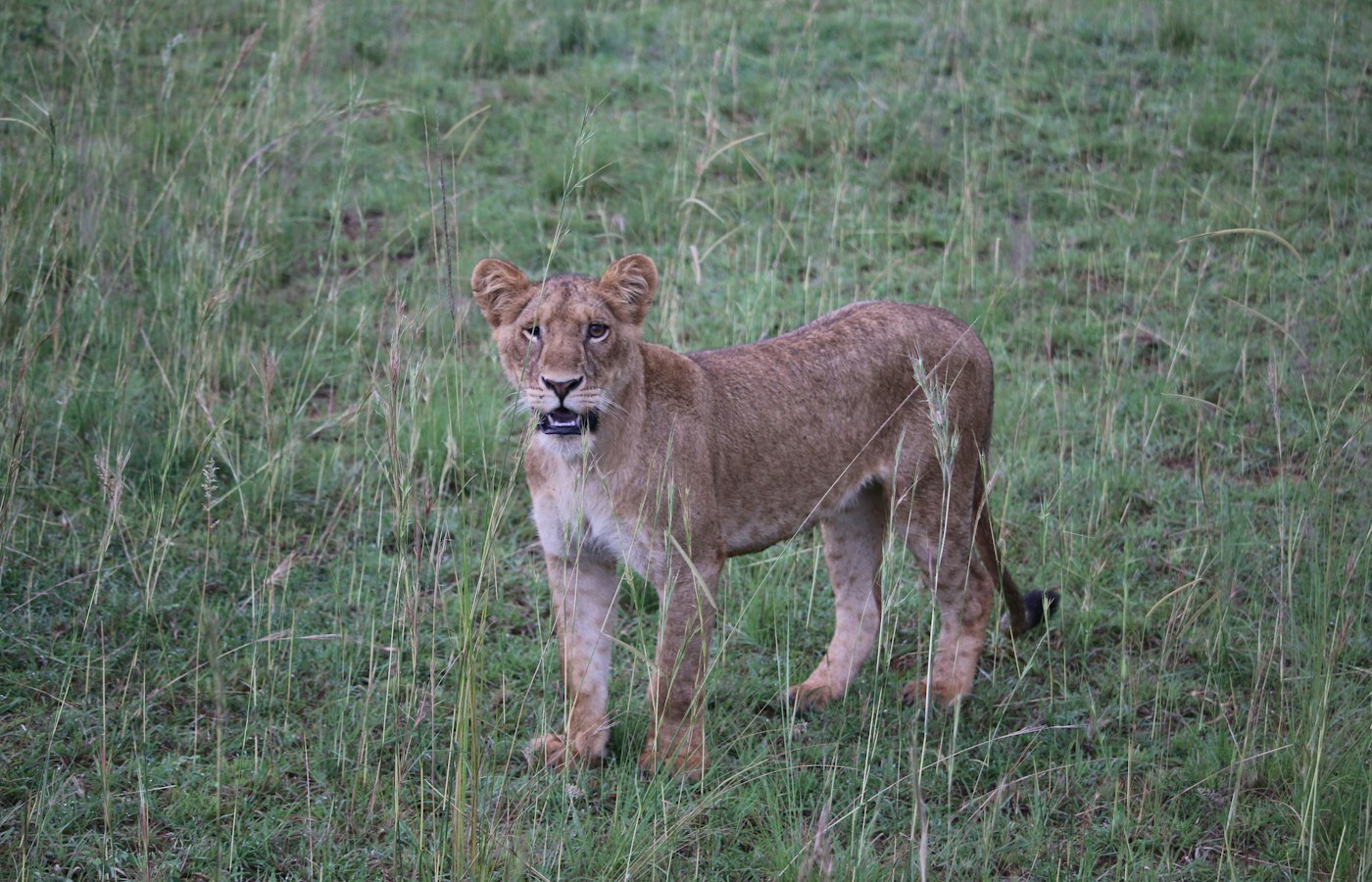
Outside the gorge, Kyambura is savanna grassland and deciduous thicket, and the animals in it are the Queen Elizabeth animals. Elephant, buffalo, lion, leopard, hippo and a run of antelope all move through the reserve, which is what a buffer zone is for. Giant forest hog turn up on the gorge slopes. Bushbuck are the antelope you are most likely to walk into on the trek itself.
Other primates come easily. Olive baboons work the rim in numbers, black and white colobus sit high in the gorge canopy, and red tailed monkeys and vervets are both common. On a slow chimpanzee trek the other primates are usually what saves the morning.
Game drive safaris in the reserve proper are a different proposition from the Kasenyi plains inside the national park. Access is on unsurfaced tracks that the wildlife authority itself describes as passable only in dry weather, and there is no developed drive circuit. In practice, most visitors do their game drives in Queen Elizabeth and treat the reserve as the place they come to walk. If you want to drive the reserve tracks, take a proper vehicle, go in a dry month, and set expectations accordingly. Sightings are not guaranteed anywhere, and they are less predictable here than on the park’s established circuits.
Birding Safaris in Kyambura and the Crater Lakes
Birding is the underrated half of the reserve and the reason it carries Important Bird Area status. Something over three hundred species have been recorded, with figures around 330 in circulation, and roughly a third of those are wetland birds. That is a function of the crater lakes rather than the gorge.
The lakes are the interesting part. Seven sit inside the reserve, three of them alkaline and four fresh. Nshenyi, Bagusa and Maseche are the saline ones, and they belong to the only cluster of alkaline lakes in Uganda. Chibwera, Kinera, Kararo and Kyamwiga hold fresh water. The salt lakes draw lesser flamingo, sometimes in the thousands and in exceptional years in far larger numbers, though the birds move between crater lakes across the whole area and no single lake holds them reliably.
In the gorge itself the target species are different. African finfoot works the river margins where the water runs quiet, which is exactly the sort of bird that rewards a slow walk and punishes a fast one. Blue headed bee eater is the other name birders come for. Falcons hunt the rim, and along the shorelines you get pelicans, storks, egrets and skimmers depending on water levels.
A birding safari here works best as a half day with a guide who knows the lake tracks, tacked onto a Queen Elizabeth stay. Going in cold and hoping to find the crater lakes on your own tends to produce a lot of driving and few birds.
Fig Tree Nature Walks and Other Kyambura Gorge Tours
Not everything at Kyambura requires a permit for the chimpanzees. The Fig Tree trail runs along the rim from the lodge area to the point where the gorge trek drops in, and it is a proper walk in its own right with views down into the canopy. Guided nature walks along the rim and partway into the forest run on the same two session timetable and cost far less than the trek.
Those walks are the sensible answer for anyone in the group who cannot manage the descent, and for children under the age limit. They are also the better option in heavy rain, when the gorge path turns into something closer to a slide.
The crater lake drive above the eastern wall is the other tour worth building in. It is a country of steep sided craters, some farmed to the waterline, some holding salt flats, and the road between them gives a view back across the rift that you do not get from the park floor. Local guiding around the lakes has grown alongside the lodge community work, so it is possible to walk sections of it with someone from a nearby village rather than only driving past.
Beyond the reserve boundary you are into the national park’s own list: the Kazinga Channel boat, the Kasenyi tracks for lion, and Ishasha to the south. Kyambura fits neatly into a day that also contains one of those.
Best Time to Visit Kyambura Wildlife Reserve for a Safari
Two rainy seasons run over this part of the rift, March through May and again September through November, with the heaviest falls in April and November. The drier windows are January to February and June through August. Rain along the Kazinga Channel is modest by Ugandan standards, around 750 mm a year, but the gorge forest catches more than the plain does and holds it longer.
| Months | Rain | Gorge path | Verdict |
|---|---|---|---|
| Jan to Feb | Low | Firm | Best |
| Mar to May | High | Slippery | Hard going |
| Jun to Aug | Low | Firm | Best |
| Sep to Nov | High | Slippery | Mixed |
| December | Falling | Drying | Good |
Read the wet months as a warning about the descent rather than about the wildlife. Chimpanzees are in the gorge year round and the forest is greener and louder in the rains. What changes is your footing on a 200 metre slope of wet clay and roots, and whether the reserve’s unsurfaced tracks are drivable at all. April and November are the two months to avoid if the trek is the whole reason you are coming.
Daytime temperatures sit around 28C on the plain and drop to about 18C overnight, which sounds pleasant and is, until you are climbing out of a humid gorge at midday. That is the argument for the morning session in any month.
Where to Stay for a Kyambura Gorge Safari
Kyambura Gorge Lodge sits on the rim above the forest and is the property most associated with the gorge. It is a small lodge of eight bandas built from local materials, with a pool looking out over the Queen Elizabeth plain and the Rwenzori beyond, and it is the base for the conservation and community work described earlier. Guests pay a community levy per night on top of the room rate, which funds that work. It is the upper end of the market and priced accordingly.
Below that, a scatter of mid range and budget places lies along the Kasese to Mbarara road near Katunguru and Kyambura village, including Fig Tree Camp and several small lodges and guesthouses within a short drive of the ranger post. They are simple and they put you at the briefing on time, which for an 8am session is the only thing that matters.
Plenty of visitors do not sleep near the gorge at all. Mweya, the main hub inside the national park, is about thirty kilometres away and holds the widest range of accommodation in the area. Staying there costs you an early start of an hour or so on the day of the trek. Given the timings, that is a reasonable trade for most people and a bad one for anyone who struggles with dawn departures.
Getting to Kyambura Wildlife Reserve for Your Safari Trip
Kyambura sits on the northeastern side of Queen Elizabeth, close to the Kasese to Mbarara road, and the turning for the ranger post is signed off it. From Kampala the southern route through Masaka and Mbarara runs around 400 kilometres and takes six to seven hours on tar. The northern route through Mubende and Fort Portal is a similar length and lands you in the Kibale area first, which suits anyone doing both chimpanzee treks.
From inside the park, Mweya to the gorge is about thirty kilometres of park road, allow an hour. From Fort Portal it is roughly two hours south. From Bwindi, coming up through Ishasha, most of a day.
Flying shortens it considerably. Scheduled and charter flights run from Entebbe and Kajjansi to Mweya and Kasese airstrips in about an hour, and both are within an easy transfer of the reserve. That is the option for travellers on a tight schedule who would rather spend the saved day in Bwindi or Kibale.
On routing, the sensible pattern is two nights in the Queen Elizabeth area with the gorge trek on the morning of the second day, the Kazinga Channel boat that afternoon, and Kasenyi at dawn. Trying to do the trek as a stop between two long drives is how people end up arriving at 9am for an 8am briefing and losing the permit.
Kyambura Safari Questions Travellers Ask Most
What does chimpanzee trekking in Kyambura Gorge cost?
The Kyambura permit is the cheapest chimpanzee permit the wildlife authority sells, at USD 100 for foreign non residents, USD 80 for foreign residents and UGX 50,000 for East African citizens. Some pages still carry USD 50 and USD 40 from an earlier tariff. From 1 January 2027 the rate doubles, to USD 200 for foreign non residents, USD 150 for foreign residents and USD 100 for the rest of Africa, so the date of your trek decides which figure applies. Confirm it with the authority or your operator before you budget.
Do you pay park entry on top of the trekking permit?
Yes, and it catches people out. Kyambura is administered within the Queen Elizabeth conservation area, so the standard park entry applies alongside the trek fee. That has been around USD 40 for foreign non residents, USD 30 for foreign residents and a nominal shilling rate for East African citizens, valid for 24 hours, with vehicles charged separately. If you are already staying inside the park on a valid entry ticket you are not paying it twice, which is another argument for treating the gorge as an add on rather than a day trip.
What does it cost to stay near Kyambura Gorge?
The rim lodge is a small luxury property at the top of the market, full board, with a community levy of about USD 50 per person per night on top of the room rate. Camps and guesthouses along the main road near Katunguru and Kyambura village run from budget to mid range and sit well below that. Mweya, half an hour away inside the park, covers everything from wildlife authority hostel beds to a full service safari lodge, and is where most itineraries put their nights.
How likely are you to see chimpanzees in Kyambura Gorge?
Less likely than at Kibale, and less likely than the marketing suggests. Operator pages quote figures near ninety percent; independent accounts and guides on the ground put it closer to fifty to seventy, better in the dry months. There is one small habituated community in a narrow strip of forest and no advance tracking team, so blank treks happen. Book it as a walk in a spectacular place that may include chimpanzees, and you will not be let down.
How fit do you need to be for the Kyambura gorge trek?
Moderately. The distance is short but the ground is not: a descent of roughly 200 metres, uneven footing, river crossings on logs, and a climb back out in humid air. Anyone who walks regularly will manage it. Bad knees will feel the descent and walking poles genuinely help. If someone in your group is not up for it, put them on the rim nature walk instead rather than starting the descent and turning back halfway.
What should you wear and carry on a Kyambura chimpanzee trek?
Boots with ankle support and real grip, long trousers tucked into your socks because safari ants are a genuine nuisance on the forest floor, a long sleeved shirt in muted colours and a light rain layer whatever the forecast says. Add insect repellent, at least a litre of water, a dry bag for the camera and a face mask, which rangers may require near the animals. Leave the tripod. In that terrain you will not use it.
Is there a minimum age for chimpanzee trekking in Kyambura?
Twelve is the standard minimum the wildlife authority applies to chimpanzee tracking, and it is the figure most operators quote for Kyambura, though a few sites say fifteen. Confirm it when you book if you are travelling with a teenager on the boundary. Younger children can do the rim walks, and the Kazinga Channel boat inside the national park is the activity most families end up building the day around instead.
Is Kyambura worth doing if you have already booked Kibale?
Yes, if your route passes through Queen Elizabeth anyway and you have a spare morning. The gorge is a completely different walk from Kibale’s flat forest, the drop from grassland into closed canopy is worth the ticket on its own, and the permit is a fraction of the Kibale price. What it is not is a second chance at the same thing. Treat it as a rift valley walk with good odds of primates and reasonable odds of chimpanzees.
Can you see anything in the reserve other than chimpanzees?
Plenty. Olive baboons, black and white colobus, red tailed monkeys and vervets are all regular, bushbuck and giant forest hog turn up on the slopes, and hippos live in the river at the bottom of the gorge. Above the eastern wall the crater lakes hold flamingo, pelicans and a long list of waterbirds, and the reserve’s overall bird list runs past three hundred species. Elephant, buffalo and lion move through the savanna sections from the national park, though the reserve tracks are rough and only drivable in dry weather.
Uganda Safaris works with Ugandan operators who run the Kyambura gorge trek honestly, which means booking the morning session, telling you what the odds are before you pay, and building the day so a slow trek does not cost you the Kazinga boat. The gorge turns up on short western routes such as the four day gorilla and wildlife safari through Bwindi and Queen Elizabeth.
It sits inside the longer circuits too, where a nine day route through Murchison Falls, Queen Elizabeth and Bwindi uses the gorge as its chimpanzee morning rather than driving to Kibale.
Check whether a quoted chimpanzee trek is Kyambura or Kibale before you compare prices, and ask an operator directly for help fitting the gorge into the rest of the trip. The full safari list is the place to start.
1 Place to Visit in This Area
Individual sites within reach of here, each with its own guide. Some are written up because the name circulates and the place does not, which is worth knowing before you plan a drive around one.
Safaris That Visit Kyambura Wildlife Reserve
Every safari listed here that visits Kyambura Wildlife Reserve. Each is sold and run by an independent Ugandan tour company. This site lists them and passes on enquiries; it takes no booking and charges you nothing.

4 Days Uganda Gorilla and Wildlife Safari
by Tranquil Safaris Verified operator

9 Days Uganda Safari Covering The Best Parks
by Insight Safari Holidays Verified operator