
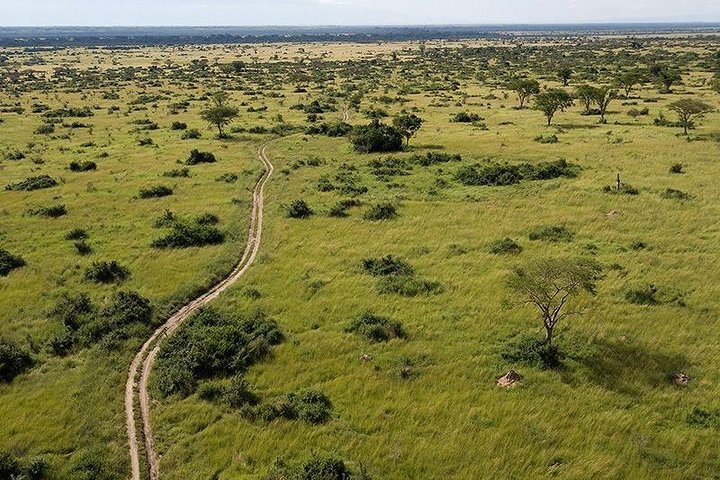
Kidepo Valley National Park is Uganda’s most remote savannah park and the only one where cheetah, caracal and greater kudu are on the list. Most Kidepo safaris are built around game drives in the Narus Valley, reached either by a long drive north or a two hour flight from Entebbe. The park lies in Karamoja, in the far northeast, hard against the South Sudan border.
Game Drive Safaris in the Narus Valley
Almost every Kidepo game drive safari happens in the Narus Valley, the broad grassland basin in the south of the park around Apoka. The reason is water. Narus holds the only permanent water in Kidepo through the long dry months, so animals that spread across the whole park in the rains pull back into this one valley, and game viewing becomes concentrated in a way it rarely is elsewhere in Uganda.
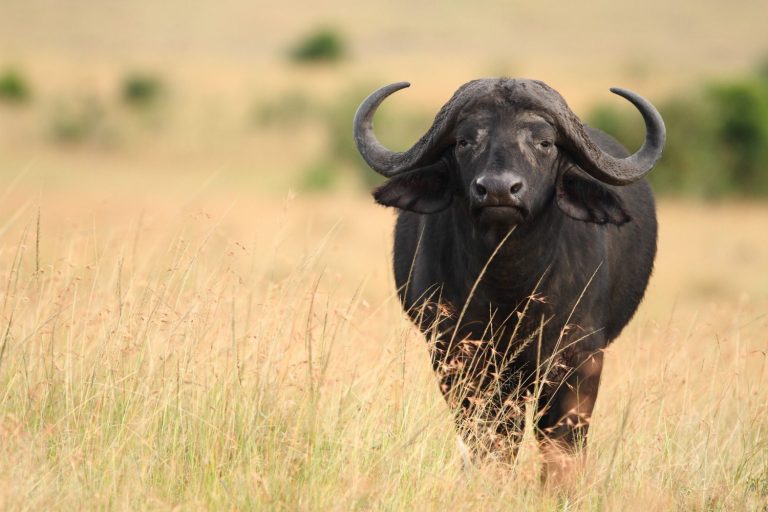
Two loop circuits run out from Apoka, each roughly twenty kilometres, and both take in the valley floor, the waterholes and the low ridges that let you look down over the whole basin. Buffalo are the headline. Kidepo’s herds run into the thousands and a single mass of them moving across open ground is the image most people take away. Elephants are back in real numbers after the poaching decades, giraffes have rebuilt from a handful of animals into a proper herd, and the lions here are relaxed with vehicles and often lying on the rock outcrops in plain sight.
What separates a drive here from one at Murchison or Queen Elizabeth is not the animals. It is that you will very likely be the only vehicle at the sighting. Visitors regularly report having the park practically to themselves, and people who have done thirty safaris across Africa put Kidepo near the top of their lists on that basis alone.
Two rules shape the driving day. The speed limit inside the park is 40 kilometres an hour, and there is no driving between roughly seven in the evening and seven in the morning, so a night drive has to be booked as a ranger led activity rather than done on your own. Plan the morning drive to leave at first light, because by ten the heat flattens everything and the animals go into shade.
Kidepo Valley Game Drives and the Kanangorok Hot Springs
The northern Kidepo Valley, which gives the park its name, is a different proposition and many visitors never see it. The Kidepo river that runs through it is seasonal, a wide bed of white sand for most of the year, fringed with borassus palms and running out toward the South Sudan border. Game is thinner here for most of the season because the water is gone, but the scenery is the best in the park and the drive out feels like leaving Uganda entirely.
At the far north end are the Kanangorok hot springs, a tepid spring that is the most permanent water source in the whole park and the reason the northern valley holds anything at all in the dry months. It is a long drive from Apoka on rough track, most of a day there and back, and it is worth doing on a three night stay rather than a two night one.
Take a ranger. This is border country, the tracks are poorly marked, and the rangers know which crossings are passable after rain. They also know where the game has moved to, which changes month to month in a way no guidebook can pin down.
The Predators and Antelope You See Only on a Kidepo Safari
The strongest argument for a Kidepo wildlife safari is the species list. Around 28 mammals recorded here occur in no other Ugandan national park, which is a function of Karamoja sitting in a dry Horn of Africa belt that the rest of the country does not touch.
The headline names are cheetah, caracal, aardwolf and bat eared fox. Be realistic about them. Cheetah are present and genuinely resident, and they are also seen a handful of times a season by a handful of people. Caracal and aardwolf are largely nocturnal and turn up on ranger led night drives more often than in daylight. Treat all four as a reason to come and none of them as a promise, and let your guide know at the briefing that you would rather work for them than tick the buffalo again.
The antelope are the easier prize and, for anyone who has done the rest of Uganda, the more novel one. Greater and lesser kudu both occur here and nowhere else in the country. So do Guenther’s dik dik, mountain reedbuck and klipspringer on the rocky ground. Add eland, Jackson’s hartebeest, oribi, Uganda kob and bushbuck and a good morning turns into a serious tally.
Kidepo also holds Uganda’s only wild ostriches, which stalk the open grass in the north of Narus and are far easier to find than any of the cats. Five primate species live here, including patas monkey, the fastest primate on the ground and a very different animal from the forest monkeys further south.
There is one addition the older guides to this park do not carry. Four southern white rhinos have been moved to Kidepo from the breeding herd at Ziwa, the first free ranging rhinos in the park since the last were seen in the Narus Valley in the early nineteen eighties. They are being held in a secured release area while they settle, so they are not yet something you look for on an ordinary game drive, and the wildlife authority has said more animals will follow.
Birding Safaris in Kidepo and the Namamukweny Valley
With 476 species recorded, Kidepo carries the second longest bird list of any Ugandan park, and a birding safari here delivers a set of dry country species that simply are not available elsewhere in the country. Around sixty of them have not been recorded in any other Ugandan park.
Raptors are the speciality. Something close to sixty birds of prey have been logged, and on a single morning drive you can work through several eagle species, harriers over the grass and vultures at anything the lions left. Ostrich, Abyssinian ground hornbill, Abyssinian roller and Clapperton’s francolin are the other names people come for.
The Namamukweny Valley in the northwest is the dedicated birding site, a sheltered pocket that draws species the open valley does not. It is quiet, shaded and reachable on a short drive plus a walk, and it is where a guide with a good ear earns their fee.
Migrant season runs roughly November through April and lifts the list toward five hundred. That overlaps neatly with the dry months, so a birding trip and a game viewing trip want the same weeks.
Mount Morungole Trekking and the Ik People
Mount Morungole trekking is the second reason people make this trip, and it is as much a cultural walk as a hike. The mountain rises to about 2,750 metres on the eastern edge of the park, and the climb runs eight hours or so there and back over steep, rough ground, with an armed ranger escort throughout.
At the top live the Ik, one of the smallest ethnic groups in Uganda at somewhere around ten thousand people, who hold the mountain sacred and farm and keep bees on its slopes. Their story is bound up with the park’s own: the Ik and the Ketebo were the original inhabitants of these valleys and were moved out when the reserve was created, which pushed them onto the high ground where they still are. That displacement was written up by anthropologists and is still cited as a case study in how not to create a protected area.
Visiting well takes some care. This is not a performance village, and the walk up is long enough that most groups arrive tired and short of time. Some operators arrange an overnight camp near the Ik homesteads instead, which changes the visit completely, and gives you the option of joining a night honey harvest. If you do the day version, go early, take your own water and food, and let the ranger set the pace on the descent.
Fitness matters here more than anywhere else in the park. If eight hours on steep ground in heat is not realistic, the Lomej and Lamoj hill walks below give you a version of the same views for a fraction of the effort.
Karamojong Cultural Tours and Manyatta Visits
The Karamojong are the pastoralist people of this whole region, cattle keepers whose lives run on herds, grazing and rain in a way that has more in common with the Maasai than with the rest of Uganda. A Karamojong cultural tour from Apoka takes you into a manyatta, the thorn fenced homestead compound, and the guiding is usually done by someone from the community.
What you get out of it depends entirely on how you go in. Ask about cattle: how many, whose, where they are grazing this month, what happens in a drought. Ask about the disarmament years and what changed. The beadwork and the dancing are real enough, but they are the surface, and the guides will go a lot deeper if you show you want them to.
Further south, Nakapelimoru near Kotido is often described as the largest village in East Africa, a sprawl of homesteads rather than a town, and it makes a substantial half day if you are driving the Karamoja route in or out rather than flying.
Agree the photography rules before you lift a camera. Payment expectations vary between communities and getting it wrong sours a visit fast.
Guided Nature Walks and Hill Hiking Tours
A guided nature walk in the Narus Valley runs about five kilometres and takes two to three hours, with an armed ranger, and it is the best value activity in the park. On foot you pick up the things a vehicle drives past: tracks in the dust, which trees the elephants have been working on, the smaller birds, the dung beetles. Buffalo and elephant are the reason for the rifle, and the rangers are careful about wind and distance.
The Lomej hills walk is a shorter climb to a viewpoint over the whole Narus basin and is the one to do on your first afternoon, because it teaches you the geography of the park before you drive it. The Lamoj mountains near the park headquarters offer a similar half day with waterfalls after rain.
Start early whatever you choose. By late morning the open valley is punishing, and rangers will often decline to walk in the middle of the day in the hot months, which is the right call.
Best Time to Visit Kidepo for a Safari
Kidepo has one long dry season and one long wet one, which makes the timing decision cleaner here than in most of Uganda. The dry months run September through March, the rains fall April through August, and the two produce genuinely different parks.
The dry season is the game viewing season. Water disappears from everywhere except Narus, the grass burns off and drops, and the animals come to you. It is also hot: afternoons average around 29C and can push to 40C, with nights down near 17C.
Read that as a straight trade. If you are coming this far for the animals, come between December and March and accept the heat. If you are coming for the country, the culture and the birds, the wet months give you a greener park and better light, and you should build the trip around Morungole and the Karamojong rather than around game drives.
The practical consequence of the rains is the drive rather than the park itself. The last stretch of road in is unsealed, and after a heavy night it is the section that decides whether you arrive on schedule.
Where to Stay on a Kidepo Safari
There are very few beds in Kidepo, which is part of why it stays empty and also why you book early. Apoka Safari Lodge sits on a rock ridge above the Narus Valley inside the park, with a handful of open fronted rooms and a pool cut into the rock. It is the only genuinely high end option and it prices accordingly.
Apoka Rest Camp, run by the Uganda Wildlife Authority, is a few minutes away and is the opposite end of the scale: simple self contained chalets and cheaper bandas, canteen food, and the same view of the same valley. For a lot of travellers it is the smart choice, because the money you save on four nights here pays for the flight in.
Between them, Nga’Moru Wilderness Camp has a handful of bandas and tents on a ridge outside the southern gate looking across to the Narus Valley, and Kidepo Savannah Lodge sits close to the same gate with bandas and safari tents. Adere Safari Lodge and Buffalo Base fill out the mid range.
One planning note that saves grief. Lodges outside the gate mean a gate transit at the start and end of every drive, and the gate opens with the park rather than before it. If you want to be in Narus at first light, that argues for staying inside.
Flying In or Driving to Kidepo, and Which Suits Your Trip
This is the decision that makes or breaks a Kidepo trip, and the ranking guides list both options without ever telling you how to choose.
By road, the shortest route runs Kampala to Karuma, Gulu, Kitgum and into the park at Lokumoit gate, around 570 kilometres and about ten hours of driving. It is tarmac as far as Kitgum and then murram for the last stretch, which is the part that slows you down and the part that suffers in the rains. The eastern route through Mbale, Moroto, Kotido and Kaabong runs 740 kilometres or more and takes twelve to thirteen hours, but tarmac now reaches Kotido and Kaabong, and it takes you through Karamoja proper rather than around it.
Nobody sensible drives it in one day. The standard is to break at Gulu or Kitgum, or to build in a night at Murchison Falls or the rhino stop at Ziwa on the way up, which turns dead driving into a second destination. If you are self driving, fill the tank in Gulu or Kitgum and carry a jerrycan, because fuel north of there is unreliable, and take a proper 4×4 rather than a soft roader.
Flying takes about two hours and fifteen minutes from Entebbe to the airstrip at Lomej, three kilometres from the park headquarters. What has changed, and what most pages still get wrong, is that this is no longer a firm daily scheduled route. Services run on set days with a minimum number of passengers to confirm the flight, the operators differ on which days and what that minimum is, and charters can be arranged from Kajjansi and from Entebbe. It still works. It just needs confirming rather than assuming, and your itinerary has to bend to the flight days rather than the other way round.
There is a bigger change coming. Construction has started on a full international airport at Lomej, next to the existing strip, a 3,600 metre runway built under an agreement between the Ugandan government and the Sharjah Chamber of Commerce, with more than a thousand local people employed on it and twelve kilometres of access road in the scope. Whatever it eventually means for visitor numbers, the park you can visit now is the empty one.
Is Kidepo Safe, and How Empty Is It Really
Karamoja carried a reputation for insecurity for decades, built on cattle raiding between armed pastoralist groups across the Uganda, Kenya and South Sudan borders. That is the history behind the question, and it deserves a straight answer rather than a brochure one.
The disarmament campaigns of recent years changed the picture substantially, and the region is now stable enough that the government is putting an airport in it and investors are putting factories in it. Tourists travel the Gulu and Kitgum route and the Moroto route routinely. Raiding has not vanished from the wider borderlands and drought pressure still drives disputes over grazing, but it is a rural and largely local problem rather than something aimed at visitors, and it does not touch the park.
Inside Kidepo the practical rules are the ones that apply in any big game park with predators. Walk only with an armed ranger. Do not drive after dark. Keep your distance from buffalo, which injure more people in Africa than lions do.
As for emptiness, the numbers are the proof. Kidepo takes a few thousand visitors in a year, against hundreds of thousands through Uganda’s western parks. On an ordinary morning drive in Narus you may not pass another vehicle at all.
Kidepo Valley National Park Background and the Karamoja Circuit
The park covers 1,442 square kilometres, making it Uganda’s third largest, on valley floors sitting roughly 900 to 1,200 metres above sea level with Morungole rising well above them. Rainfall splits between the valleys: Narus takes close to 890 millimetres a year while the northern Kidepo Valley gets nearer 640, which is the whole reason the game moves between them.
It was gazetted as a game reserve under the colonial administration in 1958 and made a national park in 1962, in the first months of independence. That second step is what displaced the Ik and the Ketebo from the valleys, and the consequences of it are still visible on Morungole today.
Kidepo does not have to be a single destination. The Karamoja circuit strings it together with the Matheniko, Bokora and Pian Upe reserves to the south, which are far less visited again and hold their own dry country species, and the drive through Moroto and Kotido is a real trip in its own right rather than a transfer.
Set against Uganda’s other savannah parks, the trade is clear enough. Murchison Falls and Queen Elizabeth are easier to reach, cheaper to combine with gorillas and chimpanzees, and busier. Kidepo asks for two more days and gives you a species list neither of them can match and a park with nobody in it. If it is your only Ugandan safari and time is short, go west. If it is your second Uganda trip, or if empty country matters more to you than convenience, this is the one.
Kidepo Safari FAQs
What does a Kidepo Valley National Park safari cost in park fees?
Park entrance is USD 40 for foreign non residents, USD 30 for foreign residents and UGX 20,000 for East African citizens, with children charged at USD 20, USD 10 and UGX 5,000. A ticket is valid for twenty four hours from entry. Activities are charged on top and are modest by Ugandan standards, since there are no permits here. A guided day game drive is USD 20 for the ranger guide, a night game drive is USD 30 per person, and bird watching and nature walks are USD 25 and USD 20 for foreign non residents and residents. Driving yourself without a guide is USD 10. The Lomej hike is USD 40 and the Lonyili summit hike USD 50. There are also pick up fees if a ranger has to collect you, at UGX 50,000 from the airstrip and UGX 100,000 from Karenga. Flights, when they are running, sit at roughly USD 420 one way and USD 700 return, and that pair of figures comes from operators rather than from the wildlife authority. None of the Kidepo fees above appear on the authority’s 2026-2027 tariff change letter, which raises primate permits and lion tracking elsewhere in the country from 1 January 2027 but leaves this park alone. Confirm flight prices with the operator before you budget.
What will accommodation cost?
The range here is unusually wide. The one high end lodge inside the park runs into the hundreds of dollars per person per night on a full board basis and reaches close to USD 700 in peak months. Mid range camps and lodges near the southern gate sit broadly between USD 110 and USD 300 per person. The Uganda Wildlife Authority rest camp at Apoka is the cheap option by a distance, with self contained chalets and simple bandas costing a small fraction of that, which is why many independent travellers use it and put the saving into flights.
How many nights do I need at Kidepo?
Three or four, and this is the single most common mistake people make. One night is not worth the travel by any measure. Two nights gives you the Narus Valley and one activity. Three gives you Narus, a cultural visit and the northern valley or Morungole. Four lets you do the hot springs run without cutting anything else. If you can only spare two nights, fly rather than drive.
Is it safe to visit Kidepo and the Karamoja region?
Yes, on current conditions. The disarmament programmes of the past two decades changed Karamoja substantially and the tourist routes through Gulu, Kitgum, Moroto and Kaabong are used routinely. Cattle raiding has not disappeared from the wider borderlands, so check current advice before a self drive through remote Karamoja, but the park itself and the standard routes in are not a security concern. Inside the park, the risks are wildlife ones: never walk without an armed ranger and do not drive between dusk and dawn.
Will I actually see cheetah?
Probably not, and any operator who guarantees it is selling you something. Cheetah are resident in Kidepo and this is the only Ugandan park where that is true, but they are seen a handful of times a season. Caracal, aardwolf and bat eared fox are largely nocturnal and show up more often on ranger led night drives than in daylight. What you can reasonably expect is lion, very large buffalo herds, elephant, giraffe, zebra, ostrich, and antelope species you will not see anywhere else in the country.
Can I drive myself around Kidepo?
Yes, and there is a reduced fee for doing it without a guide, but think it through. The tracks are poorly signed, the park is large, and a ranger knows where the game moved to this week, which is most of the value. You need a proper high clearance 4×4 rather than a soft roader, and you should fill up in Gulu or Kitgum and carry spare fuel, because supply north of there is unreliable. Most self drivers take a ranger for at least the first morning and then go alone once they know the circuits.
How hard is the Mount Morungole hike?
Harder than most visitors expect. Around eight hours there and back on steep, rocky, unshaded ground, in heat, with an armed ranger. It is a genuine hill day rather than a walk, and it is the one activity here with a real fitness requirement. If that is not realistic, the Lomej and Lamoj walks give you comparable views over the Narus basin in a couple of hours.
What should I pack for Kidepo?
Sun protection above everything, because the valley is open and the afternoons are punishing. Neutral coloured long sleeves and long trousers for the walks, closed boots for Morungole, a fleece for early mornings, and far more water than you think. Dust gets into everything on the drive in, so bag your camera gear. Bring binoculars, since a lot of the good sightings here are at range across open grass. If you are driving up, bring your own snacks and drinks for the road: there is very little between Kitgum and the gate.
Uganda Safaris works with licensed Ugandan operators who run Kidepo regularly and know which flights are actually confirmed, which route is passable this month, and which lodges have beds. The shortest of them is a three day Kidepo wildlife safari that takes in Karamoja on the way.
Couples looking at the park on its own usually end up on the four day Uganda honeymoon safari, which pairs Entebbe with Kidepo and adds nothing else.
Tell an operator how many nights you have and whether you want to drive up or fly, and you will get routings back that are honest about the trade off, including the one that says wait for a better month.
Safaris That Visit Kidepo Valley National Park
Every safari listed here that visits Kidepo Valley National Park. Each is sold and run by an independent Ugandan tour company. This site lists them and passes on enquiries; it takes no booking and charges you nothing.

3 Days Kidepo Wildlife Safari
by Tranquil Safaris Verified operator


4 Days Uganda Honeymoon Safari
by Oree Safaris Verified operator