
Traditional Music and Dance Tours in Uganda: Where to Go
Ugandan traditional music and dance: the Ndere Centre shows in Kampala, regional dance forms, the instruments to listen for, village performances and drumming lessons.
Traditional music and dance in Uganda reaches visitors in three forms: a ticketed evening at a Kampala performance centre, a village performance arranged through a community association, and a lesson where somebody hands you a drum. Bakisimba from Buganda, Ekitaguriro from Ankole, Larakaraka from Acholi and the Karimojong jumping dances are different traditions, not one show, and the instruments are the part most visitors miss.
Safaris That Include Music and Dance

Music and Dance Guide in Uganda
What a Traditional Music and Dance Experience in Uganda Covers
A traditional music and dance experience in Uganda runs in three forms: a ticketed evening at a performance centre in Kampala, a village performance arranged through a community association, and a lesson where somebody puts a drum between your knees and makes you keep time. All three exist, and they are worth very different amounts of your evening.
Uganda has more distinct dance traditions than most visitors expect, because it has more distinct peoples than most visitors expect. What gets sold as one show is usually a tour through six or seven regional forms in an hour and a half.
Ndere Centre Performances: the Anchor of Any Kampala Tour
The Ndere Centre at Ntinda in Kampala is the one fixed point. A resident troupe of professional performers runs three shows a week, on Wednesday, Friday and Sunday evenings, and each runs about three hours with food available alongside. The repertoire spans dozens of dances from across the country, played on live instruments rather than to a backing track.
It is a large venue and it fills, particularly on Fridays, so a reservation matters. Sunday starts earlier than the other two, which suits anyone flying out the next morning. The founder built the troupe up from the mid nineteen eighties, long before the centre itself existed, and the house style of introducing each dance with an explanation comes from that period of touring schools.
The one honest caveat: it is a show. The dances are real, the musicianship is high, and it is still a stage production with lighting and a running order. Treat it as the introduction rather than the authentic article, then go and find the village version.
Dances by Region: What You Are Actually Watching
Instruments Worth Watching For on a Music Tour
The drum is the obvious one and it is not the interesting one. Look for the adungu, the arched harp from West Nile, which carries melody in a way that surprises people expecting percussion. The endingidi, a single string tube fiddle, does the same job in the centre and west.
Village Performances on a Community Tour
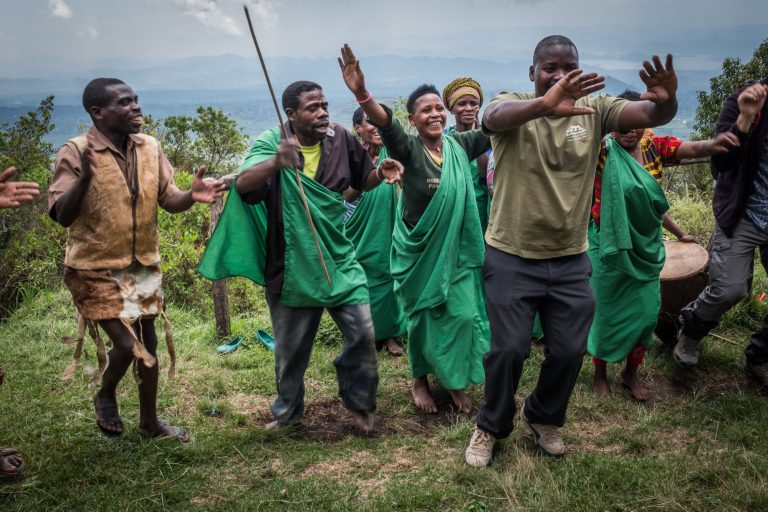
Almost every community tourism project in the country has a music and dance group, and in many of them it is the women's group with a second job. At Bigodi beside Kibale, at Buhoma and Nkuringo around Bwindi, on Lake Bunyonyi, and with Batwa groups at Mgahinga, performance is part of what the association sells.
These are shorter, rougher and much closer to how the music is actually used. Children join in. Somebody's phone rings. The drummer is the man who guided your walk that morning. Our community tourism guide covers how those associations work, and the Batwa experience guide covers the singing in Garama Cave.
Two Traditions at Risk, and Where to Hear Them on a Trip
Bigwala is a set of five or more gourd trumpets blown in hocket, each playing one note, so the melody only exists between the players. It belongs to Busoga royal occasions and it nearly died out; it sits on the UNESCO list of traditions needing urgent safeguarding, with a small number of surviving players and a revival programme training younger ones.
Ma'di bowl lyre music and dance, from the north near the South Sudan border, is on the same urgent list. Neither is something you stumble across. Both are worth asking your operator about if you are in Busoga or the north, because the answer tells you how well connected they really are.
Learning to Drum and Dance: Lessons as Part of the Experience
Etiquette, Payment and Judging a Cultural Night on Tour
The lodge cultural night is the version that most needs a question asked of it. A group is brought in, dances for forty minutes, and is paid something the guests never learn. Sometimes that is a fair fee to a working troupe. Sometimes it is a school group given transport money.
Ask the lodge what the group is paid and whether it is the same group each week. Clap, do not film continuously, join in when you are pulled up because refusing is worse than dancing badly, and buy a CD or a recording if one is offered. Tips go to the group leader in front of everyone, never to the best looking dancer.
Frequently Asked Questions About Uganda Music and Dance Tours
How much does a Ndere Centre show cost? Entry is around USD 30 for international visitors and UGX 55,000 for Ugandan nationals, with a lower rate for children and dinner charged on top at around UGX 60,000. Village performances are usually quoted as a group fee through the association rather than per head, and a lesson is priced by the hour. Confirm current rates when you reserve, since these are set by the venue rather than by any tariff.
Which night should I go to Ndere? Friday draws the biggest crowd and the fullest programme; Sunday starts earlier and is the family show; Wednesday is the quietest and the easiest to get a good seat at on short notice.
Can I photograph or film the performance? Photography is fine at the Kampala venues. In a village, ask first, and put the phone down for at least part of it. Filming a whole set and posting it is how performers end up watching themselves used as somebody's content.
Is it suitable for children? Yes, and the Sunday show at Ndere is built around that. Village performances usually turn into children dancing with children within ten minutes.
Where can I hear music that is not a tourist performance? Kampala has a live scene across bars and the national theatre, and church choirs across the country are superb and free to walk into. Festivals are the other route, and our festival guide covers what recurs and when.
Do I need to arrange this in advance? For Ndere on a Friday, yes. For a village performance, give the association a day's notice so the group can be assembled; people have fields to be in.
Music and dance evenings are arranged by independent Ugandan operators, by the venues themselves and by village associations. Write to an operator, say whether you want the Kampala show, a village performance or a lesson, and ask what the performers are paid. We take no booking and charge you nothing.