
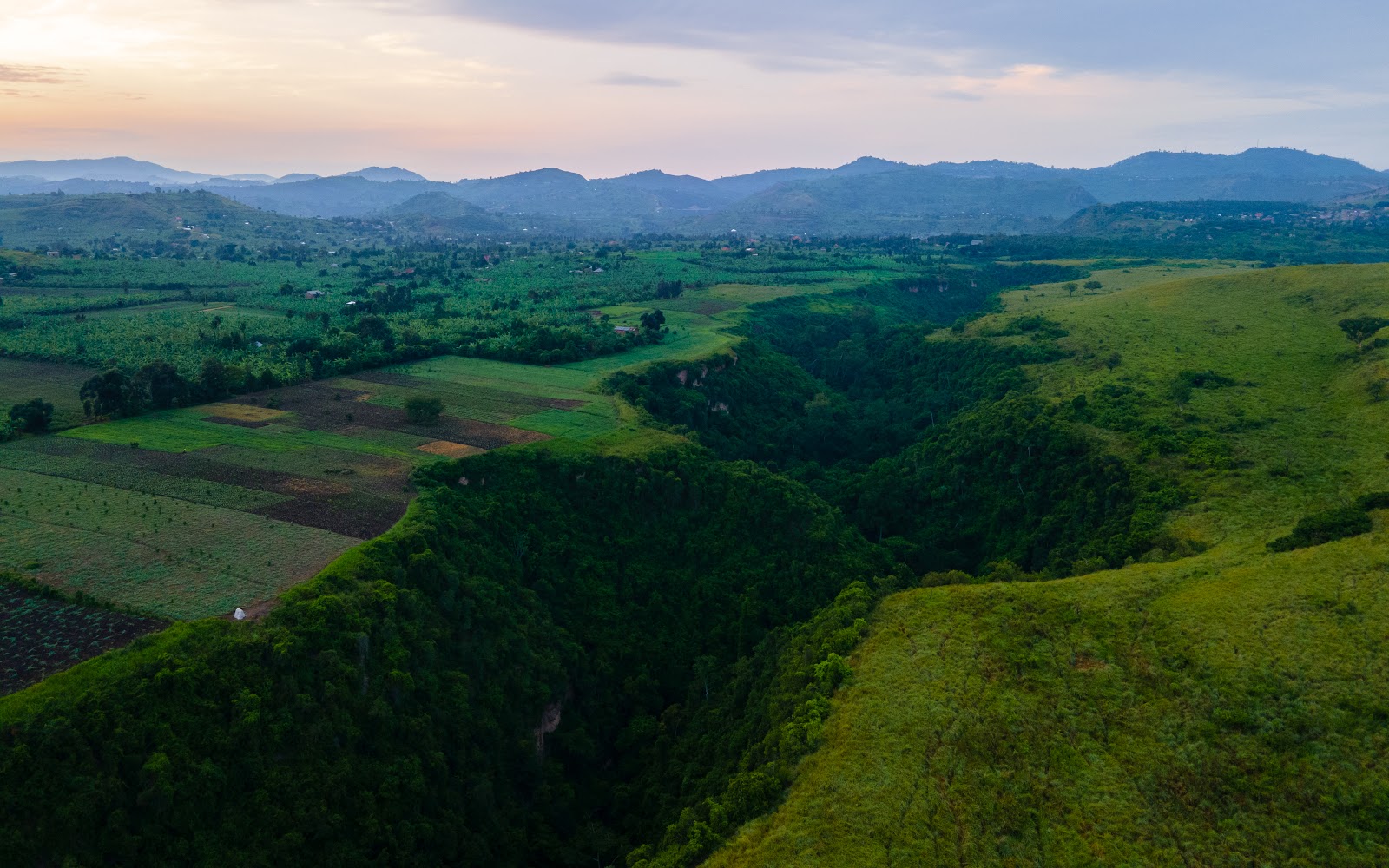
Kigezi Wildlife Reserve has no visitor gate, no trail system and no camp, so a Kigezi safari in practice means a game drive through the Ishasha sector of Queen Elizabeth National Park that the reserve buffers. Trips here are booked as Ishasha or Bwindi legs rather than as visits to the reserve. Kigezi covers savanna and forest in Rukungiri and Kanungu districts, southwestern Uganda.
What Kigezi Wildlife Reserve Is and Why It Has No Safari Product
Most pages about this reserve list game viewing, nature walks and birding as its activities. The wildlife authority’s own management plan for the protected area is blunter. It records that there is no tourism activity going on in the reserve. That was written by the agency that runs the place, in the document that governs how it is run, and nothing on the ground appears to have changed it since.
So begin from what Kigezi actually is: a strip of protected land created in 1952 out of the old Lake Edward Game Reserve, from the portions that were not folded into what became Queen Elizabeth National Park. The Game Department kept it to give the southern edge of the park a cushion. When Uganda’s wildlife statute renamed every game reserve in 1996, it became Kigezi Wildlife Reserve, and its job stayed the same.
Even the size is unsettled. The wildlife authority’s website gives 265 square kilometres, and almost every travel page repeats that figure. The authority’s own management plan for the wider protected area gives 330. Both are official. Nobody has reconciled them publicly, and a reader is better served by knowing that than by being handed one number with false confidence.
The ground sits at roughly 1,050 metres in the western arm of the rift valley, a mosaic of moist deciduous forest and grass savanna with acacia and albizia among the trees and imperata, cymbopogon, hyparrhenia and beckeropsis among the grasses. It is not a scenic set piece. It reads as ordinary country, and its value is functional rather than visual.
One change is coming. Cabinet has approved elevating Kigezi to national park status alongside Kyambura, Katonga, Echuya and Toro Semliki, and the proposal now waits on Parliament. If it goes through it would raise the entrance band and, in principle, bring investment. It would not conjure a road network overnight.
How Kigezi Wildlife Reserve Works Alongside Ishasha Safaris in Queen Elizabeth
The reserve wraps the southern and eastern flank of the national park’s Ishasha sector, and one strip of park about seven kilometres wide separates it from Lake Edward. Practically, that means the animals you see on an Ishasha game drive are the same animals that use Kigezi. There is no fence and no meaningful ecological line between the two.
What Ishasha has that Kigezi does not is a track network, rangers on shift, a gate, campsites and lodges. It also has the tree climbing lions, the reason most people book the sector at all, usually seen draped in fig trees through the middle of the day. Sightings are not guaranteed on any given drive, and lion numbers across this landscape have been falling, so treat a sighting as good luck rather than an itinerary item.
Where the reserve does earn its place on a trip is the transit. The road south from Ishasha toward Kihihi and on to Bwindi runs along and through this country, and it is the drive rather than a destination that puts you in it. Elephant and buffalo cross that road. Kob and topi graze beside it. On the right morning it is a better game drive than some paid ones, and it costs you nothing but the time to go slowly.
| What | Kigezi | Ishasha |
|---|---|---|
| Status | Reserve | Park sector |
| Tracks | None | Yes |
| Gate | No | Yes |
| Lodges | None | Several |
| Entry fee | Low band | Park rate |
Wildlife You Might See on the Kigezi Side of an Ishasha Safari
When the reserve was created it held large numbers of buffalo, topi and elephant. Poaching through the 1970s and 1980s took that apart, and illegal settlement and cultivation later swallowed roughly a hundred square kilometres along the eastern margin. What survives is a thinner version of the same community.
On the savanna sections you can expect topi, Uganda kob, buffalo, waterbuck, bushbuck, oribi and warthog, with hippo in the wetter ground and giant forest hog where the grass runs into forest. Lion and leopard both occur and both are scarce. In the riverine forest and the forest blocks there are chimpanzees, olive baboon, vervet, black and white colobus and red colobus.
The honest framing is that Kigezi is a reservoir rather than a viewing area. Animals spill into it from the park, use it, and move back. Nobody is counting them separately in a way that gets published, and there is no vehicle track from which to look for them. Anything you see, you will see from a public road or from inside the national park.
Elephant Movement Through the Kigezi Corridor on a Greater Virunga Safari
The elephant story is the one genuinely notable thing about this piece of country, and the travel pages get it half right. They say elephants roam in from the Rwindi plains in the Congo, which is true in outline and worth spelling out properly.
Queen Elizabeth and Virunga National Park in the Democratic Republic of Congo sit on opposite shores of Lake Edward and together enclose it. Elephants have long moved between the two, and the Ishasha country is now widely described as the last functioning route they use to do it. Rangers have recorded well over five hundred animals crossing in a single movement back toward the Congo side, and the population inside Queen Elizabeth has grown across recent national counts to just under four thousand. The Ishasha area itself supports a few hundred that shift back and forth.
Kigezi Wildlife Reserve is a piece of that corridor. It is one of the reasons the crossing still works, and every hectare of it that gets settled makes the route narrower. That is unglamorous conservation, and it is the actual argument for the reserve existing.
Timing matters if elephants are your interest. Several sources suggest the movement concentrates around the rains, roughly October into November and again in March and April. Treat that as a tendency rather than a timetable. Elephant movement here responds to water, grass and, on the Congo side, to security, and none of those runs on a calendar.
South Maramagambo Forest and the Chimpanzee Tracking That Never Arrived
Inside the reserve, on its northern side, lies South Maramagambo, a semi evergreen forest of roughly 152 square kilometres run jointly by the wildlife authority and the national forestry authority. It is the same forest system as the better known Maramagambo blocks further north, and it holds chimpanzees, colobus and a forest bird community quite different from the plains outside.
Here is the part nobody writes about. The management plan for the protected area proposed habituating one chimpanzee group in Kigezi to take pressure off the Kyambura gorge trek, opening tracking trails, developing birdwatching as a product and building a twenty bed tented camp at Bwentale to house the visitors. The camp went out to public tender. As far as any current source shows, none of it was built, no group was habituated, and no trails exist.
So if you read that you can track chimpanzees at Kigezi, you are reading a plan, not an offer. Chimpanzees live here. There is no habituated community, no permit and no guide. For chimpanzee tracking on this circuit the options are Kyambura gorge inside Queen Elizabeth, or Kalinzu forest on the road east, and Kibale further north for the full experience.
The forest has a more immediate problem than missing tourists. Illegal pit sawing runs through it, cutting the habitat that the chimpanzees, elephants, buffalo and colobus depend on, and pressure rose sharply during the pandemic years when timber, poles, firewood and charcoal became the fallback income for everyone nearby.
Birding Safaris Around Kigezi and the Ishasha Plains
Birding is the activity that works best here, because it does not need a vehicle track. You can bird the roadsides, the forest edge and the Ishasha and Ntungwe river lines from inside the national park, and the list you build will be the reserve’s list in all but name.
The bird community splits neatly. Open plains give you the savanna set: bee eaters, rollers, hornbills, starlings, weavers, grey crowned crane on damp ground, and raptors including martial eagle and bateleur working the thermals over the flats. Along water you get herons, storks including saddle billed stork, and fish eagle. The forest sections change everything, with the Maramagambo forest community running to nearly two hundred species in its own right.
You will see totals of two hundred and three hundred species quoted for Kigezi. Neither appears to come from a survey of the reserve. The defensible statement is that the birdlife here is comparable to the neighbouring national park’s, which is a genuinely strong claim, since Queen Elizabeth has one of the longest bird lists of any protected area in Africa.
Be sceptical about some species lists. Rwenzori turaco turns up on at least one page about Kigezi. That is a montane forest bird from a mountain range far to the north and it does not belong here.
Crop Raiding and Community Tours on the Kigezi Boundary
The land immediately outside the reserve is densely farmed, and the friction between farms and wildlife is the defining fact of daily life along this boundary. Elephants, buffalo and bushpigs come out of the protected area at night and go through crops. That is what a buffer reserve is for, and it is also why the buffer keeps getting eaten into from the farm side.
A trench was dug along part of the Ishasha boundary to hold elephants back, roughly two metres wide and two metres deep, funded through a community uplift project. It works where it is maintained and fails where it is not, and residents in some of the villages along it say plainly that it has made little difference to them. Elephants find the collapsed sections. Buffalo and bushpig barely notice it. Keeping a trench like that in working order is constant, unpaid, unglamorous labour.
Community tours run on the farmland side near Kihihi and are the one bookable thing in this area that is not a park activity. They are modest: a walk around a homestead, the crops, the trench, sometimes a craft group or a beekeeping project. What makes them worth an hour is that they put the conservation argument in front of you from the side that pays for it.
Book them through your lodge or driver rather than turning up. Agree what you are paying before you start, and ask before photographing anybody.
Where to Stay for a Kigezi and Ishasha Safari
There is nothing inside Kigezi Wildlife Reserve. No camp, no banda, no campsite. The twenty bed tented camp at Bwentale exists only in the management plan and a tender notice.
The sensible base is the Ishasha sector itself, where the national park runs campsites and where several lodges of varying price sit along the Ntungwe river and just outside the boundary near Kihihi. Those put you inside the wildlife on both sides of the road and within an easy morning of the tree climbing lion territory.
Rukungiri town is the other option that gets listed, with ordinary hotels and guesthouses. It is a long way back from the interesting country and only makes sense if you are approaching from the Mbarara direction and need a night on the road. Kihihi is closer and has basic accommodation.
Most people never sleep near here deliberately. They stop for a night on the way between Queen Elizabeth and Bwindi, which is exactly the right way to treat it.
Best Time for a Safari Through the Kigezi and Ishasha Country
Two wet seasons, roughly March to May and September into November, with drier windows from June to August and December to February. That is the southwestern pattern and Kigezi follows it.
| Period | Rain | Tracks | Game |
|---|---|---|---|
| Dec to Feb | Low | Firm | Good |
| Mar to May | Heavy | Poor | Scattered |
| Jun to Aug | Low | Best | Best |
| Sep to Nov | Heavy | Poor | Scattered |
The row that matters most is the tracks column, and the reason is soil. Ishasha sits on black cotton soil, which is firm and easy when dry and turns into deep sticky mud that holds a vehicle when it is not. Drivers who know the sector will refuse certain loops after rain, and they are right to. If you are travelling in April or October, expect the game drive to be shortened rather than cancelled, and do not plan a tight onward transfer that afternoon.
In the dry months the grass is shorter, the animals gather near the rivers and the lions are easier to find in the fig trees. The trade off is that this is when the elephants are least likely to be moving through in numbers, if that is what you came for. You cannot have both, and for most people the dry season is the better bet.
Getting to Kigezi Wildlife Reserve on a Southern Circuit Safari
Two roads reach this country. From the north, the Katunguru to Ishasha road runs down the length of Queen Elizabeth from the main Kasese highway, which is how most people arrive because they are already in the park. From the southeast, the route runs Kampala to Masaka to Mbarara to Ntungamo to Rukungiri and then on to Kihihi, roughly 320 kilometres from the capital and a long day’s drive.
A public road also crosses the reserve on its way toward Kabale, giving access to Kayonza forest. You will drive through protected land without a barrier or a ticket, which is one more sign of how this reserve is set up.
Flying in is possible. Kihihi has an airstrip served by the scheduled light aircraft routes that carry gorilla trekkers, and it is the closest strip to Ishasha, not Kisoro as one widely copied page claims. From the strip it is a short transfer to the sector.
Most itineraries put this stretch between Queen Elizabeth and Bwindi, which turns three to five hours of transfer into a game drive. Take the slow option. Leave early, keep the windows down, and treat the road itself as the activity, because on this particular corner of Uganda it genuinely is.
Kigezi Wildlife Reserve Safari Questions Answered
What does it cost to enter Kigezi Wildlife Reserve?
Kigezi sits in the wildlife authority’s lowest entrance band, which covers most of the country’s smaller reserves, at 10 USD for foreign non residents and 5 USD for foreign residents and visitors from the rest of Africa, with East African citizens paying a modest local currency rate. In practice you are unlikely to pay it, because there is no staffed entrance. What you will pay is the Ishasha sector entry, which is the standard Queen Elizabeth park rate of 40 USD for foreign non residents, 30 USD for foreign residents and 25 USD for the rest of Africa, valid twenty four hours, with children charged at half or less and under fives free. Guided game drives with a ranger, boat trips elsewhere in the park and vehicle entry are charged on top. Rates are reviewed periodically, so confirm the current tariff when you book.
Can you actually visit Kigezi Wildlife Reserve?
You can drive through it on public roads and you can look into it from the national park, but you cannot visit it the way you visit a park. There is no entrance, no trail network, no guide service and no accommodation, and the wildlife authority’s own plan for the area states there is no tourism activity in the reserve. Anyone selling you a Kigezi day trip is selling you an Ishasha game drive with a different name on it, which is fine as long as you know that is what you bought.
Is Kigezi Wildlife Reserve the same thing as the Ishasha sector?
No, though they are neighbours and share their wildlife. Ishasha is part of Queen Elizabeth National Park, with tracks, gates, rangers and lodges, and it is where the tree climbing lions are. Kigezi is a separate protected area with its own legal status, created earlier, that wraps around Ishasha’s southern and eastern side as a buffer. The two are managed together as one protected area, which is why the names get muddled.
Can you track chimpanzees at Kigezi?
Not at present. Chimpanzees live in the South Maramagambo forest inside the reserve, and the management plan proposed habituating a group and opening tracking trails there. Nothing shows that it happened. For chimpanzee tracking on this circuit, Kyambura gorge inside Queen Elizabeth runs two sessions a day, Kalinzu forest sits on the road east toward Bushenyi, and Kibale further north is the destination if the primates are the point of the trip.
Is it safe to drive past elephants on the Ishasha road?
Usually, if you behave sensibly. Elephants cross this road regularly and some of them are habituated to vehicles while others are not, particularly animals that spend time raiding crops and being chased off. Stop well back, keep the engine running, do not get between a cow and a calf, and do not get out. If a bull is on the road, wait rather than squeezing past. Drivers who work this route read the signals better than any visitor will, which is one of the arguments for hiring one.
Is Kigezi becoming a national park, and would it change anything?
Cabinet has approved elevating Kigezi to national park status alongside Kyambura, Katonga, Echuya and Toro Semliki, and the change now needs Parliament to take legal effect. If it goes through, expect a higher entrance band, more ranger presence and, over years rather than months, the possibility of the tracks and facilities that were planned before. None of that has happened yet, so plan around the reserve as it stands.
Is this stretch worth building an itinerary around?
Not on its own. Build the itinerary around Queen Elizabeth and Bwindi, then route the transfer between them through Ishasha and give it a whole morning instead of two rushed hours. That way you get the tree climbing lion country, the elephant corridor and the reserve’s edge for the price of a drive you were making anyway. Anyone planning a dedicated trip to Kigezi will find nothing at the other end.
Uganda Safaris works with Ugandan operators who will tell you plainly that Kigezi is a buffer rather than a destination, and then build the Ishasha leg so it earns its place on the way to the gorillas. That transfer is exactly the shape of trips like this four day gorilla safari running Bwindi into Queen Elizabeth, which crosses Ishasha rather than going round it.
Browse the wider Queen Elizabeth and Bwindi itineraries on the site, ask for the Ishasha transfer to be given a full morning rather than squeezed, and ask an operator directly for a driver who knows which loops hold after rain and where the lions have been lying.
1 Place to Visit in This Area
Individual sites within reach of here, each with its own guide. Some are written up because the name circulates and the place does not, which is worth knowing before you plan a drive around one.
No operator on the marketplace currently lists a safari to Kigezi Wildlife Reserve.
See every Uganda safari