
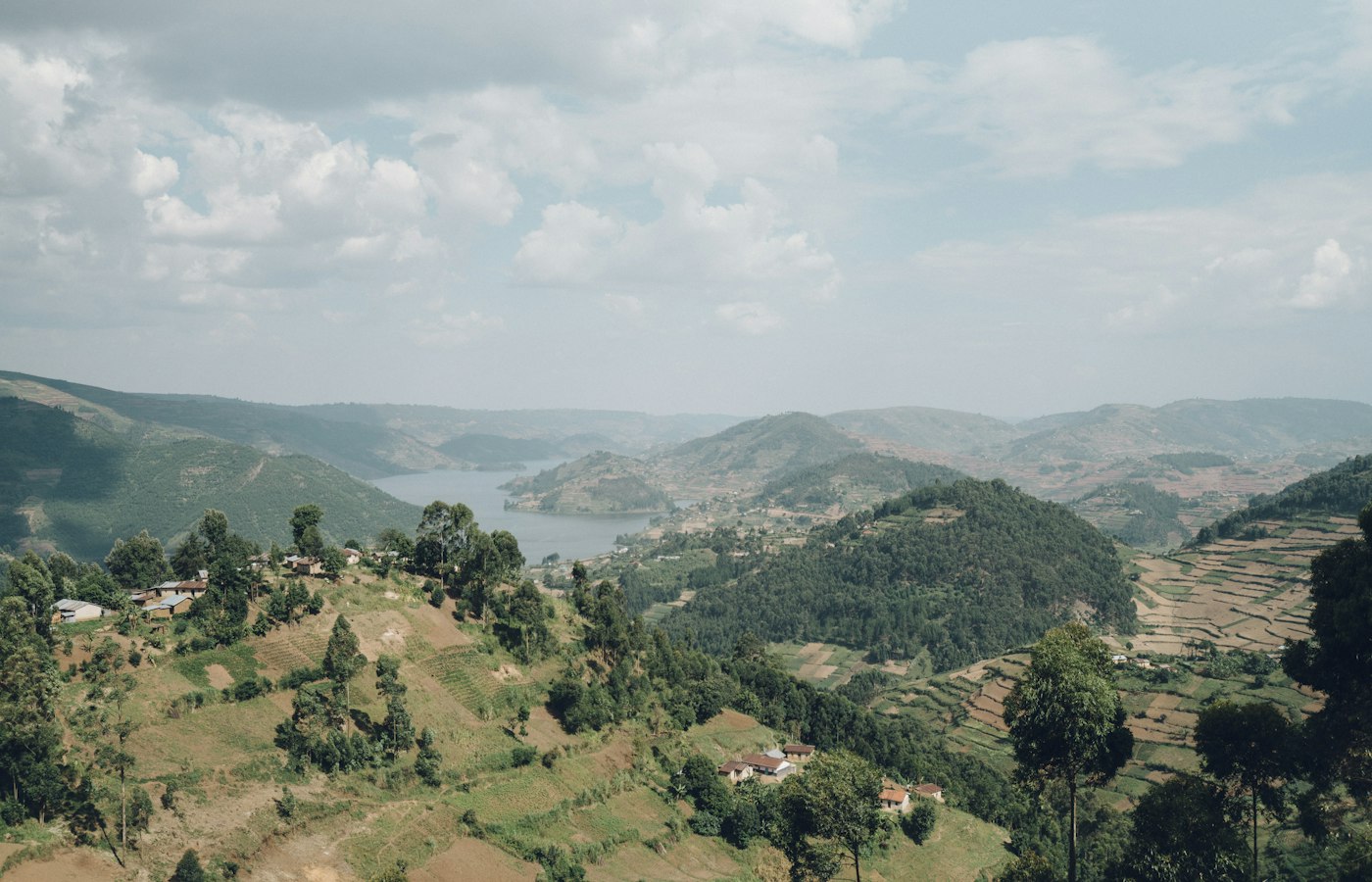
Rwenzori Mountains National Park protects Africa’s third highest summit and the only peak on the continent whose normal route still crosses a glacier. Most people come on a guided trek of three to nine days, booked through one of the two concession holders who run the mountain’s trails. The park lies in western Uganda along the Congo border, a UNESCO World Heritage Site of roughly 996 square kilometres rising out of the Albertine Rift.
Rwenzori Mountains National Park Trekking at a Glance
The range runs about 120 kilometres north to south, and Uganda holds its eastern flank while the Democratic Republic of Congo holds the western one. Ptolemy called these the Mountains of the Moon, and the name stuck long before any European saw them, which tells you how far the reports of snow near the equator travelled. The Bakonzo, who have farmed these slopes for centuries, call the range Rwenzori, the rainmaker. That is the more accurate name.
Uganda gazetted the park in 1991 and UNESCO inscribed it three years later. It is also listed as a Ramsar wetland, which surprises people who think of wetlands as flat. Around seventy percent of the park sits above 2,500 metres, and the water it sheds feeds Lake George, Lake Edward and eventually the Nile. Millions of people downstream depend on rain that falls here first.
There was a long gap when nobody trekked at all. Rebel activity closed the mountain through the late nineties and into the early two thousands, and UNESCO moved the site onto its danger list for the duration. Both problems have long since been resolved, the danger listing was lifted, and the trails reopened. What did not change is the terrain.
Margherita Peak Climbing on Mount Stanley
Margherita Peak tops out at 5,109 metres on the Mount Stanley massif, behind only Kilimanjaro and Mount Kenya. Climbing it is the reason most people book a long Rwenzori trek, and it is worth being honest about what that involves. This is not a walk to the top. The final section crosses the Stanley Plateau on rope, in crampons, over ice that has developed real crevasses, and you will want an ice axe you actually know how to use.
Mount Stanley carries several named summits. Margherita and Alexandra are the two highest, with Albert, Savoia and Elena below them. Five more massifs stand nearby: Speke at 4,890 metres, Baker at roughly 4,843, Emin near 4,798, Gessi at 4,715 and Luigi di Savoia at 4,627. Longer expeditions string several of these together over twelve days or more.
The Duke of Abruzzi’s party made the first ascent of Margherita in 1906, and they mapped an ice cap of about six and a half square kilometres. Mount Stanley now carries something closer to a third of one square kilometre. That is a loss of well over ninety percent, and the retreat has accelerated in the last few years rather than slowing. Guides who have worked the mountain for two decades describe route changes from season to season, not decade to decade.
Retreat has practical consequences. Hiking to Margherita was suspended for part of a season after a crevasse opened across the glacier, and the Uganda Wildlife Authority reopened it only after building a bridge over the gap and adding fixed ropes on the harder sections. The summit is open and being monitored, but the route is a moving target. Confirm conditions with your operator close to departure rather than assuming last season’s line still holds.
Summit day is longer than the published figures suggest. Operators quote four to five hours from Elena hut to the top, which is accurate for the climbing itself. Trip reports describe a two in the morning start and a fourteen hour round trip once the descent to a lower camp is counted, and afternoon cloud is the reason for the alarm clock rather than tradition.
Rwenzori Trekking Routes: the Central Circuit and the Kilembe Trail
Two main trekking routes climb into the peaks, and here is the thing nobody writing about this park bothers to say plainly: choosing a route also chooses your company. Rwenzori Mountaineering Services holds the Central Circuit out of Nyakalengija and trades as Active African Vacations. Rwenzori Trekking Services holds the Kilembe Trail concession in the south. Both still run. Whichever tour operator you book through, your crew on the mountain comes from one of these two.
The Central Circuit is the older route and the shorter one, usually seven days, sometimes stretched to nine with an acclimatisation day. It climbs the Bujuku valley to Elena hut, over Scott Elliot Pass, down past the Kitandara lakes and out over Freshfield Pass. It is a genuine circuit, so you do not retrace your steps.
The Kilembe Trail approaches from the south and usually runs eight to ten days. It gains height more gradually, which helps with acclimatisation, and it passes through more varied ground including the Nyamwamba valley and its chain of small lakes. Trekkers who care about photography tend to prefer it. Two further routes exist and see almost no traffic: the Bukurungu Trail, an eight day wilderness camping route, and the Kazingo Trail in the north.
Short Rwenzori Treks and the Three Day Mahoma Loop
You do not have to attempt a summit to trek here, and a good number of visitors should not. The Mahoma Loop is the three day option, climbing from the park gate through montane forest to Omukakiza camp, on past Lake Mahoma, then out via Nyabitaba. It reaches around 3,200 metres, needs no ropes or crampons, and delivers the forest, the bamboo, the chameleons and the first proper view of the high peaks.
Shorter treks exist below that. A day hike from Nyakalengija reaches the forest zone and back. Two and three day trips on the Kilembe side run to Sine camp and the Samalira falls, or up to the Mutinda lookout on four days, which is the highest most people get without committing to a summit push.
Consider these properly rather than as consolation. A three day Rwenzori trek gives you the strangest vegetation in Africa without the fourteen hour summit day, the glacier fee, the crampon hire or the risk. Plenty of experienced hikers finish a summit attempt saying the middle days were the best part anyway.
What Rwenzori Mountains Trekking Feels Like Underfoot
This is where the guides go quiet and the trip reports get loud. Rwenzori trekking is hard, and it is hard for a reason that has almost nothing to do with altitude.
The middle of the mountain is bog. Not damp ground, not a muddy patch, but saturated peat that swallows a leg to the knee. Long stretches of trail are boards and laid tree branches floating over standing water, and they move underfoot. Every step needs looking at. Trekkers who have done Kilimanjaro, Toubkal and the Alps routinely describe the Rwenzori as the hardest walking of their lives, and the complaint is never the thin air.
Which brings up footwear, and the single most useful thing in this guide. Waterproof hiking boots do not work here. What works is rubber gumboots, the sort a farmer wears, sized up and worn over gaiters with thick socks. Porters wear them. Guides wear them. Trekkers who arrive in expensive boots frequently borrow or buy gumboots partway up and finish the trek in those. The tread is worse and the ankle support is negligible, but nothing else keeps water out of ground like this, and trip reports repeatedly mention finishing a week of long days without a single blister.
Compared with Kilimanjaro, the trade is straightforward. Kilimanjaro is higher and its difficulty is almost entirely altitude. The Rwenzori is lower, the height gain is spread over more days, and altitude evacuations are relatively uncommon. What replaces them is terrain: mud, root ladders, boulder fields, river crossings, and weather that turns from sun to whiteout inside twenty minutes.
The descent is what people underestimate. Coming off Mount Baker or dropping the last two thousand metres to the gate takes eight or nine hours of steep, slippery, knee battering ground, and it takes as long as the climb did. Bring poles.
Turning back short of the summit is normal and nobody should treat it as failure. Weather closes the plateau, crevasses open, groups run out of daylight. A trek that reaches Elena hut and comes home has still crossed five vegetation zones and seen the glaciers from below. Go up planning to enjoy the week, with the summit as a bonus rather than the point, and you will have a better time.
Mountain Huts and Camps on the Rwenzori Trekking Trails
Both main routes are hut based, which is one real advantage over camping expeditions elsewhere. The huts are simple wooden buildings with bunk beds, a communal space, a separate cooking hut for the crew, and long drop toilets a short boardwalk away. Standards vary a lot. Some have been rebuilt recently and are clean and dry inside. Others are bare bunkrooms with gaps in the boards.
Cooking is done by your crew and the food is better than the setting suggests, built around rice, pasta, stews, soup and a great deal of tea. What no hut can do is dry your clothing. There is no heating, the air is saturated, and anything wet at four in the afternoon is still wet at six the next morning. Carry more dry socks than seems reasonable and keep a sleeping set sealed in a dry bag that never comes out during the day.
Five Vegetation Zones on a Rwenzori Trek
The climb through the vegetation bands is the part of a Rwenzori trekking expedition that people remember longest, and it is genuinely unlike anywhere else in Africa.
The giant lobelias and groundsels are the reason botanists come. Both are ordinary small plants at sea level that have grown to absurd size in the cold, wet, high altitude conditions of the East African mountains, and the Rwenzori grows them larger than most places. Lobelias reach several metres and the groundsels carry woody trunks with silver grey rosettes on top.
Wildlife and Birding Safaris in the Rwenzori Mountains
Set your expectations properly. A Rwenzori trek is not a wildlife safari in the way a Queen Elizabeth game drive is, and anyone selling it that way is overselling. Around seventy mammal species and more than two hundred birds are recorded across the range, but the forest is dense, the animals are shy, and heavy hunting through the seventies and eighties thinned the larger species badly.
What you can reasonably hope for on the forest days is black and white colobus, blue monkeys, L’Hoest’s monkeys and bushbuck. Forest elephant and chimpanzee are present and rarely seen. Rock hyrax turn up around the higher camps and are the animal most trekkers actually photograph, largely because they are the only one that stays still.
Birding is the stronger draw. The Rwenzori turaco is the one everyone wants, a green and crimson bird found nowhere but this range and its Congolese continuation. Alongside it: the Rwenzori batis, the Rwenzori double collared sunbird, the handsome francolin, Archer’s robin chat, the red throated alethe and the strange weaver. Birding tours run on the lower trails and the Ruboni community walks without going anywhere near the peaks.
The Rwenzori three horned chameleon deserves a mention of its own. It lives on the bamboo and forest edges, moves slowly enough to photograph properly, and the guides are very good at spotting it when nobody else can.
Best Time for a Rwenzori Mountains Trekking Expedition
Two windows are drier than the rest: June to August, and December to February. Neither is dry in any absolute sense, because this is the rainmaker and rain is what it does. The realistic difference is between trails that are boggy and trails that are flooded.
| Month | Rain | Trails | Verdict |
|---|---|---|---|
| January | Low | Firm | Good |
| February | Low | Firm | Good |
| March | Rising | Soft | Poor |
| April | Heavy | Flooded | Avoid |
| May | Heavy | Flooded | Avoid |
| June | Easing | Firming | Good |
| July | Low | Firmest | Best |
| August | Low | Firmest | Best |
| September | Rising | Soft | Fair |
| October | Heavy | Boggy | Poor |
| November | Heavy | Boggy | Poor |
| December | Easing | Firming | Good |
July and August give you the firmest ground and the clearest summit mornings, and they also give you company, since this is when the mountain is busiest. December to February is nearly as dry and much quieter, which matters more here than on most mountains because hut space is limited and a full Elena hut on summit night is not restful.
March to May and October to November are the two wet seasons. Treks still run. Rivers rise, the bog deepens past what boards can cover, and summit attempts get called off for whiteout more often than not. If those months are your only option, book a lower trek and enjoy the forest rather than paying for a summit push you probably will not get.
Whatever month you pick, the daily pattern holds: mornings are clearer, afternoons cloud over, and rain most often arrives between two and five. Plan long days to start early. That is why summit nights begin in the dark.
Guides, Porters and Bakonzo Communities on Rwenzori Treks
You cannot trek the Rwenzori unguided. Every party goes with a licensed guide, an assistant guide on longer routes, a cook, and porters, and the ratio surprises people the first time they see it. A party of two can leave the gate with ten crew. That is normal here, not extravagance, because everything from food to fuel to your duffel goes up on someone’s back.
Porters carry a maximum of eighteen kilograms each, which is why the numbers stack up. You carry a day pack with rain gear, water, snacks and a camera. Nothing else.
Nearly every guide and porter on the mountain is Bakonzo, from the villages at Nyakalengija, Kilembe and Ruboni. Trekking work is one of the few reliable incomes on these slopes, and a lot of younger porters are funding school with it. The crew you walk with are not incidental to the trip, and treating the arrangement as a straightforward employment relationship rather than a courtesy goes a long way.
The mountain is not neutral ground for them. Bakonzo belief places the god Kitasamba on the high peaks, and eighteen sacred sites on the range are recognised and protected as places of worship. Your guide may not volunteer any of this. Ask, respectfully, and most will talk about it at length.
Down at the base, the Ruboni community runs village walks, craft workshops and cultural performances, and the old Kilembe copper mines in the Nyamwamba valley are worth an hour if you arrive a day early. Both are easy add ons to a trek and both put money straight into the villages the crew come from.
Packing and Safety for a Rwenzori Trekking Adventure
Beyond gumboots and gaiters, the packing list is built around one fact: you will be wet, and then you will be cold. A four season sleeping bag rated to around minus five is the baseline for a summit trek. Full waterproof shell, top and bottom, not a light jacket. More socks than you think, in a dry bag. Gloves, hat, thermal base layers, and a second warm layer that never leaves the dry bag.
Technical gear for the glacier, meaning crampons, ice axe, helmet and rope kit, is normally hired from the operator rather than carried from home. Confirm what is included before you fly, and confirm the crampons fit whatever boots you are bringing, because a mismatch discovered at Elena hut ends your summit.
Altitude is the smaller of the two risks but it is real. The Central Circuit gains height fast enough that headaches at Bujuku are common, and the Kilembe Trail’s gentler profile is the better bet if you have had trouble before. Build in an acclimatisation day if the itinerary allows. Rescue on this mountain means being carried, which is slow, so descending early at the first sign of real trouble is the whole strategy.
The commonest planning mistakes are all the same mistake: underestimating the mountain. Booking a four day summit trek off a desk job. Bringing boots. Packing one pair of socks. Assuming the published summit time is the day length. Treating a Rwenzori trek as a Kilimanjaro warm up. Photographers should add one more: bring more battery than you plan to use, because cold and constant damp drain them fast and there is no charging above the gate.
Getting to Rwenzori Mountains National Park for Your Trek
Kasese is the gateway town.
From Kampala it is roughly 410 to 440 kilometres by road, five to seven hours depending on traffic out of the city, running southwest and then west past Mbarara and up toward Fort Portal. Most operators include the transfer.
From Kasese, the Central Circuit trailhead at Nyakalengija is about 22 to 25 kilometres, half an hour on a rough final stretch. The Kilembe trailhead sits roughly twelve kilometres out, above the old mining town. Scheduled light aircraft fly Entebbe to Kasese in about an hour, which is worth considering if your days are tight, though it costs a good deal more than the road.
Arrive a full day early. Gear checks, briefings and crew allocation happen the afternoon before, and starting a Rwenzori trek off a seven hour drive is a poor way to begin a week of hard walking.
Combining a Rwenzori Trek with a Wider Uganda Safari
The park sits in the middle of Uganda’s best circuit, which makes it easy to attach to a broader safari. Queen Elizabeth National Park is about an hour south of Kasese, with the Kazinga Channel boat and the tree climbing lions of Ishasha.
Kibale Forest and its chimpanzee tracking is an easy run north toward Fort Portal, and Semuliki with its hot springs is beyond that.
Bwindi is around six hours south for gorilla trekking. The sequencing that works best is savanna first, mountain second. Arriving at the trailhead already acclimatised to walking and to Uganda’s roads beats arriving on day two of your holiday. And after eight days of bog, a game drive from a vehicle seat is exactly the right way to end a trip.
Frequently Asked Questions About Rwenzori Mountains Trekking
How much does it cost to trek the Rwenzori Mountains?
Two costs stack. The Uganda Wildlife Authority charges a park entry fee for every day you spend inside, 35 US dollars per day for foreign non residents and 25 for foreign residents, with a much lower rate for East African citizens and 5 dollars for children, and it charges a separate Rwenzori mountain hike fee of 50 a day for foreign non residents and 40 for residents. Whether the hike fee already absorbs entry is not clear from the tariff itself, which says entrance is charged independently of mountain climbing in its general notes and then says the hiking fee includes entrance on its mountain activities page. UWA revises its conservation tariff on a two year cycle and has announced a revised structure that takes effect on 1 January 2027, so confirm the current figure with your operator at the point of booking rather than trusting any published guide. On top of that sits the trek package, which the tariff does not price at all: it hands the climbing services to the two concession holders and leaves them to set the rate. A seven or eight day summit trek on either main route is typically quoted between about 1,250 and 1,650 US dollars per person, covering park fees, hut space, crew wages, all meals on the mountain and rescue cover. Shorter treks run well below that, and private or multi peak expeditions can reach several thousand.
Do I need technical climbing skills to reach Margherita Peak?
Yes, or at least you need to be comfortable being taught them quickly. The final section crosses a glacier in crampons, roped, with fixed lines on the steeper ice and an ice axe for self arrest. Guides run a briefing and most reasonably fit people manage it without prior mountaineering, but this is genuine glacier travel and it is the one thing that separates Margherita from Kilimanjaro. If ice makes you uneasy, book a route that stops below it.
How fit do I need to be for a Rwenzori trek?
Fitter than for a comparable trek elsewhere. Days run six to nine hours on unstable ground, back to back, for a week. The useful preparation is not gym cardio but long hill walking with a pack, ideally in wet weather, with attention to ankles and knees. The descent hurts more than the climb, so downhill training matters as much as uphill.
Are porters included, and how much should I tip?
Porters are included in every package and are not optional. Each carries up to eighteen kilograms, so a group of two commonly travels with something like ten crew. Tipping sits on top of the package and is customary rather than fixed. Operator guidance, which is what most crews expect, runs to roughly 10 to 15 US dollars per day for guides and cooks and 5 to 10 per day per porter, which for a solo trekker on a week long route works out somewhere near 130 to 180 US dollars across the whole crew. Agree the split with your head guide at the end rather than handing it out piecemeal.
What footwear works best on the Rwenzori?
Rubber gumboots worn over gaiters, sized up to fit thick socks. This is not a budget compromise, it is what the guides and porters wear and what most trekkers switch to partway up. Waterproof hiking boots fill with water in the bog sections and stay full. Bring stiff boots only if you are summiting and need them for crampons, and keep them dry in your duffel until the high camp.
Is the Rwenzori harder than Kilimanjaro?
For most people, yes, though the difficulty comes from a different direction. Kilimanjaro is higher and its challenge is thin air. The Rwenzori tops out lower and spreads the height gain over more days, so altitude sickness is less often the limiting factor. What gets you is the ground: deep bog, root ladders, boulder fields, river crossings and constant wet, plus a summit day with real glacier travel on it.
Can I trek the Rwenzori without summiting a peak?
Very much so, and a lot of people should. The three day Mahoma Loop reaches around 3,200 metres through forest, bamboo and heather with no technical ground at all. Four day options on the Kilembe side reach the Mutinda lookout. These give you the vegetation zones, the birdlife and views of the glaciers without the cost, the risk or the fourteen hour summit day.
What accommodation is there before and after the trek?
A reasonable spread around Kasese and the two trailheads. Trekker hostels and community camps at Kyanjuki and Ruboni start from around 20 US dollars a night. Mid range hotels in Kasese with reliable hot water sit in the middle. At the top end, a small eco lodge near the Nyakalengija gate runs to around 200 US dollars a night. Book the night before and the night after, because you will want a hot shower more than you currently believe.
Is Margherita Peak open, and how safe is the glacier crossing?
It is open. Hiking to the summit was suspended for part of a season after a crevasse opened in the glacier, and the Uganda Wildlife Authority reopened the route after installing a bridge across the gap and adding fixed ropes on the difficult sections, with ongoing monitoring since. The ice is retreating quickly, though, and the route changes between seasons. Ask your operator for a current condition report in the weeks before you fly.
How many days do I need for a Rwenzori trekking expedition?
Seven to nine days on the Central Circuit for a summit attempt, eight to ten on the Kilembe Trail. Compressed four day summit itineraries exist and are sold, but they leave almost no margin for weather or acclimatisation and few people should book one. For a non summit trek, three days is enough to see the mountain properly. Add a day either side for travel from Kampala and gear checks.
Rwenzori treks are booked through Ugandan operators who work directly with the two concession holders on the mountain, and the right company makes the difference between a hard week you are glad you did and a hard week you regret.
An eight day Rwenzori climbing tour is the summit length route listed on the site, running from Entebbe through Kasese to Margherita Peak and back.
Compare it against the other mountain climbing itineraries on Uganda Safaris, and talk to an operator about which trail suits your fitness and the season you are travelling in before you commit.
1 Place to Visit in This Area
Individual sites within reach of here, each with its own guide. Some are written up because the name circulates and the place does not, which is worth knowing before you plan a drive around one.
Safaris That Visit Rwenzori Mountains National Park
Every safari listed here that visits Rwenzori Mountains National Park. Each is sold and run by an independent Ugandan tour company. This site lists them and passes on enquiries; it takes no booking and charges you nothing.
Open the full Rwenzori Mountains National Park listing