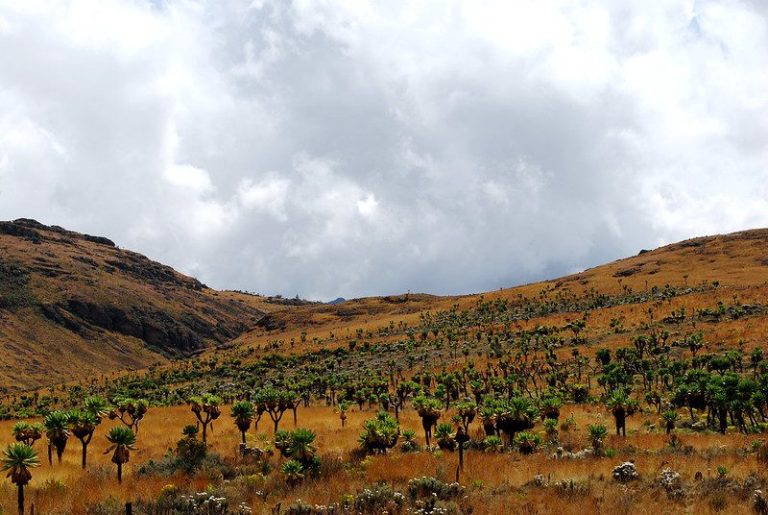

Mount Elgon National Park protects an extinct volcano on the Uganda and Kenya border whose summit, Wagagai, stands at 4,321 metres and can be walked without a rope, a crampon or any technical skill at all. Most visitors come for a three to seven day trek, a few days at Sipi Falls, or both together. The park covers roughly 1,100 square kilometres on the Ugandan side, rising above Mbale in the east of the country.
Mount Elgon National Park Trekking and Safari at a Glance
The mountain is old. Geologists put it at a minimum of 24 million years, which makes it one of the oldest volcanoes in East Africa and explains why its profile is so different from Kilimanjaro’s cone. Millions of years of erosion have worn the sides into long, gentle ramps. There is no summit pyramid to attack. You walk uphill for days and then you are at the top.
What it lacks in drama it makes up for in spread. The volcanic base covers around 4,000 square kilometres across an eighty kilometre reach, and that is the largest base of any volcano on the planet. The mountain lifts about three thousand metres above the plains around it. Uganda holds the larger share; Kenya holds the eastern flank, and the two countries manage the range together as a transboundary biosphere reserve.
Protection here goes back to the colonial period, when the slopes were held as a forest reserve. Uganda declared the national park in the early nineties. The relationship with the communities on the lower slopes has been difficult ever since, because these are some of the most densely farmed hillsides in the country and the park boundary cut through land people were using. Encroachment cases and the displacement of the Benet and Ndorobo forest communities are still live issues.
Wagagai Peak Trekking and the Mount Elgon Caldera
Wagagai is the high point at 4,321 metres, the fourth highest summit in East Africa. Four more peaks stand around the rim: Sudek at 4,302, Koitobos at 4,222, Mubiyi at 4,211 and Masaba at 4,161. The Kenyan side holds Koitobos and Endebess Bluff. On a clear morning from the top you can see a long way into both countries, though clear mornings are not the norm.
Between the peaks sits the caldera, a bowl of roughly forty square kilometres with a rim about eight kilometres across. Hot springs bubble up inside it, and the walk across the caldera floor is what most trekkers name as the best part of the trip. It is high, open, silent, and unlike any other ground in Uganda. Jackson’s Pool sits below Jackson’s Peak on the Sasa route and is the traditional stop before the final push.
Now, the correction. You will read on a great many pages, including several that rank at the top for this search, that Mount Elgon has the largest caldera in the world. It does not, and the claim has been copied between sites for years without anyone checking it.
Mount Elgon Hiking Trails: Sasa, Sipi, Piswa and Bushiyi
Four trails climb to the caldera, and they differ far more than their names suggest. Picking the right one matters more on this mountain than picking the right operator, because the routes ask genuinely different things of you.
Most experienced trekkers do not go up and down the same way. Ascending Sasa and descending Sipi is the popular combination, and it gives you the steep forested east and the long open west in one trip. Piswa up and Sipi down is the softer version of the same idea. Nine gates ring the park in total, and one of them, at Suam, opens the crossing into Kenya.
What a Mount Elgon Trek Is Actually Like Day by Day
Here is what the ranking pages leave out. Elgon is not technical and it is not especially high, and both facts get repeated so often that people arrive undertrained. It is still a long, heavy, sustained walk.
On the Sasa trail, the first few hours are the worst of the whole trek. The path leaves Budadiri and goes straight up, steep and rough, usually in mid morning heat before anyone has found their rhythm. Trekkers who have done harder mountains describe day one on Sasa as the section that hurt most, largely because it comes before your legs have adjusted to anything.
Day three is the other problem. On a standard Sasa itinerary that day covers around nineteen kilometres out to Wagagai and back to camp, and then several more kilometres on to the next campsite. Trip reports keep landing on the same recommendation: split it, and add a night rather than running the summit and the transfer together. If your operator’s itinerary does that in one push, ask whether it can be broken up. Most can.
The mountain forgives almost everything except pace. Fitness helps but is not the deciding factor, and plenty of ordinary walkers finish comfortably. The people who arrive at camp wrecked and miserable are usually the ones who spent the day matching somebody else’s speed. Walk at yours. The guides here get consistently good reviews for patience on the slippery sections, and they will not rush you unless you ask them to.
Underfoot it is mud and grass rather than the deep bog of the Rwenzori, but rain turns the steeper stretches slick and the descent asks more of your knees than the climb asks of your lungs. Bring poles.
Camping and Campsites on Mount Elgon Treks
There are no huts and no lodges inside the park. Every night on a Mount Elgon trek is under canvas, and tents, mats and sleeping bags can all be hired locally if you would rather not fly with them.
Standards vary a lot from one to the next. Some have decent pit latrines and level ground; others are functional and nothing more. Washing is a bucket of cold water, which at nearly four thousand metres is a stronger commitment than it sounds. Baby wipes get recommended by returning trekkers more often than any technical item on the packing list, and they are right.
Nights at the high camps drop close to freezing, and hail near the summit is ordinary rather than unlucky. A four season bag, thermals and merino socks are the difference between sleeping and lying awake.
Mount Elgon Caves and Cave Tours
The caves are one of the things that make an Elgon safari different from any other mountain trip in Uganda. They are not caves in the limestone sense but overhangs and tunnels cut into soft volcanic rock, some of them very large.
Kitum Cave is the famous one, on the Kenyan flank, running roughly two hundred metres back into the mountain. Its walls carry salt, and elephants walk into the dark at night to work it loose with their tusks. The grooves they have cut over generations are visible on the rock. It is one of the strangest pieces of animal behaviour anywhere in Africa and it happens here nightly.
On the Ugandan side, Khauka Cave sits on Wanale ridge above Mbale, and Kapkwai Cave lies near the Forest Exploration Centre on the Sipi trail. Tutum and Mude both double as campsites. Several are used ceremonially by the Bagisu and Sabiny for sacrifices and prayer, so ask your guide before wandering in and photographing everything.
Sipi Falls Tours, Abseiling and Coffee Trails
Sipi Falls sits on the north western shoulder of the mountain near Kapchorwa, and for a lot of visitors it is the whole trip. It is three separate waterfalls, not one, strung down a green hillside with the plains stretching out below. The main drop falls about a hundred metres, and there is a cave behind one of the others you can walk into.
The standard Sipi Falls tour is a guided loop of three to four hours taking in all three falls, run by the local community rather than the park. It is steep in places, muddy after rain, and easily the best value few hours in eastern Uganda. Abseiling down beside the main fall runs about an hour and a half and needs no prior experience.
Then there is the coffee. The slopes around Sipi and Kapchorwa grow Arabica between roughly 1,600 and 1,900 metres, and the coffee tours here are the real thing rather than a demonstration. You walk out to the trees with a grower, pick, pulp, dry, roast over a fire and drink the result the same morning. Uganda is better known for robusta, and this is where the exception lives.
Wildlife and Birding Safaris on Mount Elgon
Set expectations properly. A Mount Elgon safari is not a game viewing trip. The forest is dense, the animals are shy, and human pressure on the lower slopes has pushed the larger species higher and thinner. Elephant and buffalo are present, and both are more often heard about than seen.
What you can reasonably expect on the forest sections is black and white colobus, blue monkeys, defassa waterbuck lower down, duikers, bushbuck and the occasional giant forest hog. Leopard and hyena are on the list and almost nobody sees them.
Birding is the stronger reason to come. More than three hundred species have been recorded, and the range spans everything from forest specials to true moorland birds. The lammergeier, a bearded vulture that drops bones onto rock to break them, patrols the cliffs and the caldera rim. Up on the moorland, look for the alpine chat and the moorland francolin. Lower down, Jackson’s francolin, crowned hornbills, turacos and MacKinnon’s fiscal all turn up. Birding tours run from the Forest Exploration Centre at Kapkwai without going anywhere near the summit.
Vegetation Zones on a Mount Elgon Hiking Safari
The climb through the bands is the same sequence you get on the Rwenzori, minus the ice at the top and minus the worst of the bog on the way.
Best Time for Mount Elgon Trekking and Safari Tours
Two windows are drier than the rest: June to August, and December through February into early March. Rain is possible in any month at this altitude, and the difference between seasons is not wet against dry but slippery against very slippery.
| Month | Rain | Trails | Verdict |
|---|---|---|---|
| January | Low | Firm | Good |
| February | Low | Firm | Best |
| March | Rising | Soft | Fair |
| April | Heavy | Slick | Avoid |
| May | Heavy | Slick | Avoid |
| June | Easing | Firming | Good |
| July | Low | Firmest | Best |
| August | Low | Firmest | Best |
| September | Rising | Soft | Fair |
| October | Heavy | Muddy | Poor |
| November | Heavy | Muddy | Poor |
| December | Easing | Firming | Good |
July and August give the firmest ground and the best chance of a clear summit morning. February is the quiet equivalent, and Elgon is quiet even in its busy season, which is one of the mountain’s real pleasures. You can walk for days here and meet nobody.
April and May bring the heavy rains and the trails turn genuinely unpleasant, with the steep Sasa sections becoming a slide. October and November are wetter than they look on paper. Sipi Falls runs at its most powerful in the wet months, though, so a rainy season trip that skips the summit and concentrates on the falls, the caves and the coffee is a perfectly good plan rather than a compromise.
Bagisu and Sabiny Culture Around Mount Elgon Tours
The slopes of this mountain are among the most densely populated rural areas in Uganda, and any Mount Elgon tour spends its first and last hours walking through somebody’s farm.
The Bagisu, who also call themselves the Bamasaba, hold the western and southern slopes around Mbale, Sironko, Bududa and Manafwa. They are known across the country for imbalu, the public initiation ceremony that marks a young man’s passage into adulthood. It runs in even numbered years, without anaesthetic, in front of the whole community, and it is treated as a test of composure rather than a medical procedure. If your trip falls in an imbalu year the region is loud, busy and worth being around for.
The Sabiny hold the north eastern slopes around Kapchorwa and belong to the wider Kalenjin group that runs on into Kenya. The Ndorobo, or Benet, lived in the forest itself until the park boundary displaced them, and their situation remains unresolved.
Near Mbale there is also the Abayudaya, a Ugandan Jewish community founded early in the last century, with synagogues and a guesthouse open to visitors. It is an unusual stop and almost nobody includes it.
Packing, Fitness and Safety for a Mount Elgon Trek
The kit list is built around cold and wet rather than ice. A four season sleeping bag, full waterproofs, thermals, fleece, a warm hat and gloves, and more socks than you expect to need. Sturdy boots with real tread, because the descents are slippery. No crampons, no axe, no rope.
One small thing that returning trekkers raise constantly: get a daypack with external bottle holders. Taking a pack off and putting it back on every time you want water, six or seven hours a day for five days, grinds people down in a way that sounds trivial and is not.
Altitude is a mild risk here rather than a serious one. Wagagai sits low enough, and the routes climb slowly enough, that severe altitude sickness is uncommon. It is not impossible above four thousand metres, though, and the treatment is the same everywhere: tell your guide early and go down. Medical facilities inside the park are minimal, and rescue means being walked or carried out.
Two rangers escort every trekking party, acting as guides and as security, and that is not optional. Porters carry up to eighteen kilograms each. Hiring them is worth it even if you normally carry your own gear, because five days of full pack weight on this terrain is a different proposition from a weekend at home. They also tend to walk on ahead, so anything you want during the day needs to be in your daypack from the moment you leave camp.
Getting to Mount Elgon National Park for Your Safari
Mbale is the base.
From Kampala it is roughly 235 kilometres east along the Jinja highway then north, four to five hours in normal traffic, and the road is good by Ugandan standards. Jinja and the source of the Nile sit conveniently on the way.
From Mbale, the Sasa trailhead at Budadiri is about an hour. Kapchorwa and Sipi are an hour and a half to the north east, and the Kapkwai Forest Exploration Centre sits above Sipi. Kapkwata, for the Piswa trail, is further north again. Nine gates serve the park in total, so confirm which one your trek starts from before you book transport, because they are not close together.
Coming from Kenya, the crossing at Suam puts you on the eastern flank near Kitale, which is the route to use if you want Kitum Cave.
Combining Mount Elgon with Other Uganda Safari Tours
Eastern Uganda gets skipped by most itineraries, which is exactly why it is worth a few days. Jinja is ninety minutes back toward Kampala with white water rafting and kayaking on the Nile.
The Nyero rock paintings near Kumi are an easy detour and are some of the oldest rock art in the region. Tororo rock is climbable in a morning.
North of Elgon the road runs into Karamoja and eventually to Kidepo Valley National Park, which is the wildest savanna park in the country and the natural pairing if you want a proper game viewing safari after the mountain. Murchison Falls is the more conventional follow on, reachable across the north.
Sequence the mountain second if you can. Arriving at Budadiri already used to walking, already adjusted to the food and the roads, makes the first day on Sasa considerably less of a shock.
Frequently Asked Questions About Mount Elgon Trekking
How much does it cost to hike Mount Elgon?
The conservation tariff carries two lines for this mountain. Park entry is 35 US dollars a day for foreign non residents and 25 for foreign residents, with a much lower rate for East African citizens and a token 5 dollars for children. The Mount Elgon hiking fee is a further 50 a day for foreign non residents and 40 for residents, and it covers the compulsory ranger escort. Whether those two stack is genuinely unclear, because the tariff says one thing in its general notes, that entrance is charged independently of mountain climbing, and the opposite on its mountain activities page, that the hiking fee already includes entrance. That single contradiction is why quoted day rates land anywhere between 50 and 85 dollars. Tents and camping gear sit outside both figures. Rock climbing is 65 a day and mountain biking 100, while the Bushiyi trail excursion is 150 for the whole outing rather than per day, and the Kapkwai sector is free to enter. The revised conservation tariff that takes effect on 1 January 2027 does not change either of these Mount Elgon lines, but get a written breakdown from your operator and confirm the current Uganda Wildlife Authority figure at the point of booking rather than relying on any published guide.
Do I need technical climbing skills or ropes to reach Wagagai?
No. There is no ice, no scrambling that needs a rope, and no glacier. Wagagai is a walk to the top, which is what separates Mount Elgon from Margherita on the Rwenzori and makes it the sensible first four thousand metre peak in East Africa. Everything that makes it hard is distance, gradient and weather.
How fit do I need to be, and how many days should I allow?
Reasonably fit rather than trained. Three to four days on the Sasa trail is the fast option and it is a hard three days. Five to seven on Sipi or Piswa is more comfortable and gives you more of the mountain. Long hill walks with a loaded pack are the useful preparation, with attention to downhill work, because the descents hurt more than the climbs. Pace matters more than fitness here, and pushing to keep up with somebody faster is the commonest reason people finish the trek unhappy.
Is altitude sickness a risk on Mount Elgon?
Less than on the region’s other high mountains. Wagagai is low enough and the routes gradual enough that serious cases are uncommon, and the Piswa trail in particular has a gentle profile. Anything above four thousand metres can still cause trouble, so mention a persistent headache or nausea to your ranger early. Going down fixes it, and on this mountain going down is straightforward.
Do I have to camp, or are there huts on the mountain?
Camping only. There is no hut or lodge accommodation anywhere inside the park, and every night is in a tent at one of the designated campsites. Tents, mats and sleeping bags can all be hired locally for a few dollars a day each if you would rather not carry your own. Facilities are basic and washing means a bucket of cold water, so pack wipes.
Are porters and rangers included, and what do they cost?
Two rangers escort every party and their fee is bundled into the daily trekking charge, so that part is settled. Porters and cooks are hired separately and locally, but their rates are not left to the trailhead associations: the conservation tariff fixes both in shillings, and they come out at roughly 11 US dollars per porter per day and 8 for a cook, with each porter carrying up to eighteen kilograms. Tipping on top is customary and appreciated. Agree the numbers with your operator before you set off rather than at the gate.
Which Mount Elgon trail should I choose?
Sasa if you are short of time and confident on steep ground, since it is the quickest to the summit and by a distance the toughest first day. Sipi if you want the fullest version of the mountain, with caves and waterfalls on the way. Piswa if acclimatisation worries you or you want the best chance of wildlife. The combination most experienced trekkers choose is up Sasa and down Sipi, which gives you both sides in one trip.
Does Mount Elgon really have the largest caldera in the world?
No, and this is repeated widely enough that it is worth correcting. The caldera is around forty square kilometres, which makes it one of the largest intact calderas anywhere but not the largest. Ngorongoro’s is roughly 260 square kilometres and usually carries that title. What Mount Elgon does hold is the largest base of any volcano on Earth, around four thousand square kilometres across an eighty kilometre spread. The record is real; it just belongs to a different part of the mountain.
Where should I stay before and after the trek?
Mbale has the widest choice, with a large resort hotel and several mid range options. Sipi has the better views, including a well known clifftop backpackers with a full look at all three waterfalls, and a lodge by the river that has traded as both Sipi River Lodge and Sipi Heritage Lodge, so search both names. Budget guesthouses in the villages run to only a few US dollars a night, mid range rooms sit around 70 to 115, and the upper tier goes higher. Book the night before and the night after your trek.
Can I visit Sipi Falls without hiking the mountain?
Easily, and a lot of people should. The three falls loop is a guided walk of three to four hours run by the local community, with a fee of roughly 15 US dollars covering the guide and trail upkeep. Abseiling beside the main hundred metre fall costs around 50 dollars for about an hour and a half. Add a coffee tour and a community walk and you have two full days in Sipi without ever entering the national park. Rates move between tariff cycles and the wildlife authority does not publish them in a form that is easy to check, so confirm the figure with the authority or your operator before you budget.
Mount Elgon treks are arranged through Ugandan operators who work with the ranger teams and the porter associations at each trailhead, and the right one will happily split a hard day rather than sell you the shortest itinerary.
A six day Mount Elgon and Sipi Falls trip is the packaged version listed here, splitting the days between hiking inside the park and the falls on the lower slopes.
Set it beside the other mountain climbing itineraries on Uganda Safaris, compare routes and day counts, and ask about a written fee breakdown before you commit.
Safaris That Visit Mount Elgon National Park
Every safari listed here that visits Mount Elgon National Park. Each is sold and run by an independent Ugandan tour company. This site lists them and passes on enquiries; it takes no booking and charges you nothing.
Open the full Mount Elgon National Park listing