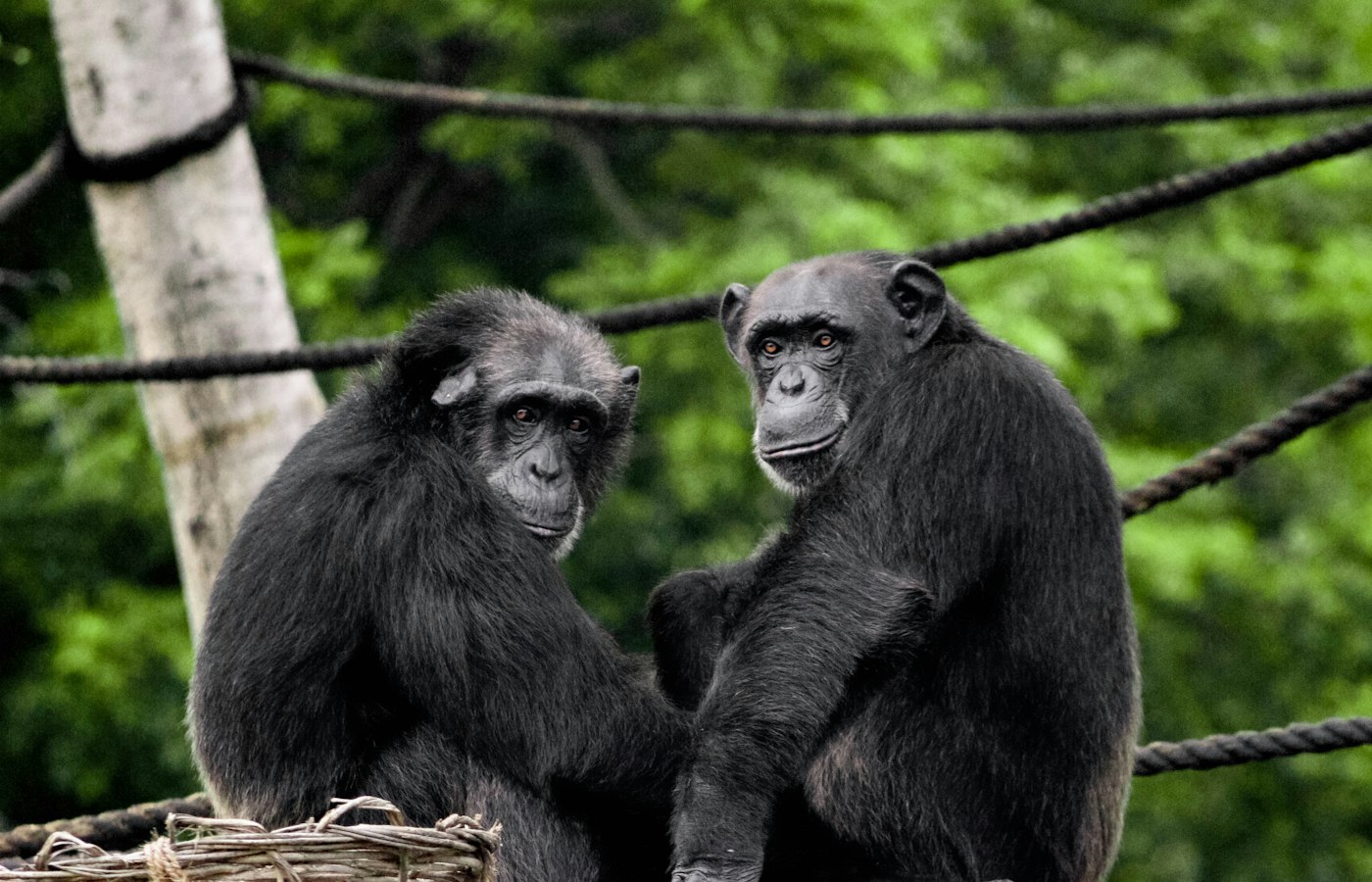
Ngamba Island is a 100 acre forested island in Lake Victoria where around fifty five orphaned chimpanzees live under permanent care, watched by visitors from a raised platform at feeding time. Most people book a half day boat tour from Entebbe, with full day and overnight options too. The island sits 23 km southeast of the airport and is run by the Chimpanzee Trust.
Chimpanzee Viewing Tours at Ngamba Island
A Ngamba Island tour is built around the supplementary feeds. The chimps forage in the forest for most of the day, then come in toward the fence line when the caregivers call them, and visitors watch from a raised timber walkway that runs along the edge of the forest block.
Four supplementary feeds happen daily. Visitors normally see the one at eleven in the morning or the one at half past two, depending on which departure they book. It lasts about half an hour and it is loud, busy and full of the social behaviour people come to see: begging, snatching, screaming, a dominance display or two, and mothers working out who gets what.
A caregiver talks the group through it. They know every animal by name and can tell you which one arrived in a sack at a border post and which one was confiscated from a hotel car park. That commentary is a large part of what you pay for, and it is what makes the place different from a zoo with a feeding schedule.
Numbers on the platform are capped per session, so this does not turn into a scrum, though a full boat plus an overnight group can still feel busy at the rail. Stand at the ends rather than the middle if you want clear photographs.
Half Day and Full Day Ngamba Island Tours Compared
Two half day departures run every day. The morning boat leaves Entebbe at nine and has you back by about a quarter to one. The afternoon boat leaves at a quarter to one and returns around five. Each gives you one feeding session, a briefing and time on the island.
The full day option usually travels by motorised canoe rather than speedboat, leaves earlier, and gets you both the morning and the afternoon feed with lunch in between. It costs less per person than the speedboat half day, because the slower boat is cheaper, and it gives you far more time. The trade is four hours of your day spent on the water instead of ninety minutes.
| Tour | Boat | Times | Feeds |
|---|---|---|---|
| Half day AM | Speedboat | 09:00 to 12:45 | One |
| Half day PM | Speedboat | 12:45 to 17:00 | One |
| Full day | Canoe | 08:00 to 15:00 | Two |
| Overnight | Speedboat | Two days | Up to four |
If you are choosing between the two half day departures, take the morning. Chimps are more active before the heat builds, the light is better on the platform, and afternoon storms over the lake are more common than morning ones.
The Boat Trip From Entebbe and the Equator Crossing
The boat trip is not a detail to skim past. Speedboats take 45 to 60 minutes each way. Motorised canoes take about ninety minutes, longer against a headwind. Life jackets are issued at the dock and rain suits are handed out on the slower boats, which tells you something about how often they are needed.
Lake Victoria can be rough under a completely clear sky. Trip reports mention arriving drenched and rattled on days that looked flat from the shore, because wind over that much open water builds a short, hard chop with no warning. If you are prone to seasickness, take something before you board rather than after, and pick the speedboat, which punches through rather than wallowing.
The crossing passes very close to the Equator, and boats will usually swing past a marker so people can take a photograph. It is a small thing, and several visitors say the crossing was as good as the chimps.
Departures leave from Entebbe, either from the jetty at the Uganda Wildlife Education Centre or from a nearby beach landing, depending on the boat and the operator. Confirm which one when you book, because they are not the same place and the boat will not wait long.
The Rescued Chimps Behind Every Ngamba Island Tour
Every chimpanzee on this island arrived because something went wrong for it. Most were seized by Uganda Wildlife Authority from the illegal trade in live animals: infants taken after their mothers were shot for meat, animals found in crates at borders, pets surrendered when they got too strong to keep. Ngamba took its first group of nineteen in the late nineteen nineties and has been receiving them ever since.
A chimp orphaned that young does not learn what it needs from its mother, and a chimp that has spent years in a cage or a compound has learned things that make it unsafe in a wild community. So none of the residents here is a candidate for release. That is the hard fact underneath the whole operation, and it is worth carrying with you onto the platform: this is lifetime care, not rehabilitation with an end date.
The island was gazetted in October 1998 and opened to visitors the following year. It was set up jointly by the Jane Goodall Institute, the Born Free Foundation, the International Fund for Animal Welfare, the Uganda Wildlife Education Centre and two Ugandan conservation bodies, and the Chimpanzee Trust has run it since.
Ask the caregivers about individual histories. They will tell you, in detail, and the stories are neither sentimental nor tidy.
Caregiver for a Day and the Forest Walk Experience
This is the part of a Ngamba Island experience that websites get wrong most often, so here is the accurate position.
On a day tour there is no contact of any kind. You watch from the platform, behind a fence and a strip of open ground, and that is the whole of it. Anyone telling you a day trip includes holding a chimp is describing something that does not happen.
The hands on options exist, but they are attached to an overnight stay and they are gated. Caregiver for a Day puts you behind the scenes preparing food, cleaning holding facilities, sitting in on health checks and helping with behavioural monitoring. Direct contact is possible under a caregiver’s supervision, and it is explicitly not promised. The forest walk with juveniles takes a very small group out with young chimps for about an hour, early in the morning or late in the afternoon, and it is part of the integration process that teaches young animals to be confident in forest.
The screening list is real and it is long. Cover for hepatitis A and B, measles, meningococcal meningitis, polio, tetanus and yellow fever, plus a negative tuberculosis test taken within the previous six months. Vaccines have to be at least two weeks old before you set foot on the island. Chimps share almost all of our DNA and almost all of our respiratory diseases, and a human cold has killed wild chimpanzees before.
Two more things people are not told often enough. Availability of the forest walk depends on whether there are young chimps in integration at the time, which is not a permanent state of affairs, so it cannot be promised months out. And the hands on options carry a substantial extra charge on top of the overnight rate. Ask about both when you enquire rather than assuming they come with the room.
Overnight Trips at the Ngamba Ecolodge
Staying the night changes the visit completely. You get both main feeds instead of one, the quiet hours in between, sunset and sunrise over the lake, and the chance to be there in the early morning when the chimps come out of their night quarters.
Accommodation is a small set of en suite safari tents on raised decks looking out over the water, with hot showers, solar lighting and a communal dining area. It is comfortable rather than grand, and reviews are consistently warm about the food, the setting and the staff. Numbers are small, so the island empties out after the last day boat leaves and you have it more or less to yourself.
Book early. There are only a handful of tents, and overnight capacity is the binding constraint on the whole caregiver and forest walk side of the operation.
One practical warning drawn from guest reports: if a chimp fails to come in at the end of the day, activities can be cancelled at short notice and the staff will offer alternatives, some of which cost extra. Nothing here is guaranteed, because the animals are not performing to a schedule.
Birding, Fishing Village Tours and the Rest of the Island
Beyond the chimps, the island and the water around it carry more than a hundred and twenty bird species. Fish eagles, pied and malachite kingfishers, cormorants, herons, weavers and the occasional palm nut vulture are all routine. Birders on the overnight stay get the better of it, because the early morning shore is where the activity is.
Boat based extras can be arranged from the island: sunset cruises, a bit of fishing on the lake, and visits to nearby fishing villages where a guide walks you through how families make a living from the water. Swimming is possible from the beach on the human side of the island, though ask the staff where and when rather than deciding for yourself.
Nothing here is a full day’s worth of activity on its own. Treat these as the reason to stay the night rather than the reason to come.
Ngamba Island Tours Against Chimpanzee Trekking in Kibale
People with one chimpanzee slot in an itinerary ask this constantly, so here is a straight answer.
Chimpanzee trekking in Kibale Forest is the wild version. You walk into forest with a ranger, find a habituated community going about its day, and spend a strictly timed hour with animals that are not fed, not fenced and not managed. It takes a full day of your itinerary plus the drive west, it needs reasonable fitness, and sightings are good but not certain.
Ngamba is the other thing entirely. Fed animals, a fence, a platform, and a story about the trade that put them there. It takes half a day from Entebbe, needs no fitness at all, works with young children and older travellers, and delivers close, clear, reliable viewing.
Travellers who have done both and can only recommend one usually pick Kibale, on the grounds that watching wild chimps in forest is the stronger wildlife experience. That is a fair verdict. But it answers a different question from the one most people are actually asking. If you have a spare morning in Entebbe at the start or end of a trip, Kibale is not an option and Ngamba is an excellent use of the time. If you have a whole day free in the west, Kibale wins.
Doing both is not redundant. They show you opposite ends of the same problem.
Best Time for a Ngamba Island Chimpanzee Trip
The island runs all year and the chimps are always there, so this is a question about the lake rather than the wildlife.
The drier stretches, roughly June to August and December to February, give calmer water and a more comfortable crossing. The wetter months, March to May and September to November, bring afternoon storms that can delay or reschedule a boat. Nothing shuts down, but a rough afternoon crossing in the rain is a different proposition from a flat morning one.
Within any day, morning beats afternoon. Water is usually calmer before noon, chimps are more active, and you avoid the build up of convective cloud that produces the worst of the lake weather.
If the schedule is tight and you are flying out that evening, take the morning boat and build in a buffer. Boats occasionally wait out weather, and the lake does not care about your check in time.
What to Pack for a Ngamba Island Day Trip
Leave the flash off and leave food out of sight. Both cause problems on the platform.
Volunteering Trips and Longer Stays on Ngamba Island
The Chimpanzee Trust takes volunteers for stretches of one to four weeks. The work is real and unglamorous: chopping and distributing food, recording behaviour, building enrichment, maintaining the facility, and on the longer placements assisting with research and joining school outreach trips on the mainland.
Longer placements bring you into contact with the wider programme, which reaches well past this island. The trust works on forest corridors and community conservation in western Uganda, where wild chimpanzees are squeezed between farmland and fragmented forest, and which is where most of the orphans on Ngamba came from.
Costs vary a lot by duration and by whether you sleep in the ecolodge or in shared dormitory accommodation, and the trust prices these case by case. Ask directly rather than trusting a figure on an operator page.
Volunteering carries the same medical screening as the caregiver programme, applied more strictly, because you will be near the animals every day for weeks rather than once.
Why Ngamba Island Is Close to Full
An island cannot grow. That single constraint drives most of the decisions made here, and it is the part of the story visitors almost never hear.
Adult females are given contraceptive implants, so that normal social and sexual behaviour continues without the group growing. The implants have failed on several occasions and a handful of chimps have been born on the island, each one welcomed and each one another mouth on a fixed patch of forest. Vasectomy for the males has been under discussion as a more reliable option.
Meanwhile the rescues keep coming, because the trade that produces orphaned chimps has not stopped. Forest clearance in western Uganda pushes chimpanzees into farmland, farmers retaliate, infants are taken, and the animals end up in a crate somewhere. The trust has to weigh every new arrival against what the island can carry, and options for the surplus, including moving some animals to a larger protected area on the mainland, have been raised without anything being settled.
It is a good reason to give the place your money. The feeding you watch, the caregiver talking you through it, the boat that brought you and the medicine cabinet you never see are all funded substantially by visitor fees, and the arithmetic is uncomfortably direct.
Ngamba Island Tour FAQs
How much does a Ngamba Island tour cost?
Half day speedboat tours start at roughly $110 per person for a reasonable sized group and climb steeply as the group shrinks, with a solo traveller paying up to about $365 because the boat costs the same whether it carries two people or twelve. The slower motorised canoe on a full day works out cheaper per head, from around $91. Children under five go free and those aged five to fifteen pay half. Caregiver for a Day is about $200 per person on top of an overnight stay. Overnight rates run from around $248 per person per night, with the return boat transfer charged separately at roughly $150. Lunch is extra on the longer trips, usually around $20. Ugandan citizens, school groups and tour operators get reduced rates.
Can you touch or hold the chimpanzees at Ngamba Island?
Not on a day tour. Viewing is from a raised platform with a fence between you and the animals, and that rule is not bent. Contact is possible only within the caregiver and forest walk programmes, which are open to overnight guests who have cleared a full medical screening in advance, and even then it is supervised and never guaranteed. Chimpanzees catch human respiratory infections easily, which is why the screening exists.
Does the forest walk with juvenile chimps still run?
It is still on offer, but it depends on whether young chimps are currently going through the integration process, so it is not something to build a trip around without confirming first. Groups are tiny, it lasts about an hour, and it goes out early or late in the day. Ask the reservations office directly when you enquire, and expect to provide vaccination records and a tuberculosis test result before it is approved.
Is Ngamba Island suitable for children and older travellers?
Very. There is no walking to speak of, no fitness requirement and no altitude, and the whole thing runs to a schedule. Children under five travel free and pay nothing on the island. The two things to think about are the boat, which can be bumpy and wet and frightens some small children, and the platform, where a short person may need lifting to see over the rail. Take the calmer morning crossing with young children.
How long is the boat trip from Entebbe?
Around 45 to 60 minutes each way by speedboat and about ninety minutes by motorised canoe, longer if the wind is against you. Departures leave from Entebbe and the exact landing point varies by operator, so confirm it rather than assuming. Life jackets are provided on every boat and rain gear on the slower ones.
Will the chimpanzees ever be released back into the wild?
No, and that is not a failure of the programme. Chimps orphaned as infants never learned what a mother teaches, and animals held for years by people have habits that would get them killed or would get people hurt. Wild chimpanzee communities are also territorial and do not accept strangers. So this is lifetime care. What the trust does upstream, protecting forest corridors and working with farming communities in the west, is the part meant to stop the next generation of orphans arriving.
Is one feeding session enough, or should I stay overnight?
A half day tour gives you a good look at the chimps and the story behind them, and for most people passing through Entebbe that is the right call. The overnight version is a different thing altogether: two main feeds, the island quiet after the day boats leave, early morning at the fence line, and access to the caregiver programme. If chimpanzees are the reason you came to Uganda, stay the night. If you have a morning to fill before a flight, the half day does the job.
Should I visit Ngamba Island or go chimpanzee trekking in Kibale?
Different experiences serving different itineraries. Kibale gives you wild chimpanzees in forest and is the stronger wildlife day, so choose it if you have a full day in western Uganda and the legs for a forest walk. Ngamba gives you close reliable viewing, the rescue story and no fitness requirement, in half a day from Entebbe. Travellers who have done both tend to rate Kibale higher as wildlife watching and rate Ngamba higher as the thing they think about afterwards.
Do I need to book in advance?
Yes. Boats run to fixed departure times, numbers on the platform are capped per session, and there are only a handful of tents for overnight guests. Same day walk ups are not how this works. Book through the trust’s reservations office or a ground handler, and if you want the caregiver programme or the forest walk, allow several weeks to sort out the medical paperwork.
Uganda Safaris works with Ugandan operators who run Ngamba as a properly timed half day or overnight rather than an afterthought squeezed around a flight, including the ones who will get you onto the morning boat and sort the medical paperwork if you want the caregiver programme.
A three day Ngamba Island tour is the listing that gives the island real time rather than a dash out and back from Entebbe.
If you would rather see chimpanzees in forest, the chimpanzee tracking itineraries run west to Kibale instead.
Our plan your safari page covers how a half day like this fits a wider route. Compare what each operator includes on the transfer, and ask directly for a hand fitting it around the rest of your trip.
Safaris That Visit Ngamba Island Chimpanzee Sanctuary
Every safari listed here that visits Ngamba Island Chimpanzee Sanctuary. Each is sold and run by an independent Ugandan tour company. This site lists them and passes on enquiries; it takes no booking and charges you nothing.
Open the full Ngamba Island Chimpanzee Sanctuary listing